


 Francais
 Deutsch
 Italiano
Refine Your Search
Worms Germany 1945 stock footage and images
- Showing 4369 to 4374 of 10470 results more
more Hide
Hide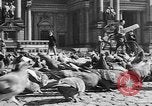
Scenic views in Berlin, Germany
Several pigeons gathered on a square. Building in the background. A man sits on steps of building, smoking a pipe. Old women sit and talk. Horse eats from feed bag while driver of the carriage (one in a line) dozes waiting for a passenger. A man riding in an open carriage lights his cigar in the wind. He wears a hat with decorative brush in hatband. Traffic passes by. A view of the Victory Column (Siegessäule) in Königsplatz A man talks on a telephone. Woman works at telephone switchboard. Mail sacks emptied and piled on tables, and then each mail piece is rapidly hand stamped. Policemen ride in open car through heavy traffic, while one of them blows on a trumpet or horn. Policeman arrests a man, holding him by the collar. Pigeons fly by the Berlin Cathedral. Newspapers and magazines on street corner (including The American "Saturday Evening Post" with cover partially visible from September 1932 edition).
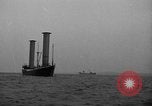
German rotor ship Buckau and German Navy warships in Kiel, Germany.
View towards starboard bow of the German Rotor Ship, "Buckau", at anchor, being photographed from a small boat that rocks with the waves. Another view towards her starboard stern. Brief closeup glimpse of one of her 50 ft tall rotor cylinders. View of the "Buckau" from starboard, abeam. Change of scene shows a German Braunschweig-class pre-dreadnought battleship of the Kaiserliche Marine at anchor, viewed from the "Buckau." Camera pans port-side of the battleship, from stern towards bow, and continues panning left showing the deck and some crew of the "Buckau," from which it is filming. Next, two German warships are seen anchored, directly astern of the rotor ship.
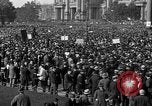
Paul von Hindenburg leads ceremonies in Deutsches Stadion, Berlin, Germany, in World War I
A crowd of German civilians is seen gathered in the Lustgarten. But the scene shifts suddenly to the Berlin Deutsches Stadion (Deutsches Stadion, Olympischer Platz 3, 14053 Berlin) in the Grunewald Racecourse. Men in old-fashioned traditional military uniforms march into the stadium, carrying flags of the various German States. They parade around the perimeter of the stadium. Flag of the German Weimar Republic flies over the principal building in the stands. The flag bearers on the field lower their flags, in salute. Next, Field Marshal Paul von Hindenburg and his deputy, General Erich Ludendorff, enter the field, leading several military officers, together with a civilian, carrying a sign reading: "I.G.I.D." They are followed by a long line of civilians. Spectators are on their feet in the stands where some men wave their hats and some women wave handkerchiefs. (World War I; World War 1; WWI; WW1)
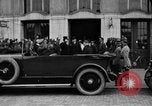
Paul von Hindenburg, President of German Reich, in a motorcade moves past the Brandenburg Gate in Berlin, Germany.
Paul von Hindenburg, second President of the German Reich,enters a car and rides in a motorcade, accompanied by Horse Guards and motorcycle escorts. Spectators line the streets to watch. Crowds fill a square. The procession passes through the Brandenburg Gate. Hindenburg leads group of politicians down the stairs of a building, where they stop and
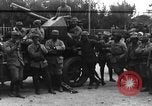
Scenes of Berlin Germany during the Kapp Putsch of 1920
The Kapp Putsch in Berlin during the Weimar Republic period. In opening scene about 20 Freikorps soldiers in uniform, are seen gathered around a motor vehicle on which an anti aircraft gun is mounted. One wears a fez. One soldier cranks a handle to raise the elevation of the gun to a high angle. Civilian spectators watch the demonstration. A warship can be seen in water behind the soldiers. Masts of docked sailing vessels are seen close behind them. Freikorps soldiers walk about. A military band plays as some of the soldiers stop and listen to them and pedestrians and motorists pass by. Flag of Prussia flies over top of a building. Helmeted German soldiers with rifles, stand about, casually, at the gates of a building. Soldiers, loaded onto a Benz truck, pass out newspaper flyers to passersby. People milling about in the street. Freikorps soldiers lined up as an officer inspects their rifles. Their insignia is visible on their left coat sleeves. Crowd of spectators stand behind barbed wire barrier surrounding a cleared square in the city secured by Army soldiers in steel helmets. One of them has Freikorps insignia on his left sleeve. Weimar Republic officials, including Philipp Scheidemann stroll across the square and proceed through the crowd outside the barbed wire barrier. Soldiers examine papers of civilian officials trying to enter the restricted area. One of them is allowed access. Army troops and Freikorps soldiers mingle together as civilians pass by them.
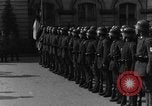
Soldiers march and distribute political papers during postwar unrest in Berlin, Germany.
German post-war revolution in Berlin. German soldiers lined up at attention with eyes right. One of them carries the German War Ensign. They are given the command to be at ease, and they all relax. Honor guard of German soldiers at attention with the German War Ensign. They execute eyes right and eyes left maneuvers and then march out, four abreast. Soldiers parade in a street, under the German War Ensign flag, accompanied by officers on horseback. Civilian spectators walk along beside them.The parading soldiers pass through a narrow street where spectators hem them in from the sides. High ranking officers are driven in a car. Soldiers loaded onto a truck hand out political papers to civilians.
CRITICALPAST.COM: About Us | Contact Us | FAQs - How to Order | License Agreement | My Account | My Lightboxes | Shopping Cart | Advanced Search | Featured Collections | Website Terms & Conditions | Privacy Policy ©2026 CriticalPast LLC.
License Agreement |
Terms & Conditions |
Privacy Policy
©2026 CriticalPast LLC.