


 Francais
 Deutsch
 Italiano
Refine Your Search
Worms Germany 1945 stock footage and images
- Showing 451 to 456 of 10469 results more
more Hide
Hide
The West Germans bid farewell to the Military Governor of the U.S. Zone of Germany General Clay on his retirement in Germany.
General Lucius D. Clay retires in Germany. General Clay shakes hands with people outside the West Berlin Schöneberg Town Hall (John-F.-Kennedy-Platz 1 10825 Berlin). West Berlin Mayor Willy Brandt accompanies General Clay. A torch light demonstration outside the General's house. General Clay waves to the crowd. People hold a banner that reads 'Thank You Lucius Clay'. General Clay shakes hands with the crowd.
Heinkel He 280 turbojet fighter aircraft, designed by Germany during World War II, is flown over grasslands in Germany.
In Germany, a demonstration of a Heinkel He 280 aircraft, the first turbojet-powered fighter aircraft in the world. Animated drawing of German Heinkel He 280 turbojet fighter aircraft. View of a He 280 fighter aircraft on an airfield, preparing for takeoff. It makes an extremely long flat takeoff. Trees in the background. Men on an airfield. Buildings in the background. Vehicles parked on the airfield. He 280 fighter aircraft in flight over grasslands. The He 280 aircraft lands. The aircraft parked on the airfield in the background. (This was one of only nine He 280 prototypes built by Heinkel, following on its experience with the He 178 prototype)
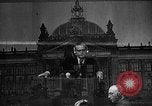
Footage after Reichstag fire, and of rearmament of Germany presented during the Nuremberg Trials in Nuremberg, Germany.
Nazi rise to power, rearmament and remilitarization of Germany leading up to World War 2, and actions related the Nuremberg Trials held at the Palace of Justice in Nuremberg, Germany, following World War II. Exterior view of the Reichstag in Berlin. Joseph Goebbels at desk during the Nuremberg Trials. Hans Bernd Gisevius, former official of the Berlin police administration, testifies concerning his investigation of the Reichstag fire. Hans Gisevius relates how Goebbels recruited reliable Nazis to intentionally burn down the Reichstag as a propaganda stunt to help the Nazi movement. Nuremberg War Trial defendants stand in their dock including Herman Goering, Rudolf Hess, Joachim von Ribbentrop, Wilhelm Keitel, Karl Donitz, Erich Raeder, Baldur von Schirach and Fritz Sauckel. Close up of Herman Goring. Footage showing firefighters spraying water on smoking ruins of Reichstag following Reichstag fire in 1933. A German police officer stands guard at the smoking ruins of the Reichstag. View from a high ridge of League of Nations Palace of Nations in Geneva, and then inside the League of Nations meeting chamber during the disarmament conference of 1933. View of a German Kriegsmarine submarine launching in 1934. Steel mill operations and Industrial war materiel operations in Germany in the early 1930's as Germany rearmed and restarted war production. A Nazi party meeting in Germany where General Werner von Blomberg announces compulsory military service. View of legal document describing new military service law. View of newly recruited (conscripted) civilian German men with suitcases marching forward report for mandatory military training. Nazi forces in training march goosestep at training camp; Junkers 52 aircraft in background. Soldiers goosestep while walking bicycles in a line. Nazi troops trained. Scenes of remilitarization of Rhineland, violating terms of the Treaty of Versailles, as Nazi troops in 1936 march over the Hohenzollern Bridge crossing the River Rhine, with Cologne Cathedral rising in the background.
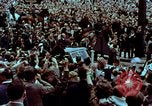
United States President John F. Kennedy visits Bonn, Germany
United States President John F Kennedy visits the Cologne Cathedral (Domkloster 4, 50667 Köln, Germany). Crowds cheering for President Kennedy. Some German civilian are seen waving United Sates flags. Banner and posters on President's way. Security personnel in motorcycles trail behind President Kennedy’s car. View of Bonn, the capital of West Germany. Ships on the Rhine River in Bonn. Signs read “Welcome President Kennedy” and “Deutschland grüsst Kennedy” (“Germany welcomes Kennedy” in German). Flags of West Germany and United States adorn Bonn Old Town. A portrait of Presidents Kennedy and Eisenhower hanging above German copies of President Kennedy’s books “A Nation of Immigrants” and “To Turn the Tide” (“Der Weg zum Frieden” and “Dämme gegen die Flut”) on display at a storefront in Bonn, Germany. Fruits and vegetable market in front of Bonn Rathaus or City Hall. A man selling Kennedy memorabilia in the market. A woman hangs a flag of the United States near the Bonn Rathaus. German civilians on windows waiting for Kennedy’s arrival. A band plays music in front of the Rathaus. Cameramen setting up equipment. German civilians cheer and crowd the streets as German children holding small American flags. Civilian crowds in Bonn Rathaus. He addresses Bonn citizens from the Rathaus City Hall steps. “I can assure you that as long as there are any who join with us, who wish this common effort to continue, the United States will help bear its fair share of the burden in a great half-circle, stretching from Berlin to Saigon. We will keep this free world free until the day comes, as Thomas Jefferson predicted it would, that the disease of liberty, which is catching, spreads throughout the world… Ladies and gentlemen, I am grateful for your welcome. This city of Bonn is the capital. of the free world. Because of the efforts of the Chancellor and all of the German people it will continue to be a center of the free world. I salute you.” President Kennedy said. Kennedy signs Golden Book of City of Bonn and receives a set of records containing music by Ludwig van Beethoven. A movie house with sign showing "PT 109". A German man waves the German flag on top of a rooftop. After having a busy schedule President Kennedy goes to relax at the United States Embassy in West Germany. Bonn Fire Department band plays music in front of the United States Embassy in honor of President Kennedy. A photographer uses flash camera. President Kennedy meets Ministers of States of Germany, Cabinet Ministers including Ludwig Erhard and Representatives of Churches during a dinner at Palais Schaumburg (Adenauerallee 139, 53113 Bonn, Germany). West Berlin Mayor Willy Brandt shake hands with President Kennedy. Various formal and informal conferences held that evening till late night. View of the Rhine River and skyline of Bonn at sunset. Next day President Kennedy and Chancellor Adenauer meeting held at the Palais Schaumburg.
Berliner Dom, Altes Museum, Imperial Palace, Reichstag Building, University Of Berlin and Unter Den Linden in Berlin, Germany
Scenes of famous tourist destinations and architecture in Berlin, Germany, before World War 2. Views of Berliner Dom also known as the Berlin Cathedral (Am Lustgarten, 10178 Berlin, Germany), and the Altes Museum (Bodestraße 1-3, 10178 Berlin, Germany), also known as the Old Museum in Museumsinsel (Museum Island) Berlin, Germany. The Löwenkämpfer (English: The Lion Fighter) bronze equestrian statue by Albert Wolff in front of the Altes Museum. Double decker buses move in front of the Former Imperial Castle, also known as the Berlin Imperial Palace or City Palace Berlin (Stadtschloss Berliner, Schloßpl., 10178 Berlin, Germany). View of the Reichstag (Platz der Republik 1, 11011 Berlin, Germany). Trams pass by in front of the Brandenburg Gate (Pariser Platz, 10117 Berlin, Germany). A crowd around the statue in front of the Humboldt University of Berlin (Unter den Linden 6, 10117 Berlin, Germany). Police officers stand near cars on Unter Den Linden boulevard. Trams, vehicles and people on the streets of Berlin.
Rise of Fascism in Italy and Germany after World War I
Animated map depicts the spread of Fascism in Japan, Germany and its neighboring countries, and Italy. Views of Italian Fascist "Black Shirts" marching bearing flags and rendering the fascist Roman Salute. Fascists participating in the famous "March on Rome" (“Marcia su Roma”) in October 27, 1922. Spectators line the sidewalks and side of the road. Brief (jerky) views of unrest and desperate crowds of citizens in post-war Italy circa 1919 and 1920 following World War I, due to unemployment and hard times. Italian people getting food at an outdoor soup kitchen. Fascists promising better times are seen parading and riding in jammed open cars. Benito Mussolini, who was elected to Parliament in 1921, is seen in a top hat, arms akimbo, standing with other officials. Glimpse of Black Shirts marching in front of the Palazzo Venezia (Via del Plebiscito, 118, 00186 Roma RM, Italy). Back to Mussolini, again, who now makes some remarks to those standing with him and expresses himself with exaggerated body language. Another glimpse of Black Shirts marching. Film transitions to Germany, where Adolf Hitler is seen walking through a dense crowd of supporters and some brownshirts or SA stormtroopers. Hitler's clothes resemble a military uniform. Next, scenes illustrating the terrible post-World War 1 hyperinflation suffered by Germany during the Weimar Republic. Various Deutschmark (Deutsche Mark) banknotes in ridiculous denominations are shown. Baker puts a 460 billion Deutschmark price on bread. People trying to buy groceries during this period. German militaristic marchers. Fascists giving arm salutes as they parade in a city street. General Field Marshal Paul von Hindenburg (President of Germany) is seen standing in front of Germany's top military leaders. Directly behind him is Marshal August von Mackensen, in a fur busby hat with Totenkopf (death head) insignia. Other Generals wear pickelhaube spiked helmets. Hindenburg's closest associate, General Erich Ludendorff stands just behind and to the left of Hindenburg. Glimpse of German soldiers in more modern uniforms. Next, Hindenburg is seen reviewing troops in the company of their commander. Next, Hitler is seen with a group of German civilian industrialists whose interests he promises to support. Alfred Krupp Jr. sits, with his legs crossed, next to Hitler. Glimpse of Hitler, in uniform, waving from a window. People running as a cadre of mounted police canter in formation down the street.
CRITICALPAST.COM: About Us | Contact Us | FAQs - How to Order | License Agreement | My Account | My Lightboxes | Shopping Cart | Advanced Search | Featured Collections | Website Terms & Conditions | Privacy Policy ©2026 CriticalPast LLC.
License Agreement |
Terms & Conditions |
Privacy Policy
©2026 CriticalPast LLC.