


 Francais
 Deutsch
 Italiano

Refine Your Search
Worms Germany 1945 stock footage and images
- Showing 4579 to 4584 of 10479 results more
 Hide
Color Sound

Events surrounding the 1938 German annexation of Austria
Goosestepping German troops parade. A group of German Panzer I Ausf. A tanks armed with twin 7.92 mm machine guns, are seen crossing a field. A squadron of German airplanes flies overhead in formation. Spectators watch as Austrian Army troops assemble and drill in Vienna, Austria Austrian Chancellor Kurt Schuschnigg speaking before the Austrian Federal Diet on 24 February , 1938. He rejects Hitler's plans for Austria, saying: "…Austria will go thus far and no further." Closeups of some Austrian citizens. German troops entering Austria, during the "Anschluss" on 12 March 1938. British Prime Minister Neville Chamberlain at Heston Aerodrome in London, England, departing on 29 September, 1938, to meet with Adolf Hitler in Munich, Germany. His aircraft taking off. View of anti-aircraft gun set up in London, with Big Ben and Parliament building in background. Workmen with shovels breaking ground for defenses in London. A woman wearing a gas mask, carries a baby in England. Prime Minister Chamberlain speaking at Heston airport upon his return from Munich, on 16 September. 1938. Views of broken shop windows in Berlin, Germany, following the "Kristallnacht" violent anti-Jewish actions by Nazi Brown shirts on November 9 and 10, 1938. Jewish refugee men, women, and children gather around a fire and outdoor kitchen in an encampment on a field. They warm themselves by the fire. Two women pump water from a well in the field. Closeups of some of the people, including a small child. U.S. President Franklin D. Roosevelt at a table with members of his cabinet,

Newspaper headlines about start of World War 1; later U.S. entry into World War 1, and building of U.S. Navy ships for war effort
A map of Europe with German cross superimposed on it. Shows various newspaper headlines about World War I. First one indicating the death of Archduke Franz Ferdinand in 1914; next "Germany Declares War - All Europe in Arms"; next "Germany Invades France"; then "French Resist at Marne"; then "Lusitania Sunk", followed by "U.S. Declares War." The latter is seen after an image of a newspaper printing press running at high speed. A worker at the printing plant stands beside the printing press and reads the newspaper. Various headlines about America entering into World War I, including "U.S. At War" and "U.S. Troops Land in France." Scene shows several posters to promote Liberty Bonds; one reads, "Beat Back the Hun with Liberty Bonds." U.S. Navy ships being constructed during World War 1 at a shipyard. Ships at piers as men work on them. A U.S. vessel underway at sea. A United States Navy destroyer ship underway at sea.
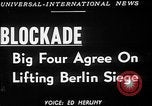
Russia agrees to lift blockade from Berlin during a conference in New York, United States.
Berlin blockade to be lifted. Public and press gathered outside United States Mission building to the United Nations in Lake Success New York, USA. Inside the building, Russian and American dignitaries and UN representatives negotiate an end to the blockade. Closeups of the negotiators, including American diplomat Philip Jessup, Soviet diplomat Yakov Malik, and Sir Alexander Cadogan and Jean Chauvel, the United Nations permanent representatives from England and France, respectively. During the talks, Russia agrees to lift blockade from Berlin, Germany, via the Jessup-Malik Agreement. Dignitaries leave after the conference concludes. A railroad yard in Germany with rail cars filled with coal and other supplies, but idle due to the blockade. View of a busy city street in Berlin and Kaiser Wilhelm Memorial Church in the distance. German pedestrian and vehicular traffic in Berlin.

Anti-Nazi protesters parade carrying picket signs, along a sidewalk in New York City, prior to World War II.
Protest against Nazi Germany held in New York City in the weeks after the Kristallnacht attacks on Jews in Germany. A sign reads "German Exposition Christmas Market Now Open." Anti-Nazi protesters march carrying picket signs along a sidewalk in front of the exposition of German goods. One of the signs reads "Boycott Nazi Goods." Another sign reads "German Exposition Christmas Market Dec 16-24". American and Nazi flags fly from the building.
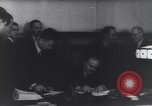
Signing of the German-Soviet Border and Commercial Agreement, by German Friedrich Werner von Schulenberg and Soviet Vyacheslav Molotov.
German diplomat Friedrich Werner von Schulenberg, of Nazi Germany, and Vyacheslav Molotov, of the Soviet Union meet together in Moscow, Russia, to sign the German-Soviet Border and Commercial Agreement. View of the two men and other representatives from each country at the signing ceremony. Narrator indicates that the agreement document covers expanded trade and commerce between the countries, establishes the northern border, and covers repatriation of Germans from republics including Lithuania and Estonia. View of the German and Soviet leaders each signing the document. Wax seals are added and a close-up of the signature page of the agreement is shown. (The Agreement also included the third set of secret protocols of the Hitler-Stalin Act or German-Soviet Treaty of Nonaggression. It followed the German-Soviet Frontier Treaty, which was the second secret protocol. Despite the pact, Germany attacked the Soviet Union 6 months later.) (World War II period).
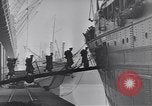
U.S. Army Service Forces transporting troops and supplies worldwide during World War II.
U.S. troops board a large troop transport ship via a gangplank. Troops on an intermediate deck of the ship. Some are sprawled out relaxing. View from above of more troops boarding a ship. Men and equipment on the pier below. American forces at various far flung places where the U.S. Army Services Forces facilitated their transport and logistic support. Fleeting glimpses of troops in: Ireland; Alaska; Trinidad; and South America. Troops jam the upper deck of a transport ship. Army Service Forces officers in a planning meeting. Naval officers on deck of a ship look through binoculars as U.S. Naval ships bombard the coast of Solomon Islands and landing craft carry marines in an amphibious assault. Next, a man is seen annotating a map of North Africa. Secret maps pertaining to Allied landings in Tunisia and Algeria. Animated map illustrates amphibious landings on North African coast, highlighting Casablanca, Oran, and Algeria. Landing craft carry troops and supplies that are piled up in the sand beach. Soldiers moving military supplies ashore, in fire brigade fashion. Soldiers working at desks in Offices of the Army Service Forces. Filing cabinet in background. Trucks on the move in remote locations. Supply ship being loaded at a terminal. Fuel drums and army vehicles a being loaded aboard ships. Officers seated at a conference table. Ordinary American enlisted soldiers in a griping session at an Army post in the United States. Camera pans over large formation of soldiers. Animated chart shows more than half of servicemen who are part of Army Service Forces (ASF), are unaware of that. Troops marching in review at a tropical location, where reviewing officers wear pith helmets. Chart illustrates lack of unit pride in ASF. Images of various ASF logos. Chart shows results of polling data from soldiers and service members. Signal Corps and Engineers elements of ASF have the greatest unit pride. But most think better of other branches of the Army. More troops marching, in steel helmets and carrying rifles with bayonets affixed. Troops marching overlaid by "50%" indicating that half don't believe their contributions to the war effort are significant. Troops lined up (for pay?). More charts expressing concern about low morale. A heavy gun firing. German paratroopers jumping from a formation of Junkers Ju 52 aircraft. Charts expressing prevailing U.S. troops view that Germany wouldn't be too hard to defeat. Chart showing lack of understanding about why the U.S. is fighting Germany. Image of President Franklin D. Roosevelt and Prime Minister Churchill seated in front of their key military officers at Casablanca Conference in World War 2. Chart shows U.S. soldiers believe that the greatest war effort is expended by the U.S. followed by Russia, with China and Britain providing little. Chart illustrates that only half U.S. troops want to get overseas and fight. Chart shows U.S. War Department films can correct this problem.
CRITICALPAST.COM: About Us | Contact Us | FAQs - How to Order | License Agreement | My Account | My Lightboxes | Shopping Cart | Advanced Search | Featured Collections | Website Terms & Conditions | Privacy Policy ©2026 CriticalPast LLC.
License Agreement |
Terms & Conditions |
Privacy Policy
©2026 CriticalPast LLC.