


 Francais
 Deutsch
 Italiano
Refine Your Search
Worms Germany 1945 stock footage and images
- Showing 4681 to 4686 of 10470 results more
more Hide
Hide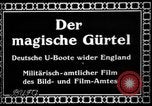
German submarine UB-35 leaves port on mission during World War I
Early slates allude to failed attempts at peaceful resolution of issues between Germany and England, in World War 1, and the Kaiser's consequent decision on February 1, 1917, to intensify German submarine warfare against Britain. Slate refers to Churchill's admitted concerns expressed in the "Sunday Pictorial," about the resulting constraint on England's control of the seas around the British Isles, referring to the U-boats creating a magic girdle (Magischen Gurtel) around England, which becomes the title for the film. In the first part, Captain, Lothar von Arnauld de la Periere of the German U-boat UB-35, stands in a skiff as he is rowed out to his submarine. He exchanges salutes with his officers, as he boards the U-35, nestled against a German ship. He gives the order to cast off the lines and proceed half power in reverse. The crew scrambles to get underway. German sailors on the nearby ship watch from her railings. Sailors use a long pole to help move the submarine away from the ship. Officers and men on the ship wave as the U-boat pulls away. Views from the submarine deck as it moves on the surface of the water heading toward the Mediterranean Sea. (World War i; World War 1; WWI; WW1)

Day and night bombing on German targets by Allied bombers from England during World War II
A line of B-25 Mitchell bombers on an airfield in Britain. They display the British roundel on their fuselages. A line of British de havilland Mosquito bombers on a British airfield. One has its engines running and ground crew are removing ground power unit. A line of Martin B-26 Marauder bombers taxiing on an airfield. Several persons on the ground wave as a pair of B-26s take off in formation. The B-26s display French roundels on their fuselages. View of a B-26 heading toward the camera on takeoff. British Avro Lancaster bombers taxiing out for takeoff. Closeup of one pilot in cockpit of a Lancaster with engines running. The bomber displays numerous mission symbols below the cockpit as well as some nose art. A Lancaster taking off. An animated map showing England, France, Belgium, Holland, and Germany. Enemy gun and rocket sites are depicted as important targets. A formation of B-26 bombers in flight. Closeup of one from above. Formation of Mosquito bombers in flight at low altitude over water.Two British B-25 bombers in close formation above clouds. Next, the animated map shows lines of communication that are important targets. .B-25s seen dropping bombs. Views from aircraft of bombs exploding on the ground. A B-26 bomber surrounded by black Flak clouds. More bombs exploding. More B-25s dropping bombs. Animated map highlights transportation centers such as railroad lines and junctions as the next targets. B-26 bombers dropping bombs in flak clouds and views of exploding bombs below. Finally, the animated map shows enemy war factories throughout Europe that are to be targeted. Huge fires and explosions at night from bombed war factories.
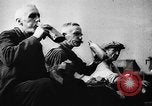
Germans laborers rest beside dragon's teeth at the Siegfried Line and Adolf Hitler with other officials tour Westwall bunkers
Germans at the Siegfried Line World War 2 defenses in Germany. German laborers take rest next to dragon's teeth (tank traps). Adolf Hitler in his car gives a Nazi salute. He rides on a road arriving at a Westwall standardized bunker. He speaks with other officials including Commander in Chief of Army Group 2, General Erwin von Witzleben, and enters a bunker. Views of German soldiers at Westwall bunker -- appears to be Regelbau 35 -- loading large artillery gun. Hitler and officials look at a map. Newspaper headlines announcing von Witzleben's declaration to Hitler about readiness of the Westwall fortifications.
German boys work in a railroad machine shop during World War II
German boys or possibly Hitler Youth work at a railroad machine workshop in Germany during World War 2. A factory foreman or supervisor checks the work done by a teenage child labor group in the production plant. Boys close a locomotive door and examine their work. A train engine starts and the locomotive is ready to move from the station. An engineer and a teenage youth inside the train. A signal tower gives departure signal. Teenage girl assists with train dispatching, signaling, and switching. German civilians get aboard the train. A woman dispatcher with a baby in her arms. She hands over the baby to the mother through a train window. She waves her hand on departure.
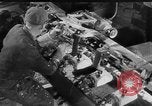
German workers make hand and leg prosthetic devices for soldier amputees during World War II.
A German man works on a wood lathe to make wooden hands and legs for amputees in Germany during World War 2. The man makes wooden hand prosthetics for amputees. He cuts hole in wooden blocks. A piece of wood is shaped like a bone. Group of disabled young German men, presumably all veteran German soldiers wounded in combat, is seen outside a hospital, playing ball and exercising with use of prosthetics. A man rides a bicycle wearing his prosthesis. A soldier walks up a hill with a gun on his shoulder. Shows soldiers using prosthesis.
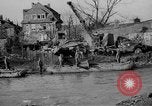
3rd Division fires rocket barrages and First United States Army Infantry advances through German towns east of Inde River
Activities of First United States Army pressing eastward in Germany during World War 2. U.S. engineers and soldiers build a bridge over the Inde River since all nearby crossings had been destroyed by retreating German forces. Army vehicles cross the completed bridge. Soldiers bring heavy artillery and adjust it. View changes to Mausbach area to the South, where rockets are launched by 3rd Armored Division toward the river. Line of 75 U.S. Army rockets seen being loaded by U.S. soldiers and then fired together. Bright flashes and smoke as rockets are fired. Tanks of the 3rd Division moving out from the town. A U.S. vehicle in the advancing column toward Gressenich is hit by German guns. U.S. Army tanks, lined up like artillery, fire on German forces at Gressenich. Continuous line of 3rd Armored Division tanks, armored vehicles, and 6x6 vehicles come to the front and advance on roads of cities and villages moving eastward, and supporting the U.S. First Army Infantry. 1st Army infantry move through Hurtgen forest near Aachen. Ruined German factory is used as an observtion base by U.S. forces to coordinate attack on Gressenich, which was captured on November 19, 1944. 3rd Armored Division tanks move into open fields to continue offensive toward Werth, with U.S. infantry soldiers staying close to tanks for cover. Soldiers carry the wounded U.S. tank commander after German counter fire hits lead U.S. tank in the column. The wounded soldier is dragged to safety. Men of U.S. Army 1st Division Infantry enter town of Werth under German mortar fire and move from house to house clearing enemy snipers and mopping up in the ruins. U.S. Army soldiers guard a column of German prisoners (POW) who surrendered in Werth. View of ruined and destroyed buildings in German towns like Hamich after defeat. U.S. Army soldiers move through the town on foot with a small church in the background. U.S. Army trucks arrive in a rubbled village with food and ammunition for the offensive drive toward the Ruhr.
CRITICALPAST.COM: About Us | Contact Us | FAQs - How to Order | License Agreement | My Account | My Lightboxes | Shopping Cart | Advanced Search | Featured Collections | Website Terms & Conditions | Privacy Policy ©2026 CriticalPast LLC.
License Agreement |
Terms & Conditions |
Privacy Policy
©2026 CriticalPast LLC.