


 Francais
 Deutsch
 Italiano
Refine Your Search
Worms Germany 1945 stock footage and images
- Showing 4759 to 4764 of 10470 results more
more Hide
Hide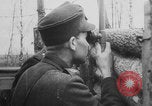
German Artillerymen train at established facility in German forest during World War II
Film begins showing two German soldiers in an established log lined firing position at an artillery training facility in Germany during World War 2. One is using a periscopic telescope. Closeup of a soldier hurrying along a log-lined trench toward a communication center. He picks up a field telephone that is next seen ringing and picked up at another communication center manned by several German officers. One takes the phone call. Scene shifts to an artillery crew at a log-lined gun emplacement where they attend to a 10.5cm artillery piece. Closeup of soldier signalling for guns to fire. Shells exploding in the distance. Crew at another gun emplacement hold their ears as their gun fires. Many more views of guns firing and smoke filling the air.
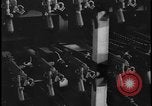
German weapons and munitions inside bunker storage; German soldiers aim artillery through pillbox and march at Siegfried Line fortification.
Various weapons and ammunition found inside a bunker in the Siegfried Line in Nazi Germany. Camera shows neatly-arranged rifles, artillery, artillery shells, and cannons inside a bunker. Long lines of light infantry artillery in storage including Pak 36 (Panzerabwehrkanone 36) is a 3.7 cm caliber German anti-tank guns and German le IG G18 75mm infantry support guns. Rows of cannons in storage and many shells. Sign says “Sechsscharten Turm” (German: “Six-slot tower”). German solders pull chains to lift armament up from storage. Soldier push a rail cart full of artillery shells into an elevator after track signal changes to indicate entrance clear. German soldiers aim artillery with cannon in foreground inside bunker. POV aiming cannon from inside German bunker through pillbox embrasure to outside. Various German artillery pieces moving into aiming position through embrasure as seen from outside bunker pillboxes. German soldiers marching into a bunker. View of Dragon's teeth tank barriers arranged on the Siegfried Line.
Activities of Nazi soldiers inside bunker railroad cars, elevators, underground tunnels, dormitory rooms before the start of WW2
German Nazi soldiers ride underground railroad small gauge train cars inside bunker tunnel in the Siegfried Line in western Germany before World War II. Other German soldiers march alongside soldiers in rail cars. Soldiers enter an elevator while others take stairs alongside. Elevator door closes and soldiers seen rising to upper bunker areas. POV inside bunker elevator as it passes German troops on stairs. Bunker door sign reads “Unterk. Räume," which is German for "sub spaces," German soldiers smoke cigarettes and socialize together inside a dormitory room in the bunker.
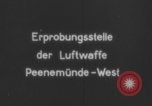
German V-1 rocket fails to launch during WW2
Title card says “Erprobungsstelle der Luftwaffe Peenemünde- West” (“Test site of the Peenemünde-West air force” in English). “Flakzielgerät 76 V99 Schnittaufnahmen 4.8. 1943 HK” (“Anti-aircraft target device 76 V99 cut recordings 4.8. 1943 HK” in English). A V-1 rocket, also known as a buzz bomb or doodlebug, on a launch ramp in Germany during World War 2. The Argus engine on the V-1 fires up, but the rocket fails to launch from the ramp.
Animation depicting parts of a WW2 V-1 rocket missile in German
Title card saying “Erprobungsstelle der Luftwaffe Karlshagen” (“Test site of the Air Force Karlshagen” in English). “Flakzielgerät 76 Trick 3.1. 1944” (“Anti-aircraft target device 76 trick 3.1.1944” in English). Animation demonstrating the parts- such as the engine (Triebwerk), tail unit (Leitwerk), wings (Tragflächen) and odometer (Wegmesser)- of a V-1 rocket, an early cruise missile developed in Germany during World War 2. Animation demonstrating cut away parts and the inside parts of a V-1 rocket in German.
German animation shows V-1 Argus motor function during WWII.
Title card saying “Flakzielgerät 76 Trickaufnahmen Argus 11. 12. 1943 HK” (“Flak target device 76 trick shots Argus 11.12.1943 HK” in English). An Illustration showing the parts of the Argus engine of the V-1 rocket, an early cruise missile developed in Germany during World War 2, with the parts named in German. Animation demonstrates how the pulse-jet action works on the Argus jet engine.
CRITICALPAST.COM: About Us | Contact Us | FAQs - How to Order | License Agreement | My Account | My Lightboxes | Shopping Cart | Advanced Search | Featured Collections | Website Terms & Conditions | Privacy Policy ©2026 CriticalPast LLC.
License Agreement |
Terms & Conditions |
Privacy Policy
©2026 CriticalPast LLC.