


 Francais
 Deutsch
 Italiano
Refine Your Search
Worms Germany 1945 stock footage and images
- Showing 5815 to 5820 of 10470 results more
more Hide
Hide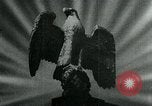
German Leader Hermann Goering officiates at a military funeral for World War II German pilot ace, Helmut Lent
Film begins showing German ace pilot Oberleutnant (Major) Helmut Lent, of a night fighter wing, with other pilots on the occasion of his 100th aerial victory, on July 31, 1944, when he was awarded the Knight's Cross of the Iron Cross with Oak Leaves, Swords and Diamonds. Next, a night fighter Messerschmitt Bf 110 twin-engine heavy fighter is seen taxiing out for takeoff at night in heavy rain. Scene shifts to a Nazi memorial service for Major Lent, who was killed in a crash on October 5, 1944. His flag-covered coffin is seen flanked by an honor guard. A display of his military awards is seen, also. View from beside the honor guard shows Field Marshal Hermann Goering raising his baton in salute as other attending the ceremony render the Nazi salute. Goering offers his condolences to parents of Major Lent. He then ascends steps toward the coffin and salutes. View from behind the honor guard as Goering delivers a eulogy. View Luftwaffe (Air Force) officers filling the seats of the hall, including famous ace, Adolf Galland. Goering steps from the podium and stands in front of the coffin, saluting with his baton, as the audience rises and all render the Nazi hand salute. With help of two soldiers, Goering places a large wreath of flowers before the coffin. Closeup of the wreath and Goering saluting with his baton. A large wreath with ribbons showing it is from the Furhrer (Hitler).
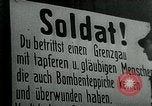
German troops preparing to head toward the war front in World War II
As film opens, a sign in German is displayed reading "Soldier You enter an area with brave and believing people who also know and have overcome carpet bombing." Camera focuses on a large seemingly undamaged cathedral. German troops are seen gathering up their gear and preparing to move during World War 2. Glimpse of a German sailor standing nearby. People boarding a tram with the cathedral in the background. A truck driver stopped and presenting identification to a German soldier on the sidewalk. German troops with their gear, including bedrolls, walking en masse toward and past the camera. Several older civilian men in the background. Signs on building walls (in German) reading "With the Leader to Victory" and "Now fight even more to Victory."
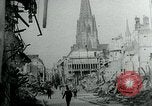
German people evacuate a city subject to Allied bombing during World War II
A large cathedral dominates the opening scene. It seems relatively undamaged although their are destroyed buildings all around it from bombing during World War 2. People are seen carrying their belongings as they flee the area. They pass through narrow corridors between destroyed buildings. View of an orphanage named St. Catharina. View of infants in cribs inside the orphanage. Staff and nurses leading the children out of the building and then loading them aboard a bus. One attendant giving treats to very small infants. Staff waving goodbye to the children and caregivers on the bus, as it departs. Refugees using wagons pulled by cattle to transport them and their belongings. Livestock on the hoof being herded along a road.

Adolf Hitler and Nazi officials meet in Munich, early in World War II, on the anniversary of the Beer Hall Putsch of November 9, 1923.
Narrator announces the "9th of November in Munich." (It is 1941, early in World War 2.) A gathering of Nazi officials in a church. They are celebrating the anniversary of the Nazi Beer Hall Putsch of November 9, 1923. Next, a large group of Nazi officials are seen conversing in a large hall. Adolf Hitler arrives to the cheers and Nazi salutes of the attendees, as he walks through their midst and spends time greeting and shaking hands with his old comrades from the 1920s. He steps to a podium. Closeup of him at the podium responding to the adulation of the assembly by rendering a bent elbow Nazi salute. The audience is applauding. According to the narrator, Hitler speaks disparagingly about U.S. President Roosevelt and Soviet leader Stalin.
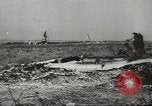
German citizens evacuate from cities and towns being bombed by Allied forces during World War II
Film begins, showing remains of a Boeing B-17F from the U.S. 100th Bombardment Group (BG) with home base at RAF Station Thorpe Abbotts, England, during World War 2. Camera pans over a field of debris containing two of the aircraft's engines and the wreckage of the fuselage and tail. The tail displays the Square D symbol of the 100th BG, plus the letter "T" and some of its tail number: "2303." Camera pans interior wreckage including crew seats and oxygen tanks. It then shows broken wings along with bodies of several crew members wearing parachute harnesses. A different side of the fuselage and tail shows the tail number "230311." This fully identifies it as B-17, number 42-23011. A field grade German officer and another officer examine the wreckage. Views of aircraft wreckage, in a forest, including a Browning M2 .50 caliber machine gun and another aircraft engine. Scene shifts to nearby town, where German women in white are serving meals at an outdoor food kitchen, for local people who are preparing to evacuate. A camper van loaded with family belongings is seen moving in the background. Several women, carrying plates of their food, walk toward tables. Some sit and eat at a table with a German soldier. Women make themselves sandwiches with foods laid out on a butcher block table. Closeup of a large drum of drinking water. local people fill containers from it. German children are seen aboard a bus waving goodbye to their mothers during evacuation for their safety. German children are placed aboard open boats at a port, for transport to safety out of war zone. German women and children board a train during evacuation to safety. Huge piles of their luggage is stacked on the train platform. View of a substantial private home in a residential area. Inside view shows it has been converted into nursery for infants, who are seen in many small cribs. Women sit on the lawn behind a substantial country home, as some small children run toward them from the house.
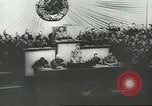
German invasion of Poland and Denmark at start of World War II
Adolf Hitler addressing the Reichstag, meeting in the Kroll Opera House makes fun of an April 1939, letter from President Franklin D. Roosevelt. Hitler reads a list of countries that FDR asked him not to invade. As he drones on through the extensive list, it becomes comical and the Reichstag member burst out in laughter. Next heavy guns are seen firing and formations of German Junkers JU-52 airplanes flying overhead as narrator cites September 1st 1939 and the German invasion of Poland as start of World War 2. Motorized German forces, and infantry are seen rushing across the landscape. German 17 cm Kanone 18 guns are seen firing. Formations of German JU 87 Stuka dive bombers in flight and Heinkel He 111 bombers dropping bombs on Poland. Bombs exploding and devastation on the ground with buildings burning and collapsing. Aerial view of Polish city being bombed. Huge number of disarmed Polish Army prisoners of war walking along roads. German troops marching into Copenhagen, Denmark in 1940
CRITICALPAST.COM: About Us | Contact Us | FAQs - How to Order | License Agreement | My Account | My Lightboxes | Shopping Cart | Advanced Search | Featured Collections | Website Terms & Conditions | Privacy Policy ©2026 CriticalPast LLC.
License Agreement |
Terms & Conditions |
Privacy Policy
©2026 CriticalPast LLC.