


 Francais
 Deutsch
 Italiano

Refine Your Search
Xuan Loc Vietnam 1969 stock footage and images
- Showing 25 to 30 of 4375 results more
 Hide
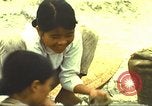
Vietnamese men, women, and children work filling sand bags for U.S. 82nd Airborne Division in Phu Bai, Hue, Vietnam.
Vietnamese young boys and girls fill sandbags. Young girl prepares a bag. They are part of a larger group of mostly women and children working to fill sand bags that will be used to fortify camp facilities of the 82nd Airborne Division Headquarters Company (this camp was later named Camp Eagle in March 1969). Soldiers of U.S. 3rd Brigade oversee the workers. U.S. Army trucks are seen in the background. (Vietnam War period).
Vietnamese young boys and girls fill sandbags during 3rd Brigade, 82nd Airborne Division base operations in Phu Bai.
U.S. 3rd Brigade, 82nd Airborne Division base camp operations in Phu Bai near Hue, Vietnam. Truck convoy enters gate of the camp. Soldiers wave from truck. Vietnamese young boys and girls fill sandbags. Soldiers look on. Soldier load sandbags onto a truck. (Vietnam War period. This camp was later named Camp Eagle in March 1969).
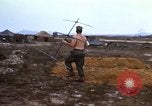
U.S. 3rd Brigade, 82nd Airborne Division soldiers set up antennas at the command post during base operations in Phu Bai.
U.S. 3rd Brigade, 82nd Airborne Division base camp operations in Phu Bai near Hue, Vietnam. Soldiers set up an antenna at a command post. Sandbags and tents in the background. Soldiers set up poles. Soldiers connect poles. Soldier attacks at a cable with an instrument. (Vietnam War period. This camp was later named Camp Eagle in March 1969).
College students at University of California., Berkeley, during 1980 U.S. Presidential elections.
Film showing students at the University of California, Berkeley, principally in 1980. It also shows glimpses of Vietnam war era background events. Opening shows students on a college campus. Two of them sit and converse. Scene shifts to National Guard troops and police near the University of California campus, in May, 1969, when Governor Ronald Reagan declared a state of emergency and sent 2,200 National Guard troops into Berkeley, California. Next, students are seen handing out voting information from booths on the Berkeley campus during the 1980 U.S. Presidential elections. Students massed on campus and some having lively conversations with others. The entrance gates to the campus are seen in the background. Students moving about on the campus and some seated at outdoor tables having snacks and conversing. A student being interviewed who speaks about employment. Complete shift of scene to American soldiers jumping from a UH-1 Huey helicopter in Vietnam. President Richard Nixon waving enthusiastically in front of the Presidential helicopter. President Lyndon Johnson glad-handing spectators as he walks along the streets of a city. Glimpse of American hostages being taken from the embassy in Tehran, Iran, November 4, 1979 during Iran hostage crisis. U.S soldiers firing a howitzer field piece in Vietnam. Returning American hostages leaving an U.S.Air Force transport plane. A woman student being interviewed at Berkeley campus about the 1980 Presidential race between Jimmy Carter and Ronald Reagan. Students seated on a long bench in a room where a picture of motion picture star, John Wayne, is displayed on a wall. A male student says Ronald Reagan has brought a new spirit into everybody in America. A Berkeley political science professor comments on the new voters. Students speaking positively about President Reagan. More views of students and voting information on campus. (Note: film is silent except for occasional interviews.)
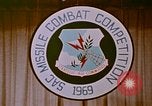
SAC personnel participate in the '1969 SAC Missile Combat Competition' and the winner receives award in the U.S.
'1969 SAC Missile Combat Competition' of USAF Strategic Air Command units in the United States. Seal of '1969 SAC Missile Combat Competition'. An SAC officer speaks on the dais. SAC units disembark an aircraft. A sign reads : 'Welcome, 1969 SAC Missile Combat Competition'. The SAC units enters a building. The personnel receive well wishes. The SAC personnel work on various equipment during the competition. An announcer makes an announcement during the award ceremony. General Bruce K. Holloway, Commander-in-Chief of the SAC speaks. General Holloway congratulates each SAC personnel. The SAC personnel applaud. The award is given for the best maintenance wing and the best minute man wing
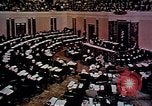
John C Stennis talks on the Role of Congress in Foreign Policies during a debate in United States.
Debate on the 'Role of Congress in Foreign Policies' between John C Stennis and William J Fulbright in United States organized by American Enterprise Institute. Moderator Peter Lasigor says that Congress is reasserting its role after Korean and Vietnam War. Distinguished citizens sit to participate and ask questions. The debaters: Senator John C Stennis, Chairman, Armed Service Committee and William J Fulbright Chairman Foreign Relations Committee. John Stennis starts the debate. Stennis talks about the role and responsibilities of Congress in domestic and foreign affairs. He speaks about his experiences in legislation as Senator. Stennis gives examples of Theodore Roosevelt, the Congo Rebellion in 1963 and National Commitment Resolution of 1969. He then talks about world affairs and foreign policies regarding World War II. Stennis mentions various treaties and resolutions related to post world war.