


 Francais
 Deutsch
 Italiano
Refine Your Search
Xuan Loc Vietnam 1969 stock footage and images
- Showing 343 to 348 of 4375 results more
more Hide
Hide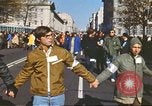
Demonstrators approach the Washington Monument marching during a moratorium to end the Vietnam War.
Peace activists and pacifist demonstrators amassed in Washington DC during a moratorium to end the Vietnam War. Anti-war demonstrators move down a street. Peace seeking people hold hands as they walk down a street in protest of the war. A man on a motorcycle ride down the street. The Washington Monument (2 15th St NW, Washington, DC 20024, United States). People march during the rally. A man carries a large wooden cross down the middle of Constitution Avenue. People form a human chain and march in a line down the street at the rally. A banner reads "Clergy Layman concerned about Vietnam." Another banner reads ' No deals in Vietnam U.S. get out now'. People milling about at the Washington Monument. A man carrying a megaphone walk among a large crowd.
U.S. Air Force B-52D aircraft, engaged in Operation Arc Light, at U-Tapao Royal Thai Air Force Base, Thailand, during the Vietnam War.
B-52D strategic bombers, converted to carry conventional munitions, in Operation Arc Light, at U-Tapao during Vietnam War. Numerous U.S. Air Force B-52D bombers of the Strategic Air Command (SAC) are parked in concrete revetments at U-Tapao Royal Thai Air Force Base, Thailand. A single B-52 begins to taxi out of its parking place. As it turns toward the camera, sunlight glints off its windshield. It taxis slowly between the other parked aircraft. Scene shifts to a B-52 moving slowly along a taxiway towards the active runway, where two other B-52s are holding short. Low mountains dominate the background. Next, the taxiing B-52 continues along, behind only one other holding short of the active runway. (These three B-52s are likely leaving on a 3-aircraft Arc Light mission over Vietnam.) View of another B-52 taxiing past one parked in a revetment, while another B-52 departs on a long takeoff role along the active runway, in the background. Camera focuses on a B-52 taking off and becoming airborne.
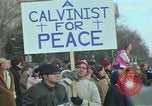
A moratorium march in Washington D.C. to protest against American involvement in the Vietnam War.
A moratorium march in Washington D.C., United States by pacifists and peace demonstrators against the Vietnam War. A banner reads 'A Calvinist for peace'. People march in Washington D.C. as they protest against American involvement in the Vietnam War and demand the end of the war. People outside the White House. People on the top of an ambulance. The Washington Memorial in the background. People in lawns with the Lincoln Memorial in the background. Anti war demonstrators gather to protest against the war. Among famous performers seen are: folk singers Pete Seeger, and Peter, Paul and Mary. Coretta Scott King (widow of Dr. Martin Luther King, Jr.) addresses the gathering. An artist being presented a memento. Activists address the gathering.
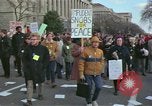
Scenes from moratorium march in Washington D.C., protesting U.S. involvement in the Vietnam War.
A moratorium march in Washington D.C by pacifists and anti-war demonstrators against the Vietnam War. A banner reads 'Impudent snobs for peace'. Demonstrators carrying American flags and wearing badges march at the rally to protest against United States involvement in the Vietnam War. One protestor carries North Vietnamese flag of National Front for the Liberation of the South. One person carries a flag with a dove on it. A banner reads 'Stop the trials'. Some protestors have hippie hair styles and clothing. A banner reads: "Bring all the troops home Now!" Many views of people on Constitution Avenue, between the Washington Monument and the Ellipse.
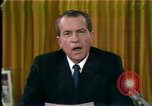
U.S. President Richard Nixon addresses nation about steps to end the war in Vietnam. He asks support of the "silent majority"
Stand of U.S. President Richard Nixon on Vietnam War. President Nixon addresses the nation about the Vietnam War from White House. He details how United States got involved in the war. He talks of protests and demonstrations of anti war activists and wants an everlasting solution to the problem. He reminds of Woodrow Wilson's efforts to end wars and peace. Nixon tells the youth of America about their demonstrations: "I respect your idealism. I share your concern for peace. I want peace as much as you do." He speaks to the "great silent majority" of Americans (contrasted with the youth demonstrators) and asks for their support in fighting "the forces of totalitarianism" and in supporting his plans for fighting and ending the war. He asks that Americans be united for peace and united against defeat. In the final part of this speech segment, President Nixon invokes the term "silent majority."
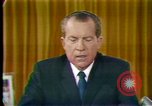
U.S. President Nixon speaks about programs of U.S. withdrawal from Vietnam, during his silent majority speech from the White House.
News special report about U.S. President Richard Nixon's 'Silent Majority' speech from the White House about Vietnam War. President Nixon addresses the nation from an office in the White House. He speaks of U.S. programs in future and replacement of all U.S. ground forces by South Vietnamese forces. He denies a fixed timetable of U.S. withdrawal and about Paris Peace Talks. He says that if violence from North Vietnam continues, the U.S. can take strong steps. He appreciates the concern of young Americans to restore peace. He calls to get united for the existence of peace. He recalls the efforts of former President Woodrow Wilson to reassure world peace during World War I