


 Francais
 Deutsch
 Italiano
Refine Your Search
Xuan Loc Vietnam 1969 stock footage and images
- Showing 3943 to 3948 of 4374 results more
more Hide
Hide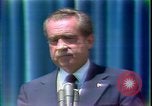
In San Clemente, California U.S. President Richard Nixon talks about the Watergate scandal and the Cambodian bombings.
U.S. President Richard Nixon talks about his officials' role in informing the prosecutors during the Watergate Scandal in San Clemente, California. A journalist seeks an explanation from the President as to why, after being informed by his officials about the White House staff's involvement in criminal activities, had he not given this information directly to the prosecutor rather than allowing his staff to conduct their own investigations. The President explains that he was under the impression that both the people responsible for communication with the prosecutor, White House Counsel John Wesley Dean and the President's Assistant for Domestic Affairs John Ehrlichman, were keeping the prosecutor informed. Another journalist asks the President whether he felt he owned an apology to American citizens with regard to the Cambodian bombing. The President states that he does not feel that way since the bombed area in Cambodia was occupied by North Vietnam Communists and was being used for attacking and killing American soldiers. The President felt that his countrymen would be thankful to him for taking the necessary action in order to save the lives of American soldiers. (Vietnam War period).
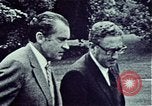
U S President Richard Nixon with Secretary Dr Henry Kissinger and Patrick Buchanan speak about measures to bring World peace.
Special Consultants, Counselors and assistants of U.S. President Richard Nixon speak about him as President of United States. Richard Nixon with U.S. Secretary of States, Dr Henry Kissinger discuss while walking in the White House. Dr Kissinger talks about his role assigned by Nixon, in the U.S. Air Force One plane. Assistant Patrick J. Buchanan talks about Nixon's efforts to bring peace in Vietnam, Middle-East and People's Republic of China. The secretary during an official government ceremony in China with U.S. and Chinese flags hanging together on a wall. (Vietnam War period).
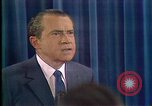
U.S. President Richard Nixon speaks about the Paris Peace Conference during a press conference at White House in Washington DC.
President Nixon speaks to press reporters about increasing numbers of demonstrations and public unrest in the United States, in response to a reporter's question. Another reporter asks about the boycott of North Vietnam in the Paris Peace Talks. Nixon answers that the U.S. would enter into the next stage of the Vietnam War peace talks.
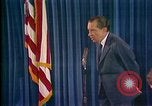
A reporter questions President Nixon about North Vietnamese military movement, during a press conference, Washington DC.
President Richard Nixon answers a press reporter's questions about actions of the North Vietnamese and their plans to raid the U.S. Marine bases in South Vietnam. President Nixon reminds them about the talks he had with the North Vietnamese leadership and hopes that they will not raid the U.S. Marines. (Vietnam War period).
U.S. 34th Division Artillery troops arrive and eat breakfast at McChord Air Force Base in Washington, United States.
U.S. 34th Division Artillery at McChord Air Force Base in Washington, United States prior to their deployment to Vietnam during the Vietnam War. Soldiers disembark from a bus. They line up in front of a mess tent. A band plays as the soldiers eat breakfast. Two officers drink coffee and talk in front of an urn.
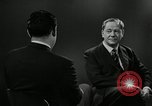
Robert Grainger Ker Thompson interviewed by a reporter, people celebrate independence in Malaysia
Film about guerrilla war for independence fought between Commonwealth armed forces and Malayan Communist Party in Malaysia. Reporter interviews former Secretary of Defense for Malaya, Sir Robert Grainger Ker Thompson. He compares the Guerrilla war condition in Malaysia and Vietnam. He insists that the strategies take time to be executed as it takes time to take people into confidence. They discuss on role of Vietcong. A board reads 'Merdeka'. People cheer at independence in 1957. Tribes play on drums. People carry burning torches. Prime Minister of Malaysia Tunku Abdul Rahman meets people. A fireworks show during the independence celebrations. (Vietnam War period).