


 Francais
 Deutsch
 Italiano
Refine Your Search
Yokohama Japan 1945 stock footage and images
- Showing 781 to 786 of 7988 results more
more Hide
Hide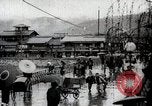
Japanese on a bridge, in the rain, near town in Japan.
Scenes from Japan during the 19th century. Japanese pedestrians walking, in a light rain, on a town bridge in Japan. Pedestrians in kimonos hold wagasa umbrellas. Rickshaws cross the bridge. Japanese women play shamisen, and two girls use a hand fan and an uchiwa fan.

Japanese rural scenes and images of modern Western-influenced buildings and fashions in Tokyo, Japan
Film begins with scenic views of mountainous Japan. A water wheel turns at river's edge. A mountain stream flowing. Views of rugged terrain, with ridges and valleys. White clouds above a valley in which a stream run. The waters gradually increase as the stream joins with others to create rivers. View of high-tension electric wires and an electric generating station at the side of a large dam. Electric trains seen in silhouette. View from a train passing large buildings and then view from the front as it traverses track along a wide rail complex, passing train stations and large buildings. A view of University of Tokyo and its distinctive clock tower (7 Chome-3-1 Hongo, Bunkyo City, Tokyo 113-8654, Japan). Street cars, bicyclists, pedestrians at Ginza shopping district. Some women in latest Western fashions on sidewalks with other women in traditional kimonos. Western imaged dolls in a shop and Japanese women in Western fashions window shopping in shops carrying such fashions. Similar Western fashions for men. An automobile and building features that appear Western in design. People in a Western-style bar having cocktails.
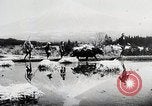
Agricultural scenes in Japan which is self-sufficient in food production prior to World War II.
Views of Japanese farmers at work in rice paddies and other agricultural fields in Japan before onset of World War 2. A line of women, in straw hats, labor in a rice field as a man pumps water into the paddy using a foot operated wheel. Rice being harvested and processed in the field. Farmers working in other fields containing grains such as wheat, barley, and oats and in vegetable patches. Japanese soldiers using grain straw to patch roofs. Other Japanese workers using such material for screens, parasols, and hats. Women harvesting fruit, in which Japan is 95% self-sufficient. Workers harvesting tea leaves. Workers at a seashore gathering salt evaporated from seawater. They carry some in wheelbarrows and some in containers using shoulder yoke.
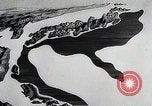
Commercial fishing industry of Japan before World War II
Animated map of fishing grounds around Japan that provide one fourth of the world's catch. Movement of the seasonal catch is tracked as it moves Northward during the year. Men and women engaged in commercial fishing, gathering in nets teeming with fish. Fishing boats plying waters of an inland sea. Fishing boats moored along the shores. Larger seagoing fishing boats leaving to operate along the coast of Honshu. Fishermen letting out nets from these boats and using cable winches to retrieve them. Views of refrigerated Japanese fishing ships that also freeze their catches, operatiing in the Siberian maritime provinces and in Alaskan and Arctic waters. Fishing boats, operating before World War 2, are seen pulling crabs aboard. View inside a floating cannery ship where salmon and crabmeat are being canned for export to places like the U.S.A. Closeup of a can displaying "ICEBOUNDBRAND" and text reading: " World Renowned Floating Cannery Pack Fresh from the Deep Sea Waters of Northern Japan. Net contents 13ounces. SELECTED CRABMEAT." Japanese wading in a river, and using trained cormorants, to catch fish. View of fisherman taking fish from his cormorant and placing them into a large jug. view of edible seaweed being harvested and laid out in the sun, in racks. Animated illustration of Japanese man and items included in his dinner of rice, soybean, fish, sea slugs, sea urchins, octopus, lily bulbs, bamboo shoots, bean curd and pickled fruits and vegetables, accompanied by a little saki (rice wine).
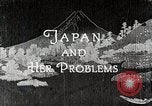
Various scenes showing Tokyo streets, Torii gates, festivals and a courtier looking at scroll in Japan
Map of North America and the United States, with a white outline for the United States border. Map of the Empire of Japan, including the Korean peninsula and Taiwan, and its borders in white. View of a lake with Mount Fuji. A train on top of Manseibashi bridge (1-1 Sotokanda, Chiyoda City, Tokyo 101-0021, Japan). Trams, vehicles, and bicycles in downtown Tokyo (likely Ginza or Marunouchi). A white Torii gate inside a Shinto shrine. People visit a Shinto shrine during spring. Japanese performers perform with fans on a Danjiri shrine cart during the Kishiwada Danjiri Festival in Osaka. Smokestacks in an industrial town. A wooden Torii gate. Japanese children flying a kite. A Buddhist monk blows a horn while deer graze in Nara. Spanish conquistadors and Japanese samurais ride horses. 18th century British woodcut showing metal tools and blacksmiths at work. 18th century prints showing European peasants working in a mill and horses in a grinding machine. A Japanese courtier opens and looks at a scroll with illustrations.
Sports and Recreation in Japan
Recreation activities in Japan. Japanese people rowing on boats in a lake. Athletics as a major part of recreational activities in Japan. Japanese men hiking up a snowy mountain. Japanese boys ice skating in a park. Two men engage in judo. Athletes participate in swimming and running competitions. Japanese children playing different sports in school ground.
CRITICALPAST.COM: About Us | Contact Us | FAQs - How to Order | License Agreement | My Account | My Lightboxes | Shopping Cart | Advanced Search | Featured Collections | Website Terms & Conditions | Privacy Policy ©2026 CriticalPast LLC.
License Agreement |
Terms & Conditions |
Privacy Policy
©2026 CriticalPast LLC.