


 Francais
 Deutsch
 Italiano
Refine Your Search
Yokohama Japan 1945 stock footage and images
- Showing 103 to 108 of 7988 results more
more Hide
Hide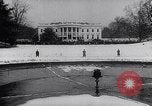
Harry Truman sworn in after death of Roosevelt and surrender of Germany to Allied Nations in World War II during 1945.
A review of significant events that occurred in the year 1945. Scenes from fourth inauguration of Franklin D. Roosevelt as President. Wide view of snow covered lawn of the White House, and guards positioned on the south White House lawn. View of President Roosevelt as he is sworn in as President of the United States, on the south portico of the White House due to wartime austerity measures, on January 20, 1945. Roosevelt, Winston Churchill and Joseph Stalin pose at the Yalta Conference. Death of Roosevelt in April 1945. Burial procession and funeral ceremony of Franklin Roosevelt. Men and women weeping. An African American woman waves her handkerchief as she mourns. Wreath on grave of President Roosevelt. Harry S. Truman sworn in as U.S. President on April 12, 1945. Surrender of the Germans signed by General Jodl and General W.B. Smith in Reims, France. Representatives of Russia, Britain, France and United States at the surrender. General Dwight Eisenhower smiles.

Allied aircraft bomb the City of Dresden in Germany on February 13, 1945 (British) and again on February 15 (American)
British Royal Air Force Lancaster bomber aircraft drop bombs over German targets in Dresden during night of February 13-14, 1945, during World War 2. Bombs impact and view of explosions and smoke. Two views of German scarecrow bombs exploding, designed to look like the explosion of an Allied bomber aircraft in order to intimidate the enemy. United States Army Air Force B-17 bombers attack the City of Dresden two days later on February 15-16, 1945, focusing on railroad marshaling yards. Relentless bombing by both the American and British forces destroy the city completely.
Montage of scenes during World War II on the Western front during January 1945
January, 1945, on the Western front during World War 2. Troops of the U.S. 8th Infantry Division test new white camouflage coveralls for use in snow. They patrol in snow covered forest areas on the Western Front. A sergeant makes outdoor field adjustments to the coveralls using a knife and captured German sewing machine. He helps a soldier who tries on his new coverall. The material used is from old mattress covers. Several soldiers are seen putting on the camouflage coveralls. Scene shifts to U.S. troops with a jeep towing a 20mm Italian dual purpose gun for use in Germany. On January 2, 1945, they set up and fire the gun at targets a half mile away. In Belgium, U.S. Army engineers of Company B, 238th Engineer Battalion, improvise remote controlled bazooka shells as road blocks. They set them up on fence posts and fire them by ordinary flashlight batteries. U.S. soldiers from a Signal Company of the 99th Infantry Division are seen using a Weasel vehicle (officially designated an M29C light cargo carrier) to lay communication cables through snow in the 1st Army Sector, Belgium. Views of the wire spool on back of the weasel, and soldiers pulling wire from it.
Opening statement of the prosecution at the Nuremberg Trials; flashback scenes of Nazi crimes and starving civilians in 1945
Events related the Nuremberg Trials held at the Palace of Justice in Nuremberg, Germany. Flashbacks of a variety of Nazi crimes against humanity during World War II. Europe during 1945. War devastation: buildings and cities laid in waste, people in hunger and despair emerge from shelters searching for the causes of the war and of the immediate human suffering. Deprived children and adults weep, starve and beg on the streets. November 21, 1945, Nuremberg, Palace of Justice, seat of the International Military Tribunal. List shows the names of the convicted Nazi criminals. Chief prosecutor from the United States, Robert Houghwout Jackson, makes the opening statement of the prosecution. He presents Count 1 of the indictment a conspiracy to commit war crimes and crimes against peace and humanity. He makes the statement that criminals who have done injustice to the laws of humanity must be brought to justice. Stenographers wearing headphones take down notes. Defendants stand in their dock including Herman Goring, Rudolf Hess, Joachim von Ribbentrop, Wilhelm Keitel, Karl Donitz, Erich Raeder, Baldur von Schirach and Fritz Sauckel. Faces of the convicted criminals. Scenes from mass burial of victims from German bombing of Coventry, England. Scenes from the end of World War 2, with women weeping and civilian victims of war in Europe, including Germany, seen scavenging on streets for food. Women and hungry children scrape out trash cans and metal lids for bites of food. Desperate civilians cut down remaining tree stumps from formerly tree-lined streets to use for fuel. A group of men and women struggle in a food relief line in Italy.
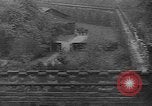
German war criminals are executed by Allied occupying forces in 1945, in World War 2
View from above, of the surrounding walls and courtyard of a prison in Rheinbach, Germany. Ground view inside the prison yard, where German civilian Matthias Gierens is being escorted to the gallows by U.S. military police, and accompanied by a German Catholic priest, on June 29, 1945. They ascend the gallows and final charges and sentence are read to Gierens. Next scene shows bodies stacked up at the Bergen-Belsen concentration camp operated by Nazi Germany. Scene returns to the gallows, and a hood is placed over Gierens' head. View of Allied army officer witnesses, in formation, at parade rest. Noose is placed over Gierens' hood. View of a a bird flying overhead, trapdoor opens, Gierens drops, and noose tightens. Next is an unrelated scene of several German soldiers being executed. They are seen hanging from four gallows in a line in a public square while a large crowd, possibly Soviet citizens, looks on. (Notes: Regarding the execution of Gierens in the opening scene: German civilian Matthias Gierens was a 37 year old railroad worker. He was executed for the August 15, 1944, murder near Priest, Germany, of a downed American airman, who was later identified as U.S. Army Air Forces 2nd Lieutenant Lester E. Reuss. Gierens and three other German civilians, Peter Kohn, Peter Back, and Matthias Krein, were convicted on June 2, 1945 in Ahrweiler, Germany, of the murder. Their trial was the first Allied trial in Germany of civilians charged with a war crime.)
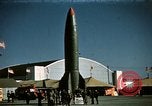
U.S. Army Air Forces Fair at Wright Field in October, 1945
Views of the U.S. Army Air Forces fair hosted at Wright Field, near Dayton, Ohio, in October, 1945.The highlights of the event were exhibits of captured German and Japanese aircraft, rockets, and equipment. A German V-2 Rocket Motor on display. Soldiers observe the rocket. A German Junkers Ju 388 Störtebeker multi-role aircraft on display. A German Messerschmitt ME-262 Schwalbe fighter on display. A German pilot's victories recorded on the side of a plane. Two soldiers take a look at a Japanese Kamikaze bomb. One of them gets into the bomb seat. American officers and soldiers view the exhibits. 'Alles Kaputt' written on the side of a German Junkers Ju-290 bomber (one of the candidate aircraft, with further development, in Germany's Amerika Bomber project for a long-range bomber capable of striking the United States). Soldiers walk under the plane. 'Transient Aircraft' written on the control tower building in the background. (World War II period).
CRITICALPAST.COM: About Us | Contact Us | FAQs - How to Order | License Agreement | My Account | My Lightboxes | Shopping Cart | Advanced Search | Featured Collections | Website Terms & Conditions | Privacy Policy ©2026 CriticalPast LLC.
License Agreement |
Terms & Conditions |
Privacy Policy
©2026 CriticalPast LLC.