


 Francais
 Deutsch
 Italiano

Refine Your Search
Yokohama Japan 1945 stock footage and images
- Showing 121 to 126 of 7991 results more
 Hide
Color Sound
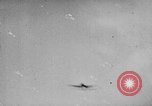
American ships of Task force 58 defend against Japanese Kamikaze attacks during April and May, of 1945 in World War II battle of Okinawa.
Film opens with shaky views of Japanese Kamikaze airplane attacking and being shot down by gunners on a U.S. Navy aircraft carrier of Task Force 58, during the Okinawa campaign of World War 2. Burning wrecked aircraft seen on the carrier flight deck. Firefighters run across flight deck with hoses. A landing F4F fighter plane number 59 runs into the flaming wreckage on the deck, and explodes. View from the side of F4F number 58 engulfed in flames as it sits in a pool of firefighting foam. Black flak clouds in the air. A Kamikaze aircraft crashes harmlessly into the sea. Deck crewmen help a pilot out of the cockpit of a fire scorched F4F. View of sailors standing next to a pair of heavy gun barrels on a U.S. warship. Parachuting U.S. pilot seen touching down in the water after bailing out of his aircraft. Sailors running across the flight deck of a carrier. View of the pilot in his life vest being helped aboard the carrier. More views of flak filled sky and a flaming Japanese airplane diving straight down to crash harmlessly in the water. View of American flag at half mast on a U.S. Navy warship. It is April 12, 1945 and President Franklin D. Roosevelt (FDR) has just died. View of sailors on deck in a memorial service for the President. Closeup of mourners singing with hymnals open. Closeup glimpse of FDR. More views of mourners. Scene changes to Japanese Kamikaze being blasted out of the air in pieces, by anti-aircraft fire from a U.S. carrier. The remains fall into the sea. View from U.S. ship, of a Japanese Nakajima L2D transport aircraft with flames coming out of its right wing, as it descends close to the water near the ship, with its landing gear down. View from a more distant ship of the transport plane exploding in the water near a U.S. Escort aircraft carrier. Twin Bofors anti-aircraft guns firing from a U.S. ship. Tracer bullets fill the sky aimed at a Japanese Kamikaze plane. Slates overlay the scene announcing Japanese aircraft shot down: "April 6th: 277 aircraft; April 12th: 100; May 3rd: 97;" Film ends showing more anti-aircraft fire from ships against attacking Japanese aircraft.
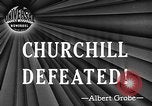
British Wartime General Election gives control to the Labor party in 1945
Opening slate of this film reads" Churchill Defeated." It goes on to show Winston Churchill attending his last meeting with wartime allied leaders at Podsdam, Germany in July, 1945. He shakes hands with Soviet Foreign Minister Vyacheslav Molotov. His replacement, Clement Attlee who is also there. View from above of Soviet leader, Joseph Stalin greeting the new British Prime Minister, Clement Attlee, who is accompanied by Foreign Secretary Anthony Eden and U.S. President Harry Truman, accompanied by Secretary of State James F. Byrnes. The wartime leaders gather around a large round table. Closeup of Marshal Stalin and Soviet Foreign Minister Molotov. Closeup of U.S. President Harry S. Truman at the conference table. View from above of the principals at the table. Film shifts to scenes of Major Attlee campaigning for votes. People in street listening to Ernest Bevin campaigning. Views of Winston Churchill being given a hearty farewell by a crowd, as he rides through on an open vehicle. Closeups of him he picks up a microphone to address the throng. Scene shifts to views of British voters casting their ballots. King George VI strolls with new Prime Minister Attlee and Winston Churchill. He poses with the new Prime Minister (Attlee) and Ernest Bevin on his right. At his left is Winston Churchill and Anthony Eden. Closeups of Clement Attlee.
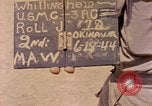
Wounded U.S. Marines being loaded aboard Stinson L-5B Sentinel ambulance aircraft in Okinawa , June 1945.
Air evacuation of wounded United States Marines in Okinawa, Japan during World War II. Marines unload a litter patient from an ambulance and load it aboard U.S. Army Air Forces L-5B aircraft of the 163rd Liaison Squadron. Aircraft taxis for take off. A signalman with flags with numerous Marine and Air Force L-5 aircraft in the background. Marines unload a wounded marine on a stretcher from the ambulance and load it aboard L-5B aircraft. Another litter patient being loaded aboard the L-5B aircraft. Identifiable aircraft serial numbers: 44-16995, 163rd Liaison Squadron
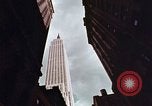
Views of the Empire State Building in New York City, including views during construction and after 1945 plane crash.
The Empire State Building (20 W 34th St., New York, NY 10001, United States) in New York City. Views of the Empire State Building in 1970. Views of the Empire State Building under construction in 1930 and 1931. A blimp passing near the Empire State building in the 1930s. People gathered in front of the Empire State Building for its grand opening in May 1931. Next scene shows the 79th floor of the Empire State Building engulfed in flames after a B-25 aircraft crashed into the building in 1945. Views of the fire from the ground and from the 79th floor areas as firemen extinguish flames. The final scene is street levels views of the Empire State building from a moving vehicle, again in 1970.
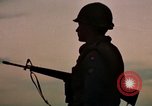
Visual saga of the American Soldier from 1945 to 1970: WWII; Korea; Berlin Crisis;Cuban Missile Crisis; Red China
Review of conflicts involving U.S. from World War 2 to 1970. A U.S. soldier with rifle and binoculars, on guard. German Chancellor Adolf Hitler speaks in Germany to mass audience. German mobilization and blitzkrieg. U.S. troops firing small arms on island in Pacific, battling Japanese. U.S. soldiers on half-track firing artillery. Explosive destruction of Nazi swastika and Eagle symbol on top of building in Zeppelin Field, Nuremberg, Germany. General Douglas MacArthur stands as Japanese General signs surrender documents aboard USS Missouri, ending World War II. Times Square in New York City on Victory over Japan Day (VJ Day) marking end of World War 2. American troops firing artillery and small arms in Korean War. Soviet leader Nikita Khrushchev speaking at the United Nations. Newspaper headlines about postwar Berlin Crisis. Soviet missiles on display in military parade in Red Square in Moscow, Russia, Soviet Union. Soviet General Georgy Zhukov and Nikita Khrushchev, at Kremlin, reviewing the parade. Cuban President Fidel Castro giving a speech. A newspaper headline reading: "Khrushchev orders removal of missiles" ending the Cuban Missile Crisis. Soviet cargo ship with covered missiles on its deck. Red flag with image of Lenin and message: 'Partido Communista Dominicano' and a crowd chanting support for the Communist party in the Dominican Republic. Communist Chinese people marching with massed flags in the People’s Republic of China. Chairman Mao Zedong waving to a crowd of young supporters and Red Guards in China as they chant. A United States soldier in South Vietnam during Vietnam War looks through binoculars and then walks carrying his M-16 rifle. A map of Vietnam.
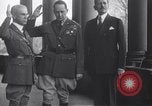
General Douglas MacArthur in 1930-1945; training of the Philippine Army; leading Allied troops against Japanese forces (WW2)
General Douglas MacArthur is appointed Chief of Staff, with rank of full General, in 1930. United States troops marching with the American flag. General MacArthur with two French military officers, during a tour of Europe. He is decorated by French Officials. MacArthur visits Germany and inspects German troops. U.S. President Roosevelt reappoints MacArthur as Chief of the Staff. MacArthur speaking to an audience in Washington DC. Scenes of MacArthur's headquarters in the Philippines. Filipinos walking outside MacArthur’s office. MacArthur at his office in the Philippines with Eisenhower at his side. MacArthur talks on the telephone. Flags of the United States and the Philippines. Filipino troops marching at Fort Santiago inside the walled city of Intramuros in Manila. MacArthur supervises the creation of a Philippine Army before World War 2. Philippine Army cadets perform outdoor calisthenics and attend a meeting. Philippine Army cadets train in knife fighting together with U.S. soldiers. View of Japanese attack of U.S. Navy ships and airfields at Pearl Harbor in December 1941. Japanese bombardment of the Philippines in December 1941 and into early 1942 as Japanese occupy Philippines during World War II. View of Corregidor Island. U.S. Army and Filipino soldiers on Corregidor load and fire artillery at the Japanese before the fall of Corregidor. U.S. soldiers in the Bataan peninsula. Face of MacArthur superimposed over a montage of American factory workers manufacturing ammunition and military vehicles. Start of the Bataan Death March. PT boat carrying MacArthur leaves Corregidor. War equipment prepared in factories. A battleship underway to Australia. MacArthur in Australia. U.S. convoy moves towards Japanese held islands in the Pacific. Allied soldiers land on the islands. A soldier lands on a beach and raises the American Flag. MacArthur points to the Philippines on a map and discuss war strategy. In accordance with the plan key positions in the Pacific are attacked. MacArthur looks on as United States soldiers land on the islands. MacArthur while smoking a pipe inspects the landing of Allied soldiers on islands behind heavy bombardment. Amphibious tractors land on the beach of Palo, Leyte. Allied paratroops make a landing. United States troops sail on rubber boats towards the beach of Palo, Leyte. Paratroopers on parachutes landing in Leyte. MacArthur confers with Allied Commanders. Allied troops walk past a destroyed Bahay Kubo nipa hut. Japanese soldiers are taken as prisoners in the Philippines.
CRITICALPAST.COM: About Us | Contact Us | FAQs - How to Order | License Agreement | My Account | My Lightboxes | Shopping Cart | Advanced Search | Featured Collections | Website Terms & Conditions | Privacy Policy ©2026 CriticalPast LLC.
License Agreement |
Terms & Conditions |
Privacy Policy
©2026 CriticalPast LLC.