


 Francais
 Deutsch
 Italiano
Refine Your Search
Yokohama Japan 1945 stock footage and images
- Showing 1399 to 1404 of 7988 results more
more Hide
Hide
Views of China and Japan in the period leading up to the 2nd Sino-Japanese war
Film opens with outline map of Japan shown in contrast to 20 times larger China and figures representing China's 6 times greater population. Map of China is shown in pieces representing its numerous internal fiefdoms. In contrast, Japanese soldiers are shown marching in review before their singular leader, Emperor Hirohito and other national military leaders. Film shows contrasting 20th century characteristics of China and Japan. Sun Yat-sen, who figured prominently in post-Imperial China, and is considered the founding father of the Republic of China, is shown speaking to crowds. Narrator states that in 1911, this man fathered a peoples' revolution which brought to an end, China's ancient Imperial government. View of Chinese people marching and carrying flags and banners. Books are shown comparing China's Sun Yat-sen to America's George Washingon. Sun Yat-sen's political statement, shown in Chinese, contains words similar those in Abraham Lincoln's Gettysburg address. View of schools and colleges built in the new Republic of China. Chinese students shown in libraries. A couple dining in a Chinese hotel restaurant, overlooking other buildings. A tall clock tower looms at the same height outside their window. Steel being erected for a tall building. Architects at work. Scientist looking through a microscope. Technicians at work in a chemistry laboratory. Medical staff and patients in a modern hospital. Children in school under compulsory education program. Chinese people exercising their freedoms of expression and religion. The funeral of Sun Yat-sen, in 1925, attended by his successor, Chiang Kai-shek, and other Chinese leaders in military uniforms. Chinese people attending an outdoor ceremony. Examples of areas needing modernisation. Chinese workers using manually operated machinery to process fabrics. Commercial vessel plying a river using wind and sail only. Views of steam locomotives and trains being introduced to link parts of China. Trucks moving goods over roads (still unpaved). Miners working in open air mines, digging coal and iron. Molten tin being poured from a crucible. Machines performing complex tasks in a fabric mill and women tending spinning and knitting machines. School children engaged in collective outdoor games and exercise drills. Scene shifts to Japan, where Emperor Hirohito, on a white horse, leads military leaders in reviewing Japanese forces. A formation of Japanese Model 97 medium tanks passing in review, with tank commanders saluting from their turrets. Glimpse of Japanese steel mill. Headline in World-Telegram newspaper of 14 february, 1934, reads: "Tokyo House Passes Huge Arms Budget." A Los Angeles newspaper of 23 November, 1934, expands on the same story. New Orleans Times-Picayune, Sunday, 5, May, 1936, reports that Japan is strained by its huge arms costs.
Relief and rebuilding works by the occupation forces of United States in Germany and Japan after World War II.
U.S. War Department information film "Overseas Mission" describes relief and rebuilding works in Germany and Japan by United States Army, after World War II. Battle between the Allied forces and the Nazi armies, soldiers and artillery fire during battle in German cities and towns. General Eisenhower signs accepting surrender of Germany. General MacArthur signs accepting surrender of Japan to mark the end of World War II. Soldiers carry casualties on litters. Treaty of Versailles after World War I. Newspaper lines read Nazi rearmament of Germany. Allied tanks and troops march in Germany. Marching Allied forces in Japan. Destroyed buildings and factories in cities of Japan and Germany. Nuremberg trials and arrests of Nazi generals. Allied forces dismantle German factories and industrial plants capable of making war materiel. A U.S. Army officer pushes handle to detonate explosives destroying a German factory. Nazi flags, German ammunitions and German factories are destroyed. Nazi troops and civilians saluting Hitler. Allied army engineers make roads and bridges, medics checking patients to prevent epidemics. Borders guarded, Nazi Germans tried. Prisoners of Nazi and Japanese released, dispensary checkup their health. Japanese prisoners released, board a bus. Declaration of Independence on July 4, 1776. Re-establishment of press, churches, courts and schools. Japanese children at school. Election in the occupied countries to run democratic government. Map showing opposite positions of occupied countries. Rations for occupation forces and civilians transported in trucks. Officers hiring labor to carry out relief works.
Attack on Pearl Harbor by Japanese, and President Roosevelt asks for war declaration on Japan in 'date of infamy' speech.
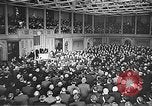
United States Government film entitled "The World At War" dealing with World War 2. Film opens showing Japanese warplanes in formation above a Japanese military installation. Slate reads: "Pearl Harbor December 7, 1941. An airfield is seen filled with parked U.S. Army Air Forces B-17 bombers. Two Boeing XB-17 (Model 299) bombers are parked next to each other on the ramp. Derricks and ships are shown at the Pearl Harbor naval base. A formation of Japanese Mitsubishi G3M bombers is seen in flight. They are seen overhead as bombs explode on the U.S. Navy Air Station at Ford Island destroying hangars and aircraft. Next, is shown the famous image of the USS Arizona burning, listing, and sinking, after being bombed. Film continues, panning over post-air raid views of destruction. On December 8, 1941, U.S. President Franklin D. Roosevelt, addresses the Congress, delivering his declaration of war message. He calls December 7, 1941 "a date which will live in infamy." Roosevelt recounts that the United States was at peace with japan and in conversation with its government and Emperor, in the interest of maintaining peace.in the Pacific. even at the time of the attack. Japanese ambassador and his colleagues seen visiting State Department offices to meet with U.S. Secretary of State prior and even during the initial attack operations by Japan.Roosevelt recounts that the United States was still in conversation with Japan even at the time of the attack. Japanese ambassador and his colleagues seen visiting State Department offices to meet with U.S. Secretary of State prior and even during the initial attack operations by Japan. Photographers take pictures of the visiting Japanese delegation. President Roosevelt asks Congress to affirm that a state of War exists between the United States and the Japanese Empire.
Japanese observers send information to Japan from Honolulu, Hawaii before the attack on Pearl Harbor during World War II.
A film dramatizes the relay of intelligence to Japan from Honolulu, Hawaii prior to Japanese attack on Pearl Harbor during World War II. Japanese spy activities in Honolulu shows a Japanese man sending information to Japan by short wave radio signals. A Japanese fisherman relays information. Shows how information is relayed by sending a diplomatic pouch to Tokyo, Japan from the Japanese consul in Honolulu. An American citizen talks about Japan sending Japanese priests to the U.S. Japanese people listen to Japanese radio broadcast in a house. Two men, one enacts as Uncle Sam and other one as an American citizen. They talk to each other about Japanese people. Landscape of Hawaii showing Diamond Head.
President Franklin D. Roosevelt signs the declaration of war against Japan after the attack on Pearl Harbor, United States.
America declares war on Japan during World War 2. U.S. President Franklin Delano Roosevelt addresses Congress at the U.S. Capitol. He gives a speech recounting the attack on Pearl Harbor and speaks of American success to come in the war against Japan. The President signs the declaration of war against Japan after the attack of Pearl Harbor. A large group of civilians enlist into the armed forces. Civilian young men taking an oath of service. View of new military recruits marching on a dock beside New York Harbor with view of New York City Manhattan skyline behind them. Newly commissioned U.S. officers at commissioning ceremony. Group of citizens gathered at a memorial service in Hawaii laying wreaths and mourning the loss of American lives from the Pearl Harbor attack by Japan. U.S. Navy Admiral Chester W. Nimitz presents medals to men of the armed forces who had defended Pearl Harbor. A large fleet en route to Honolulu with supplies. General Douglas MacArthur at his desk working on orders and talking on telephone. Filipino Forces march in Manila. Massive heavy artillery long gun being fired on Corregidor at Japanese forces.

A Shinto priest performs purification rites and a mayor's wife christens Japan Air Lines new trans Pacific DC-7 aircraft in San Francisco.
Christening of Japan Air Lines (Japan Airlines) new transpacific DC-7 aircraft in San Francisco, California. A Shinto priest performs a blessing for aircraft. The Shinto priest leave offering. San Francisco's Mayor George Christopher's wife (Tula Sarantitis) christens Japan Air Lines new transpacific Douglas DC-7 transport aircraft. Mrs. Tula Sarantitis-Christopher scoops from a wooden bucket with melted snow from Mount Fuji using a Chōzubachi dipper. Mrs. Sarantitis-Christopher ritually purifies the new Japan Air Lines aircraft.
CRITICALPAST.COM: About Us | Contact Us | FAQs - How to Order | License Agreement | My Account | My Lightboxes | Shopping Cart | Advanced Search | Featured Collections | Website Terms & Conditions | Privacy Policy ©2026 CriticalPast LLC.
License Agreement |
Terms & Conditions |
Privacy Policy
©2026 CriticalPast LLC.