


 Francais
 Deutsch
 Italiano
Refine Your Search
Yokohama Japan 1945 stock footage and images
- Showing 1813 to 1818 of 7988 results more
more Hide
Hide
Expansionist policies of Japan, Italy and Germany converge, leading to World War 2
Film begins with peaceful scenes of Japan, including Mount Fuji; women in traditional Kimonos strolling among cherry blossoms; exquisite gardens; Geisha girls in traditional dress holding fans; and picturesque peasant farmers binding sheaves of grain. Evidence of Japan adopting Western styles and ways, shown by modern buildings, motor vehicles, and many Japanese in Western clothes going about their daily business on busy city streets. A Japanese stadium filled with spectators at a baseball game. One difference from an American baseball game is that the players are seen marching onto the field accompanied by a military band and later all sharing in raising the Japanese flag to start the event. View of line of players in jerseys as flag is raised (jersey team name Tomasyo?) Views of the baseball game underway. Baseball player with "Y" logo on front steps up to plate to bat. Scene changes to demonstrations of Japanese Navy as senior Naval Officers review Japanese sailors aboard a warship. A formation of Japanese warships underway. Closeup of a Japanese destroyer. A flotilla of Japanese warships being overflown by several formations of Naval aircraft. A flight of Kawanishi H6K Naval flying boats flying in loose formation. A parade of Japanese light and medium tanks including Type 95 Ha-Go tanks (some with offset turrets). View from rear of the parade. Many tanks crossing a field. Emperor Hirohito, riding a white horse, reviewing Type 97 Chi-Ha medium tanks and their crews standing at attention. Tanks raising dust as they move in formations on a road and in a field. Japanese infantry soldiers high step march in review past the Emperor on his white horse. Massed Japanese infantry on parade. View, again, of the high-stepping Japanese infantry marching past the Emperor as a segue to Italian infantry goosestepping on parade. Several views of such parades. Mussolini giving an impassioned speech to Italians from balcony on the Palazzo Venezia in Rome on November 4, 1938. A huge flat field filled with Italian SPAD XIII army biplanes parked in symmetric rows. Emperor Haile Selassie of Ethiopia speaking from a shelter, rallies his tribesmen to resist invasion by Italian forces. They are seen in tribal dress, armed with spears and ancient rifles, as they answer the Emperor's call. View of Italian L3 light tanks advancing across desert terrain. Italian cavalry charging. Italian infantry moving forward. Italian Caproni Ca.111bis light bomber in flight. Bombs dropping through the air. Barrages by batteries of Italian artillery. Shells striking a hilltop fortress. An open air stadium with one section containing many Japanese attendees waving Japanese flags. A Japanese statesman reading a speech in Japanese. View of the stadium filled with Italians. "Saluti" written on the edge of the section occupied by Japanese attendees. An Italian spokesman in black uniform welcomes the Japanese contingent. A Japanese translator stands beside him. Closeup of cheering Japanese who have heard the greeting translated. Scene shifts to Japanese infantry hi-stepping past Emperor Hirohito and immediately to Italian troops goosestepping and then to German troops goosestepping as they (according to narrator) march into Austria on March 13th 1938. View of German troops marching into Austrian town to cheers from civilians on sidewalks waving Nazi swastika flags and rendering Nazi salutes. Numerous utility vehicles carry German soldiers through the town. More German soldiers arriving in tanks and on motorcycles. Some arrive on horse-drawn caissons towing field artillery pieces.
12,000 Chinese in protest parade against Japan
12,000 Chinese in protest parade against Japan. 12,000 Chinese men and women parade through Chinatown with colorful floats. Several men are in native costumes. They carry huge banners in demonstration of united support for defense forces fighting Japanese invasion. A banner reads 'Japan breaks International treaties'. Children watch the parade from balcony of their house.
Riots in Japan and President Eisenhower's visit to Manila, Philippines.
Riots in Tokyo, Japan. Communist led student mobs attack and force open the gate of the Parliament. A clash between the police and the mob. The police use high speed water guns to chase away the rioters. U.S. President Dwight D. Eisenhower's proposed visit to Japan is canceled. An aircraft lands in Manila, Philippines. President Eisenhower disembarks from the aircraft. He is warmly greeted by the people. A 21 gun salute is given in his honor. The President, his son and daughter in law are welcomed by Filipino President Carlos Polístico García. The President's motorcade rolls through the streets escorted by police escorts. People on the sides of streets and on top of buildings to welcome the President. The President gets off a car and is greeted by dignitaries.
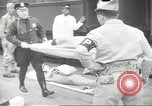
Japanese Nationals and Issei arrive by train and buses at Jersey City, New Jersey for repatriation to Japan in World War II
Opening scene shows police officer removing a sick person, on a litter from a Pennsylvania Railroad train at a station and placing them gently on a railway cart. A uniformed U.S. Army Military policeman helps them. Next, Japanese Nationals and Issei families with many small children are seen leaving a train and walking along a railway platform. A Red Cross woman in white stands behind an ambulance, where a newborn infant lies on a litter. Policeman carry two women on litters and place them in the ambulance. The newborn baby is being cradled in the arms of the Red Cross woman. A Japanese family climbs aboard a bus. Railway workers transport travelers' baggage on a large cart. Police stand near by as a U.S. Army Military policeman boards a bus filled with Japanese to be repatriated to Japan. Two MPs watch as Japanese to be repatriated climb aboard another bus. A group of Japanese men enter a bus, followed by Armed U.S. Army soldiers who also board. An official guides a train to a stopping point on a train station. A large group of men to be repatriated to Japan step from the train under guard by many armed U.S. soldiers.
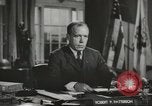
American Undersecretary of War speaks to difficulties facing Allies in confronting Germany and Japan in World War II
Undersecretary of War, Robert Porter Patterson, Sr. speaks about a report from the General staff outlining the needs for combating Germany and Japan in World War 2. He cites Operation Husky, the invasion of Sicily, as an example of what will be needed. He continues to narrate in the background as an animated map appears showing the buildup of supplies and Allied forces in North Africa; Allied air forces flying 60 thousand sorties over Sicily and, the direct amphibious assault using 3,200 vessels. Map also depicts opposing forces of 12 (“unwilling”) Italian Divisions and 3-1/2 German Divisions. View of Allied troops carrying some of their 31 thousand casualties on stretchers from field ambulances. Allied medics attending to the wounded. Some are seen lying on stretchers in a row on the ground near a wall. Interior of a field hospital where surgeons and other medical personnel treat the wounded. Animated map shifts to Europe with Germany at its center, showing , in contrast to Sicily that was only an “outpost,”, the heavily fortified perimeter of Axis controlled areas; the axis industrial might; and the disposition of 300 German Divisions (mostly on the Eastern front) defending the region. Next, the map illustrates Japan’s defended regions in the Pacific Image returns to Undersecretary Patterson i n his office, speaking of the Allied offensives planned for next year (1944), and emphasizing their challenge and difficulty. Scene shifts to General Jonathan Wainwright and his garrison at Corregidor, in the Philippines, surrendering to Japanese forces in 1941. Japanese military camera pans over the Americans being taken prisoner. Other Americans and Filipinos are seen being marched together under guard. Scene shifts to classic views of the Japanese attack on Pearl Harbor, Hawaii, on December 7, 1941. View of Japanese soldiers executing two Chinese civilians in 1937. Dangling bodies of persons hung by Nazis during Operation Barbarossa in Russia, in 1941 A Russian soldier comforts a little girl as he escorts her across a snowy landscape. Time bomb left by German forces retreating from Naples, Italy, in 1943, blows up a Post office building . Views of damage to building and bodies of victims. American Military Police assisting a victim. American soldiers carrying an injured civilian on a litter. Scene shifts to British Foreign Minister, Anthony Eden, Soviet Foreign Minister, Vyacheslav Molotov, and U.S. Secretary of State, Cordell Hull, entering a hall in the Spiridonovka Palace, during the 1943 Moscow Conference in Russia. Close-up of the American, Soviet, and British flags on a table. View of many delegates seated around the table. Close-up of Molotov, Eden, and Hull signing conference document.
Japan expands its military presence and influence in the Pacific before World War II. U.S. employs air power early in the war.
Opening scene shows Emperor Hirohito of Japan dressed in military uniform, astride a white horse, riding along a path, followed by military officers. (Narrator cites Japanese declaration of war against the U.S. and Britain on December 7, 1941.) Japanese soldiers in two groups engage in local war games against each other. Animated map shows Japan and the expansion of her influence and military presence throughout the Pacific. Aerial view through scattered clouds, of Japanese fleet of warships. Aerial view of American warplanes in formation through scattered clouds. Closeup from cockpit of a U.S. A-20 Havoc aircraft, showing its left engine and prop and a second A-20 flying to its left in close formation. Swerving wake of a Japanese warship engaged in evasive maneuvers on surface of the sea, below. Several scenes of U.S. aircraft strafing Japanese warships. Aerial view from a U.S. B-25, flying above Japanese ships, of another B-25, with its bomb bay doors open as it launches a torpedo. Japanese ship is struck, explodes, and sinks stern first. Glimpse of more Japanese ships in a convoy.
CRITICALPAST.COM: About Us | Contact Us | FAQs - How to Order | License Agreement | My Account | My Lightboxes | Shopping Cart | Advanced Search | Featured Collections | Website Terms & Conditions | Privacy Policy ©2026 CriticalPast LLC.
License Agreement |
Terms & Conditions |
Privacy Policy
©2026 CriticalPast LLC.