


 Francais
 Deutsch
 Italiano
Refine Your Search
Yokohama Japan 1945 stock footage and images
- Showing 1867 to 1872 of 7988 results more
more Hide
Hide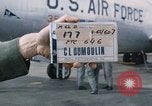
A United States KC-135 A aircraft at Kadena Air Base in Okinawa, Japan during the Vietnam War.
United States aircraft at Kadena Air Base in Okinawa, Japan during the Vietnam War. United States KC-135 A aircraft being refueled at the air base. An airman climbs up a ladder and gets into a plane. KC-135 A aircraft lined up on the flight line with vehicles moving about the air base in the foreground. A sign reads ' Warning Restricted Area '. A KC-135 A aircraft taxis. Another aircraft in the foreground.
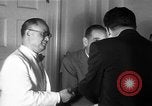
U.S. Vice President Richard Nixon meets with Foreign Minister Shigemitsu Mamoru, of Japan at the U.S. Capitol in Washington DC.
President Richard Nixon seated with Foreign Minister Shigemitsu Mamoru, of Japan in a room of the U.S. Capitol in Washington DC. President Nixon converses with the Foreign Minister. They come out and stand on the steps of the Capitol building. President Richard Nixon points out something.
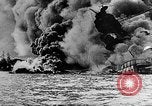
Japan extends its empire into Manchuria, Mongolia, and China in 1931 and 1932
Brief opening scenes show ships being engulfed in flames and smoke from Japanese attack on Pearl Harbor, December 7, 1941 in World War 2. Focus is primarily on the USS Arizona. Scene shifts to Japanese troops assembling on a pier and boarding troop transport ships bound for Manchuria and China, following the Mukden Incident of September, 1931. Japanese troops are then seen marching into Manchuria on September 18, 1931. A formation of Japanese soldiers presents arms. In another formation, they shoulder swords. Closeup of a Japanese soldier in a steel helmet with chin strap in place. A steam locomotive pulls a train into the Chin Hsien station on the South Manchurian Railway. A Japanese train on that line had been dynamited, triggering a Japanese push into Mukden. View from behind a train leaving Chin Hsien on the South Manchurian Railway. Japanese battalions place bundles of straw across a stream to facilitate troop crossing. A column of Japanese troops is seen crossing the water on the makeshift straw crossing. Japanese troops advancing along with supplies carried by pack animals. Troops traverse a sandy berm past an abandoned two-wheel cart. A formation of 12 Japanese G3M bombers flies overhead in a "V" formation en route to bomb Mukden. View of Chinese population running for shelter from the bombing. Chinese walk past some civilian casualties lying in a street. The League of Nations headquarters in Palais Wilson, Geneva, Switzerland. A memorial to Woodrow Wilson at the Palais Wilson reads: "A La Memoire De Woodrow Wilson President des Etats-Vnis,Fondatevr DL La Societe Des Nations, La Ville de Geneve." A car driving away from the entrance of the League Headquarters. Closeup of doorway with sign identifying it as the entrance for delegates and members of the Press. League delegates are seen inside its meeting hall. Japanese warships are seen next, attacking 15 miles from Shanghai with naval gunfire.Three Mitsubishi 2MR4 (Type 10)Reconnaissance biplanes are seen in flight above the barrel of a large naval gun. Japanese troops marching into Shanghai, as people on the roadside wave Japanese flags. Next, they are seen marching out of Shanghai at the insistence of the League of Nations. After signing a truce with China, on May 4, 1932, Japanese troops are seen entering Mongolia, in September, 1932, which they reconstituted as the Puppet State of Manchuko. A Japanese soldier standing atop a building waving a Japanese flag. Japanese statesmen resigning and leaving the League of Nations in protest after it labeled Japan an aggressor. Japanese forces fire a long barrel Type 89 cannon (150mm) as they push into China proper. Group of Japanese artillerymen use range finders, Periscopic viewers and binoculars to guide the gunners. Shell explodes raising large amount of earth. More views of artillery firing and infantry advancing. Infantry crossing a bridge and raising siege ladders to scale a fortress. Engines running on Japanese Ki 30 Type 97 airplanes, as pilots get final briefing and orders. They salute, board their aircraft, and are seen in formation aloft, dropping bombs. View from the air of bombs striking below. View from a bomber of its bombs dropping from the aircraft (bombs away view) and exploding on the ground. A column of Chinese soldiers moves along a section of the Great Wall of China heading into the interior of China. Civilians moving all manner of equipment and machinery into the interior.
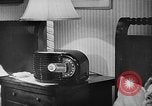
America's actions as World War II breaks out in Europe and Japan attacks China in Asia
Americans in bed listen to radio announcing beginning of World War 2 in Europe. French troops deploying to Maginot Line fortresses and firing their heavy guns. German heavy artillery firing. A rail gun firing. Pollsters gather American opinions about the war.Congress convenes in Special session. President Roosevelt requests changes in Neutrality Act. Senator Gerald P. Nye of North Dakota argues against and Senator Elbert D. Thomas (Utah) argues for changes in neutrality. Pollsters seek American's opinions. U.S. Congress ends arms embargo. The ship SS American Farmer (United States Lines) underway in the ocean. Animated map of Asia and views of Japanese forces bombarding China. Chinese civilians fleeing bombardment. Japanese soldiers executing two Chinese men. Dead Chinese civilians. American housewife being asked opinion about Chinese-Japanese conflict. Japanese ships load U.S. scrap iron, as some Americans protest. Dean Acheson, Assistant Secretary of State explaining U.S. law and decision to stop all exports to Japan in Summer 1941.
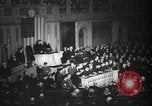
President Franklin D. Roosevelt addresses Congress at the U.S. Capitol in Washington DC, and declares war on Japan (WW2)
U.S. President Franklin D. Roosevelt at the U.S. Capitol in Washington DC. President Roosevelt at podium addressing Congress in World War II. He recounts events leading up to the Japanese attack and delivers his declaration of war against Japan. He describes the attack as "unprovoked and dastardly" and asks the Congress to affirm that since the attack on December 7, 1941, a State of War has existed between the United States and the Japanese Empire. He speaks about the war and states that the Americans will surely succeed in the war. The officials applaud at the President's statement.
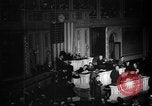
The declaration of the state of war between the United States and Japan is declared at the U.S. Capitol in Washington DC (WW2)
Officials of the United States Congress gather at the U.S. Capitol. A clerk reads the resolution following the Japanese attack on Pearl Harbor and it indicates that a state of war between the United States and Japan is declared in World War II. It further pledges all of the resources of the country to the war effort. Senators, Congressmen, and other dignitaries hear the resolution. Members cheer and applaud. The Speaker of the House, Samuel Rayburn, calls the House to order.
CRITICALPAST.COM: About Us | Contact Us | FAQs - How to Order | License Agreement | My Account | My Lightboxes | Shopping Cart | Advanced Search | Featured Collections | Website Terms & Conditions | Privacy Policy ©2026 CriticalPast LLC.
License Agreement |
Terms & Conditions |
Privacy Policy
©2026 CriticalPast LLC.