


 Francais
 Deutsch
 Italiano
Refine Your Search
Yokohama Japan 1945 stock footage and images
- Showing 2269 to 2274 of 7988 results more
more Hide
Hide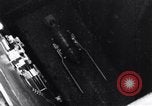
B-25 Mitchell bombers on deck, Lt Col. Doolittle and U.S. Navy Captain Marc A. Mitscher talk during the Tokyo Japan raid.
General activities on USS Hornet in the Pacific show the preparation for the Doolittle Raid on Tokyo. A bomb comes up on a small elevator U.S. Lieutenant Colonel Doolittle wires a Japanese medal on the bomb for its return to its originators. A medal on the bomb. U.S. Army Air Forces men seated around the bomb. Lt Col. James Harold Doolittle and U.S. Navy Captain Marc A. Mitscher near the bomb. Close up of Marc A. Mitscher. (World War II period).
John Foster Dulles and Assistant Secretary of Army, Earl D Johnson depart for Japan.
Dulles and Johnson with James E Webb, Special Assistant to Secretary of State, Major General Parks, Chairman of Information, Department of Army. Dulles and Johnson shaking hands with Webb and General Parks. The two men walking up the ramp of plane. They turn around as Dulles waves his hat. General Parks, Mrs. Earl Johnson and Mrs. Pace waving goodbye.
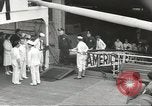
Japanese Nationals and Issei, with families, board the Swedish ocean liner M.S. Gripsholm at Jersey City, New Jersey, for repatriation to Japan, in World War II
Film starts showing the Swedish ocean liner M.S. Gripsholm, docked at Jersey City, New Jersey, in World War 2. Some Ship's officers and crew are on deck and two armed Sailors stand on either side where the ramp meets the ship's deck. Two uniformed policeman come up the boarding ramp carrying a person on a littter. Ship's officer directs them where to take that person. Next, Japanese Nationals and Issei with their families begin boarding. Ship's officer and a sailor direct them where to go. Many boarding have small children. A ship's officer and a sailor carry another person aboard on a litter. A woman alone breezes past the guards. More families with small children board. An ambulatory, disabled , young Japanese woman is helped aboard by a man and a nurse. Two nurses help another woman board. Scene shifts to the pier where U.S. customs officials check baggage being brought aboard the ship and check identifications of passengers who will board. Next, a ship's doctor is seen attending a young girl in the ship's infirmary. He checks her vital signs. Then a Red Cross nurse enters and takes the patient's temperature and pulse rate.
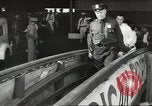
The Swedish ship M.S. Gripsholm boarding persons being repatriated to Japan during World War II
A Boarding ramp is seen extending to the docket Swedish ocean liner, M.S. Gripsholm, from a covered pier at Jersey City, New Jersey, during World War 2. A policeman and a ship's crewman carry a sick man aboard on a litter. At the base of the ramp, Japanese Nationals and Issei stand in group waiting to board. Two armed U.S. sailors guard the ramp. View switches to the Gripsholm's deck where passenger families are happily greeting one another. Many are family and friends who know each other. Camera pans along the ship's deck, where many passengers are seated and others continue to greet one another. View of several passengers seated outdoors, on deck. Two small children squat near the railing to look outside. The Manhattan, New York City skyline is seen in fog, in the background. On the main deck, girl walks with a very small child. Two little girls descend a stairs to a lower deck. Several little boys stand by a railing to look out on the Hudson River. A mother brings a very small child up the gang plank.
Japan exploits human and material resources in occupied Asian countries of its Empire, to support its war effort against the Allies (WW2)
A solitary Japanese Army sentry walks his post along a seawall in a coastal area under Japanese military control in World War II. Local people go about their daily activities in a city under Japanese administration. A Japanese military policeman, wearing a white armband, directs traffic. A Japanese Army officer converses with another Japanese military policeman. A passenger speeds past them in a rickshaw. A Japanese military officer waves a loaded truck onward. Japanese replace old buildings and install new communication lines in a city. Japanese military engineers survey and Japanese troops build lines of communication, including a railroad bridge. Japanese officials scrutinize credentials of people at a checkpoint. A Japanese soldier searches a man. People are waved through a checkpoint after their credentials are reviewed. Workers in a textile plant. Laborers at construction sites use carrying poles to transport materials. Other laborers carrying sacks of material on their backs, as they unload a barge at a waterfront. Glimpse of a Japanese controlled harbor.
Japanese troops in streets of Shanghai, China following occupation by Japan in December 1941 of World War II.
Activities of Japanese soldiers in Shanghai China occupying international settlement areas of Shanghai right after the Japanese attack on Pearl Harbor in World War 2. Shanghai residents crowd on the streets near a waterfront. Japanese soldiers unload from a truck. The troops stand near the entrance to a building. The soldiers walk down a street. Wartime street scenes of city under Japanese attack. Japanese armored vehicle go down a street. The soldiers carry a battle flag. A Japanese river gunboat. A flag flying from the gunboat. The Japanese gunboat at a harbor of Shanghai.
CRITICALPAST.COM: About Us | Contact Us | FAQs - How to Order | License Agreement | My Account | My Lightboxes | Shopping Cart | Advanced Search | Featured Collections | Website Terms & Conditions | Privacy Policy ©2026 CriticalPast LLC.
License Agreement |
Terms & Conditions |
Privacy Policy
©2026 CriticalPast LLC.