


 Francais
 Deutsch
 Italiano
Refine Your Search
Yokohama Japan 1945 stock footage and images
- Showing 229 to 234 of 7988 results more
more Hide
Hide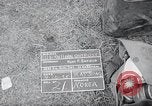
U.S. and Russian soldiers gather round a fellow soldier who plays a guitar.
Shows a group of U.S. and Russian soldiers showing snapshots to one another at the US-Russian Outpost at the 38th Parallel in Kaesong. U.S. and Russian soldiers gather around a Russian soldier who plays a guitar and entertains all.25 September 1945. (World War II period).
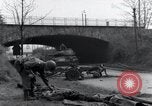
U.S. Army officer identifies remains of American soldiers killed in final days of World War II, in Hilden, Germany.
A U.S. Army Captain examines bodies of American soldiers of the 46th Tank Battalion, 13th Armored Division, killed when their Sherman M4 tank was struck by panzerfaust anti-tank weapons and 20mm fire, on April 17, 1945, in the final days of World War 2, in Europe. The wrecked tank and human remains are seen at the intersection of Ellerstraße & Hülsenstraße, in Hilden Germany. Closeup of the Captain looking closely at the dog tags of one dead soldier. Next, he is seen checking the dog tags of other dead tank crew members, as local German townspeople watch from nearby. He and another officer cover the bodies with a large tarpaulin.
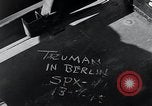
President Truman reviews troops of U.S. 2nd Armored Division, enroute to Berlin for Potsdam Conference
July 16, 1945, with President Truman and his party enroute to Berlin Germany, prior to the "Big Three" conference at Potsdam. President Harry S. Truman is seated in right rear of open car. Secretary of State, James F. Byrnes sits next to him in the center, and Fleet Admiral William D. Leahy, Personal Chief of Staff to the President, is in the left rear seat. U.S. Army Brigadier. An Army Major General stands beside the car speaking to the occupants. Brigadier General Harry H. Vaughan (wearing sun glasses), long time friend and aide to the President, steps close to the car. Scene shifts to the President and his party, standing in a moving vehicle, as they review troops of the 2nd Armored Division, standing in front of their tanks, M10 Tank Destroyers, and other armored vehicles. The President and Secretary Byrnes remove their hats and hold them over their hearts,while military officers render hand salutes as they pass the colors. Views from vehicle passing the formation.View from ground of Presidential party at attention with flag of the 17th Battalion displayed. A Lieutenant from the 17th Armored Engineer Battalion reads a citation and Brigadier General John Howell Collier, Commander, 2nd Armored Division, unfurls unit citation ribbon, that President Truman then ties to the Guidon of Company E, 17th Armored Engineer Battalion. As President Truman reportedly described the event in his diary: "We reviewed the Second Armored Division and tied a citation on the guidon of Company E, 17th Armored Engineer Battalion. General Collier, who seemed to know his stuff, put us in a reconnaissance car built with side seats and no top, just like a hoodlum wagon minus the top on a fire truck, with seats and no hose, and we drove slowly down a mile and a half of good soldiers and some millions of dollars' worth of equipment -- which had amply paid its way to Berlin." (World War II period).
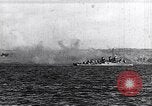
U.S. Coast Guard combat cameramen capture beachhead activities in Iwo Jima.
1945: Combat cameramen film the U.S. forces landing at the Iwo Jima beachhead. Marines and Coast Guard landing parties under attack, explosions at sea. A Coast Guard cutter. Barrage balloons in the sky. Landing Crafts move towards the shore. Explosions in the water. The U.S. Coast Guard landing party on the shore. Beachhead activities as the U.S. Marines arrive. Landing Craft reach the shore. Troops climb out, unload equipment and run inland. A crane at work. Troops crouch in the Landing Craft. They treat a wounded comrade. (World War II period).

New German soldier Volkssturm recruits and conscripts pledge allegiance to their country and Hitler, and receive their rifles.
A new German army unit in uniform is assembled in a large hall, late in World War 2 (January 1945), comprised of Volkssturm ("people's army") conscripts (mostly youth and elderly). Rifles are stacked in the foreground. A German officer at a podium gives a speech. The soldiers raise their hands and pledge allegiance to their country and leader (Hitler). The hand of a soldier on the German flag. The rifles are distributed to the individual Volkssturm soldiers.
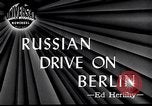
Soviet advance and liberation of Warsaw and Poznan during drive toward Berlin in World War 2
Russian attacks on Warsaw and Poznan in World War II in late 1944 and early 1945. Soviet army using tanks, heavy artillery, machine guns and grenades advance forward. Marshal Zhukov and Marshal Rosokofskey inspecting Russian cossacks advancing on horses. A Soviet soldier is shot by a sniper while running through street intersection. A Russian machine gunner firing a Soviet DP-28 light machine gun shoots at building to take out a sniper's nest. Dead bodies of German snipers in rooms next to windows. Views of ruined city of Poznan. Liberated concentration camp victims, including a woman who has been blinded in one eye. Interior of a room in Poznan Prison loaded with torture equipment, including a guillotine. Piles of bodies of persons mass executed during German retreat. Women crying over bodies in coffins of three Polish men that were found hanging in the liberated prison. German Generalmajor Ernst Mattern and his fellow officers seen after surrendering Fort Winiary Citadel (Poznan Citadel). Soviet soldiers. Liberated civilians in Poznan hit and beat German soldier prisoners of war as they are marched under Soviet guard. Scenes of ruined Warsaw include a sign that reads, 'Adolf Hitler Platz.' A wrecked trolley or street car with signs on it that read, ''Wierzeno' and 'Ein u. Ausstieg nur fur Deutsche' which translates to English as, 'On and off exit points only for Germans' The ruined home of Frederic Chopin in Warsaw. The Polish flag flying again after battle.
CRITICALPAST.COM: About Us | Contact Us | FAQs - How to Order | License Agreement | My Account | My Lightboxes | Shopping Cart | Advanced Search | Featured Collections | Website Terms & Conditions | Privacy Policy ©2026 CriticalPast LLC.
License Agreement |
Terms & Conditions |
Privacy Policy
©2026 CriticalPast LLC.