


 Francais
 Deutsch
 Italiano
Refine Your Search
Yokohama Japan 1945 stock footage and images
- Showing 2401 to 2406 of 7988 results more
more Hide
Hide
Bulldozers, power shovels and trucks at work during the reconstruction of Saipan airfield in the Mariana Islands.
Reconstruction of Saipan airfield in the Mariana Islands by American soldiers. Damaged hangars on Saipan airfield due to bombings by Japan. Men beside bulldozers parked in an area. A bulldozer clearing the airstrip. Men set detonation charges on the ground. The bulldozers at work in the background. The charges going off resulting in explosions. Power shovels, bucket elevators and trucks used to reconstruct the airstrip. Equipment at work on the airstrip. Narrow gauge flatcars are loaded with supplies by a crane. The flatcars moving on a path. The supplies are unloaded. A man beside a flatcar. Men beside equipment clearing the airstrip. Two U.S. soldiers sitting on a track and one of them writes 'B & O Express' on the back of a rail cart. The men shake hands. A man beside a rail cart of drums on a track. Men stand on materials in rail carts and the rail carts move. Several tents in view. (World War II period).
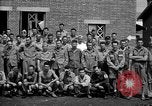
Japanese prisoners of war work under American guards and former American prisoners of war at a camp area in Mukden, Manchuria.
Showing change of prisoners from American to Japanese in Mukden, Manchuria during last days of World War II. Former POW (prisoners of war) Constant J. Wasilewaki, surviving POWs from cattle boat in which 1,623 POWs left the Philippines but only 400 reached Japan. Survivors of Bataan "Death March" includes Lieutenant Colonel Tarpley, Trspnell, Wilson and Lieutenant C.Y. Christis, men of 200th Coast Artillery corps. American prisoners of war Criville A. Johnson, Robert E. Butler worth play bass and guitar that they made while in prison. Cartoon called 'Changie- Changie' drawn by Benny Pinson, depicting change of prisoners from American to Japanese. Prison wall. High tension wire on top. Lieutenant Christie stack Red Cross carton atop pile. Japanese prisoners carry supplies under guard.
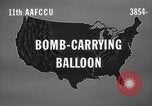
Japanese bomb balloons bound for the United States are shot down; examination of parachute and bomb apparatus
Evaluation of Japanese bomb-carrying balloons sent across the Pacific to the United States by Japan during World War 2. Gun camera footage of American fighter planes from Aleutian Island bases firing at Japanese balloons en route to the Pacific coast of the United States. A balloon bomb which reached the shores of the United States. but did not explode is examined by United States Army soldiers. They unfold the rice paper parachute portion of the balloon and examine its construction. Close-up views of the balloon control mechanism are shown, including a circular frame that would hold anti-personnel and incendiary bombs. Details of the wet cell battery and ballast weights are shown, including barometric aneroid switches which would operate to release ballast from simple hooks, as needed, to control balloon altitude. Narrator indicates it is believed the main purpose of the bombs was to start brush and forest fires.
U.S. Navy's Task Force 58 in the Battle of Okinawa during World War II.
Opening title is: "The Fleet That Came To Stay." Opening scene shows a U.S. warship dimly in darkness, during World War 2. Three American sailors in battle gear, lean over the ship's railing and discuss their destination: "Okinawa.". One sailor walks along the deck, past many more looking over the railing. The men discuss being only 320 miles from Japan, itself. Nose view of a Japanese Kawasaki Ki-61 aircraft with engine running. View of it taking off, followed by a succession of views showing numerous similar Japanese aircraft taking off. A U.S. B-29 bomber taking off and views of B-29s in formation aloft. Bombs dropping from the B-29s and seen from the aircraft as they explode on Japanese targets below.
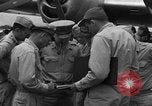
Major General Curtis LeMay holds a conference with his staff after a raid on Kobe in Saipan, Mariana Islands.
Review of air raids in Saipan, Mariana Islands during World War II. United States Army Air Forces Major General Curtis LeMay and General Thomas S. Power discuss the bombing mission on Kobe, Japan with other officers. Colonels Blanchard, Roberts, Warren and Muehleisen read maps and orders.
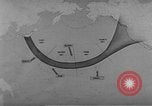
U.S. Navy personnel demonstrates balancing mechanism of fire balloon used to attack North America during World War II.
Diagram shows pattern of air currents that carried Japanese paper balloon fire bombs from Japan to America's West Coast, during World War II. The paper bomb balloon or fire balloon unit consists of the paper gas sac and an automatic balancing and firing control device. United States Navy personnel inspects the balloon as it descends to the ground. He looks at the paper bags filled with sand which provide balance and the central payload,incendiary and bombs. He holds paper material and inspects its strength. The balloon is filled with hydrogen gas. Pressure is exerted by a rubber ring. United States Navy personnel demonstrates the various parts: demolition block,aneroid switches,jacks,blow out plugs,incendiaries and central payload. He demonstrates the balancing mechanism: Balance bags,payloads and incendiaries are suspended by T-hooks switched between the blow out plugs on the balancing ring. A man unhooks the T-hook and releases balance bags.
CRITICALPAST.COM: About Us | Contact Us | FAQs - How to Order | License Agreement | My Account | My Lightboxes | Shopping Cart | Advanced Search | Featured Collections | Website Terms & Conditions | Privacy Policy ©2026 CriticalPast LLC.
License Agreement |
Terms & Conditions |
Privacy Policy
©2026 CriticalPast LLC.