


 Francais
 Deutsch
 Italiano
Refine Your Search
Yokohama Japan 1945 stock footage and images
- Showing 2437 to 2442 of 7988 results more
more Hide
Hide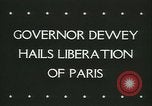
Speaking from the NY State Capitol, Governor Thomas Dewey hails the Liberation of Paris by the Allied forces in World War II.
New York Governor Thomas E. Dewey hails the Liberation of Paris by the Allied forces. The New York State Capitol building (State St. and, Washington Ave, Albany, NY 12224, United States) in Albany, New York. Governor Dewey addresses the nation regarding the Liberation of Paris in World War II. He states that the incident is an inspiration to others still under the Nazi German occupation. He talks about the contribution of Allied forces to the cause, America's war efforts and the goal to defeat Germany and Japan.
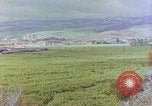
Japanese ships targeted by U.S. Navy cruisers during Operation Road's End; oil fire and ammunition explosion at Pearl Harbor
View of green fields and Hawaii hills. Two U.S. Navy cruisers steaming out at sea. United States cruisers fire on convoy of Japanese ships during Operation Road's End, destroying the naval forces of Japan following the war. Smoke and fire rises from the Japanese cargo ship which is hit. Scene shifts to a huge fire with thick black smoke rising from a dock at Pearl Harbor. A massive ammunition explosion triggered by the fire is seen.
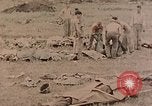
1st Marine Division bury fallen Marines from battle of Peleliu, Palau Islands, in World War II
Burial of dead U.S. Marines, from battle of Peleliu, Palau Islands against Japan in World War 2. (Location is likely, island of Bliliou near Village of Teliu.) The covered bodies of fallen Marines are set out on litters. Later, Marines, wearing arm length black rubber gloves, lower the bodies into graves. A caterpillar tractor with bulldozer attachment smooths earth over the line of grave sites each dug in a row.
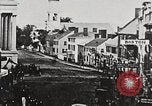
Bell Telephone advertisement chronicles costs for telephone calls reducing from 1915 to 1970.
Bell Telephone television advertisement depicts the cost of telephone calls over years from 1915 to 1970. Pictures of streets and houses in Boston. Portrait of Alexander Graham Bell. The cost of telephone from 20.70 dollars in 1915 reduced to 70 cents in 1970. Rapid paced montage of images (some still and some motion) from 1915 to 1970. Poster reads 'Japan at War'. Man and woman dance. Missile launched from launch pad. Aircraft parked on runway. The cost of long distance telephone charges reduced over the years. Different types of telephones seen in 1970.
Rise of Fascism in Italy and Germany after World War I
Animated map depicts the spread of Fascism in Japan, Germany and its neighboring countries, and Italy. Views of Italian Fascist "Black Shirts" marching bearing flags and rendering the fascist Roman Salute. Fascists participating in the famous "March on Rome" (“Marcia su Roma”) in October 27, 1922. Spectators line the sidewalks and side of the road. Brief (jerky) views of unrest and desperate crowds of citizens in post-war Italy circa 1919 and 1920 following World War I, due to unemployment and hard times. Italian people getting food at an outdoor soup kitchen. Fascists promising better times are seen parading and riding in jammed open cars. Benito Mussolini, who was elected to Parliament in 1921, is seen in a top hat, arms akimbo, standing with other officials. Glimpse of Black Shirts marching in front of the Palazzo Venezia (Via del Plebiscito, 118, 00186 Roma RM, Italy). Back to Mussolini, again, who now makes some remarks to those standing with him and expresses himself with exaggerated body language. Another glimpse of Black Shirts marching. Film transitions to Germany, where Adolf Hitler is seen walking through a dense crowd of supporters and some brownshirts or SA stormtroopers. Hitler's clothes resemble a military uniform. Next, scenes illustrating the terrible post-World War 1 hyperinflation suffered by Germany during the Weimar Republic. Various Deutschmark (Deutsche Mark) banknotes in ridiculous denominations are shown. Baker puts a 460 billion Deutschmark price on bread. People trying to buy groceries during this period. German militaristic marchers. Fascists giving arm salutes as they parade in a city street. General Field Marshal Paul von Hindenburg (President of Germany) is seen standing in front of Germany's top military leaders. Directly behind him is Marshal August von Mackensen, in a fur busby hat with Totenkopf (death head) insignia. Other Generals wear pickelhaube spiked helmets. Hindenburg's closest associate, General Erich Ludendorff stands just behind and to the left of Hindenburg. Glimpse of German soldiers in more modern uniforms. Next, Hindenburg is seen reviewing troops in the company of their commander. Next, Hitler is seen with a group of German civilian industrialists whose interests he promises to support. Alfred Krupp Jr. sits, with his legs crossed, next to Hitler. Glimpse of Hitler, in uniform, waving from a window. People running as a cadre of mounted police canter in formation down the street.
Japanese bombardment of Shanghai in 1932
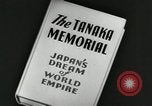
Opening scene shows a book entitled, "The Tanaka Memorial, Japan's dream of world empire." Next, a hand checks off "Conquest of Manchuria" as Phase 1 of the plan being completed. Next is Phase II, the conquest of China. Animated map shows Japanese warships bombarding the city of Shanghai in 1932. Scenes of Japanese naval guns firing. A shell striking at the waterfront. Japanese Naval officer observing with binoculars from deck of ship close to the city. Shells or aerial bombs exploding and smoke rising in the city itself. Residents of the city running in panic seeking shelter from the bombardment. Japanese Type 13-1 carrier-borne attack biplane aircraft (B1M1) from the aircraft carriers Kaga and Hosho are seen in flight overhead. Bombs exploding in the heart of Shanghai. Local people jamming a bridge with vehicles and rickshaws evacuating the city. More views of Naval guns firing and bombers overhead. A large building in flames. People fleeing near the port. Two Japanese Navy Type 90 Carrier-based bi-wing aircraft (Nakajima A2N) maneuver above fleeing Chinese who look up at them. Next bomb explosions fill the screen. More naval guns firing and explosions on street in which victims lie where they fell. Dead civilians in the streets. A Chinese woman mourning in the midst of rubble. Bombs falling and explosions. A sign reading "Shanghai South." Two Mitsubishi B2M aircraft fly overhead. Scenes of dead and wounded Chinese victims, including and children. Japanese aircraft flying low over burning buildings, with smoke rising above its flight altitude. Japanese marines charge a Shanghai beach in an amphibious assault and enter the city. Several hit the ground in a defensive posture. Gunfire directed at a building window. Combat along the waterfront. Republic of China flag flying from a large building. Japanese forces firing at that building with field artillery. Truckloads of Japanese marines deploying in the city. A marine searching a Chinese man. Animated map shows Japanese shifting their offensive to the North in 1933 and annexing the province of Jehol as part of Manchuria. Japanese cavalry advancing along a road. Closeup of the Chinese national flag fluttering. Generalissimo Chiang Kai-Shek leading a contingent of Chinese military and officials. A large group of Chinese men volunteering to join in defense. Chinese soldiers marching en masse along the Great Wall of China.
CRITICALPAST.COM: About Us | Contact Us | FAQs - How to Order | License Agreement | My Account | My Lightboxes | Shopping Cart | Advanced Search | Featured Collections | Website Terms & Conditions | Privacy Policy ©2026 CriticalPast LLC.
License Agreement |
Terms & Conditions |
Privacy Policy
©2026 CriticalPast LLC.