


 Francais
 Deutsch
 Italiano
Refine Your Search
Yokohama Japan 1945 stock footage and images
- Showing 2473 to 2478 of 7988 results more
more Hide
Hide
Lord Louis Mountbatten arrives at Electra House, London to inaugurate a telecommunication service.
Lord Louis Mountbatten inaugurates telecommunication service between Malta and England from Electra House, London. Car of Lord Mountbatten arrives. People stand besides road with umbrellas.Mountbatten takes off his over coat, his wife stands besides him. They pose for photographers with chairman of London Telecommunication services. Lord Louis rolls picture to machine and presses a button. Governor of Malta gets the message of goodwill signed by Lord Mountbatten. Men work at Telecommunication office. Chairman, lady and Lord Mountbatten address workers of Electra house. Chairman speaks. Lord Louis comes and speaks. He thanks and appraises workers of telecom unit. He speaks about the telegram he got from the Commander of Forces in Japan. People present in the hall laugh at the humorous incident.
Japanese representatives at the UN Assembly, UN and UNESCO in United States and Paris.
Japanese diplomats in the United States. Car and bus traffic of 1950s cars on street in Washington Dc with the United States Capitol building in the background. Elected Japanese representatives climb up stairs of the U.S. assembly. The U.S. Vice President Allen W Barkley and Secretary David Rice Atchison receives Japanese representatives and shake hands with them. They pose. Building of the United Nations (The temporary United Nations Headquarters building in Lake Success, Long Island, New York, in the Sperry Gyroscope Corp building.) Japanese representatives go in the building. Warren Austin, a U.S. delegate stands and shakes hands with the representatives. They sit in hall, wear headphones and listen to the translated discussions. Scene changes to Paris, with car traffic on street and Arc de Triomphe in background. Building of the UNESCO (United Nations Educational Scientific and Cultural Organization). Japanese representatives get in the building. Meeting in session. Representatives of Japan, Laos, Vietnam and Cambodia. Japanese representative addresses and shakes hands with the UNESCO president and other members.
Primer Mr Shigeru Yoshida addresses and signs peace treaty with representatives of other countries in San Francisco, CA
San Francisco Peace Treaty conference with Japan, in San Francisco, California. Beginning shows the War Memorial Opera House and Van Ness Avenue. U.S. President Harry S Truman steps to a podium, at the Opera House, to address delegates at the conference. With him on the stage are Dr. Warren Kelchner, Temporary Chairperson of the Japanese Peace Treaty Conference, Governor Earl Warren of California, and Secretary of State Dean Acheson. Next, Dean Acheson is seen seated at the center of a table with Dr. Kelchner, at his right, as Soviet representative Andrei A. Gromyko steps to the microphone and speaks. (Narrator says he raises complaint about rules of procedure.) Dean Acheson removes his translating headset in frustration. Next, a representative of Poland comes to the microphone, and calls for delays. View of delegates in the audience. New Zealand representative, Sir Carl August Berendsen, takes the stand to renounce delaying tactics. Audience members applaud. Carlos P. Rómulo, of the Philippines, speaks in support of the treaty. John foster Dulles, of the United States, steps to the podium to speak for the treaty. Next, Japanese Premier, Shigeru Yoshida, referring to notes in a roll of paper, endorses the treaty. Audience applauds. Secretary of State Acheson is seen signing the treaty for the United States, followed by representatives of: Australia; Cambodia; Great Britain; Ceylon; France; Indonesia; Philippines; and Pakistan. Next, the Japanese delegation comes forward, and Prime Minster Shingera Yoshida, signs the historic document. Closeups of ordinary Japanese from all walks of life. Japanese people commuting to work.
New Japanese ambassador to Kingdom of Italy, presents credentials at Quirinal Palace in Rome, Italy (WW2)
Zenbei Horikiri, the new Ambassador of Japan to the Kingdom of Italy, presents his credentials to King Victor Emmanuel III in Rome, Italy during World War II. Hokiri stands with an Italian officer during the ceremony at the Quirinal Palace. To his right, behind him, similarly dressed, is Shun'ichi Kase,secretary to Japanese Foreign Minister Yōsuke Matsuoka. (Shun'ichi later served as chargé d’affaires in Italy commencing in 1943.) Japanese and Italian officers are part of the two-nation entourage that emerges from the palace following the event. They proceed down the steps of the Quirinal Palace (Palazzo del Quirinale, Piazza del Quirinale, 00187 Roma RM, Italy) and across the Piazza del Quirinale, where camera shows a glimpse of one of the statues at the Obelisk and Fountain of Castor and Pollux (containing sculptures of Castor and Pollux as horse tamers). Next, a motorcade of the officials' cars drives out of the palace complex, past two guard posts.
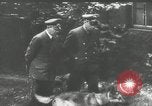
Japanese General Oshima Hiroshi visits the Wolf's lair during World War II. High ranking German officers congregate at the Wolf's Lair
Adolf Hitler and German Foreign Minister Joachim von Ribbentrop walk side by side, at the Wolf's Lair, Hitler's headquarters in the woods of Gierloz, Rastenburg, East Prussia (Poland) during World War 2. Hitler pets a dog as they walk. General Franz Halder walks with General William Keitel. Next, Von Ribbentrop and Keitel are both seen escorting General Oshima Hiroshi, envoy from Japan, and an aide. Behind them is Walter Hewel of the Foreign Ministry, and Admiral Hans-Georg von Friedeburg, in a white jacket. The group enters a Wolf's Lair building. (Ōshima met with Hitler on October 3, 1942 at the Wolf's Lair.) Scene shifts to outdoors, where high ranking German officers enjoy themselves, with introductions and salutes, and converse, and joke with one another. Next, Hermann Goering is seen walking with Walter Hewel. Scene changes showing Goering, with several other German officials, in wooded area with flowering trees in background. Camera zooms in showing Admiral Theodor Burchardi, who renders a traditional military salute to Goering. German officers huddle, with Goering looking on, over a map. Goering and Admiral Karl Dönitz are the seen conversing as they walk. The next scene is a view from inside a Wolf's Lair building , as Hermann Goering leads a large group of German officers. He steps up the entrance to the building. Change of scene shows Adolf Hitler saying goodbyes and shaking hands with the visiting officers.
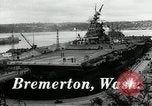
The aircraft carrier USS Bunker Hill being repaired at the Puget Sound Naval Shipyard, Bremerton, Washington, during World War II
View of the aircraft carrier, USS Bunker Hill in dry dock at Bremerton, Washington. She is being repaired after being attacked by Japanese Kamikazes during the invasion of Okinawa in World War 2, in which suffered more than 600 casualties including 346 dead and 43 missing. View of the ship's captain, George Seitz, looking over the damage to the ship. Camera shows severe damage below decks of the Bunker Hill and outside, where the flight deck is seen completely destroyed and collapsed into the ship's interior. View of a large scoreboard displaying a Japanese flag for every enemy plane downed by crew of the Bunker Hill. A sailor totals them and writes "475" on the board. Crew members are massed on shore and wave enthusiastically about returning to sea and rejoining the battle against Japan. (Note: The USS Bunker Hill repairs were not completed until after the war ended.)
CRITICALPAST.COM: About Us | Contact Us | FAQs - How to Order | License Agreement | My Account | My Lightboxes | Shopping Cart | Advanced Search | Featured Collections | Website Terms & Conditions | Privacy Policy ©2026 CriticalPast LLC.
License Agreement |
Terms & Conditions |
Privacy Policy
©2026 CriticalPast LLC.