


 Francais
 Deutsch
 Italiano
Refine Your Search
Yokohama Japan 1945 stock footage and images
- Showing 253 to 258 of 7988 results more
more Hide
Hide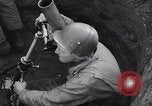
United States 81 mm mortar crews fire shells at enemy targets in Germany during World War II
American soldiers in fortified position firing 81mm mortar in support of U.S. infantry in Germany during final months of World War 2, in Europe. Early in February,1945, U.S. soldiers of Company M, 3rd Battalion, 313th Regiment, 79th Division, are seen supplementing their ammunition with captured German 80mm mortar shells. Closeup of the U.S. 81mm mortar shell next to a German 80mm shell. M Company soldiers firing the German shells from their 81mm mortars at German targets across the Mulde River. They are operating amongst homes in a residential area. Explosions in distance from the mortar shells.
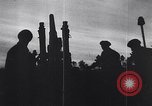
British and Canadian Infantry of 1st Canadian Army capture Kleve (Cleve) Germany during World War 2
Artillery batteries of British and Canadian forces, under command of Field Marshal Montgomery, bombard German positions on the German-Dutch border.British artillery firing BL 4.5 inch Medium Guns and 155mm heavy guns, in an 11 hour bombardment of German positions east of Nijmegen, Netherlands. Snow covers the ground. A British Land Mattress rocket launcher firing a salvo of 3-inch rockets. I Infantry of 1st Canadian Army, under command of General H.T.G Crerar, march toward an area between the Mars and Rhine rivers. They move through forest of the Reichswald, where they encounter Siegfried Line obstacles. British and Canadian tanks using heavy chain mine flails are seen beating their way through mine fields. Infantry in single file silhouetted against a light sky. Canadian Sherman tanks advancing with infantry. One is labeled "Spitfire II." Churchill tanks and heavy vehicles advance, including Churchill AVRE fascine mat-laying vehicles and Churchill ARKs (Armoured Ramp Carriers). Sherman tanks pass, including one named "Diana." British Armor pushing through rain-soaked and partly flooded towns towing BL 4.5 guns. They reach Kleve (formerly spelled Cleve) on February 11, 1945. Roadside sign reads: "Reichs-Grenze"(Border of Germany). Sherman tank of the 6th Guards Tank Brigade firing point blank on city street in Kleve. British troops taking cover behind tank destroyer moving slowly along street. Large number of German prisoners of war being marched to an assembly area. British infantry continuing their advance toward Goch, Germany.
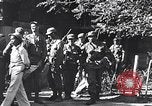
U.S. Rangers and Filipino guerrillas rescue Allied prisoners from Japanese prison camp in Philippines during World War II.
On January 30, 1945, 121 members of the 6th Ranger Battalion and 286 Filipino guerrillas are seen setting out on a 30 mile trek behind Japanese lines, to free Allied prisoners of war (POWs) and civilians from a Japanese camp near Cabanatuan City, in the Philippines, during World War 2. They stretch out in a long, informal column as they traverse low flat lands and ford a wide shallow river. The men carry weapons and supplies (some on their heads) as they move along, almost like a Safari. Scene shifts to rescued prisoner, Major Emil P. Reed, U.s. Army Medical Corps,26th Cavalry. He was the senior officer among prisoners at the Cabanatuan prison camp number 1. He recounts being told by the Japanese Commandant that commencing January 7th, they were free at their own risk, but also assured them they would not be molested by the Japanese if they stayed within their regular camp area. Sergeant Samuel E. Goldy, Signal Corps, also speaks a few words about that period when Japanese were departing. Next the camera records the Rangers and Filipino guerillas returning with the approximately 500 freed POWs. Some Filipino women and children watch them return. At one point, the cadre climb aboard army trucks and continue their journey in a convoy. The POWs climb down from their trucks at the 92nd Evacuation Hospital, in Guimba, Luzon. Some take pleasure is simply lying down on the grass at the site. Many gather around hospital staff handing out packages of treats, including cigarettes, candy and the like. A couple of them express pleasure as they smoke cigarettes. Two frail and injured are seen hobbling with canes. Some appear seriously malnourished. A group are seen trying on new clothes. A British prisoner, Sergeant Robert Bell, Manchester Regiment, British Army, speaks of his experience. He was taken prisoner in Singapore and sent to Thailand where he worked to build a railway for the Japanese. Many prisoners died there from disease and malnutrition. He was one of a small number who survived after being on a Japanese ship with other prisoners when it was sunk by American dive bombers. Sergeant Walter Ring, of San Roque, Luzon, is seated, relaxed on a chair, as he recounts his experiences. Two young Filipino boys sit on the grass at his feet. He reaches to one, whom he says is his son Louis and to the other, his son Sam. His captivity began on Bataan in 1942. Finally, after rest and rehabilitation, the former POWs are seen heading away from the battle fronts to be transported back to the U.S.A.
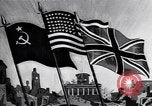
President Harry S. Truman of United States travels to Berlin, for Peace Conference, after World War II in Europe
A film titled 'Berlin conference 1945' shows United States President Harry S. Truman and Secretary of State James F. Byrnes aboard the Cruiser USS Augusta (CA-31) while on their way to Germany for Three-Power Berlin Peace Conference. Several views of President Truman aboard the USS Augusta. He salutes with hand over heart as U.S. Navy warships pass in review. Truman and Secretary of State, Byrnes, descend a stair on the ship. They are seated on deck and President Truman waves his hat at people on the shore, as the Augusta enters port at Antwerp, Belgium. Senior Allied officers come aboard to greet the President and his party. President Truman walks down the gangplank to the pier, followed by Secretary Byrnes. Truman and Byrnes in back seat of an open car, accompanied by Secret Service agents, waves to spectators as they drive off the pier. Later, a motorcade is seen passing parked airplanes. Truman greets Officers of the U.S. Army 35th Division. He boards Air Force One, the "Sacred Cow," a VC-54C aircraft (tail number: 2107451) at Brussels Airport, Belgium. The Air Force One seen in flight above clouds and then parking at airfield in Germany. Presidential motorcade in Berlin, on Unter Den Linden, and passing through the Brandenburg Gate. Portraits of Truman, Stalin, and Churchill, on stone pillars. Inserted scenes of Hitler in motorcade and speaking in Berlin. President Truman speaking in an outdoor venue, with General Omar Bradley and other high ranking American officers standing behind him. His remarks are broadcast and people shown listening in America
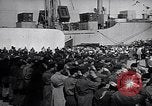
Soldiers of United States 591st Engineering Corp return home from the European theater of war in World War 2
A newsreel titled '2,000,000th G. I, head for home' shows soldiers of United States Army 591st Engineering Corp head for home after 22 months from European theater of war. Charles Hudgins being presented a plaque by an officer as other soldiers look on, as Hudgins is the 2,000,000th soldier to return. American soldiers say goodbye to dear ones before embarking a ship at a European port. Second half of clip shifts subject matter, showing exterior views of the landscape and grounds of the Culzean Castle in Ayrshire, Scotland, then owned by the Kennedy family, who donated it in 1945 to the National Trust for Scotland, with the stipulation that the top floor apartment of the Castle would be offered to General Eisenhower for his use for the rest of his life (it was later nicknamed the "Scottish White House" by then President Eisenhower). Views of the castle grounds, walls, gates, defense cannons.
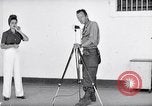
Interview with liberated female internee Georgette Kramer from the Los Banos camp in Manila, World War 2
Interview in Manila with freed female internee Georgette Kramer from the Japanese operated Los Baños internment camp (liberated 13 days before the interview). A microphone is set on a tripod stand for the interview. Ms. Kramer relates how she was wounded by a stray Japanese bullet during the February 23, 1945 liberation operation. During the firefight with Allied forces a bullet went through her mother's arm, through Ms. Kramer's abdominal wall, and into her friend's hand. Wounded, they were rushed to a tank. She says one other internee was also shot through the hip. When asked what she wants to do now that she is free she says she is not sure. A young girl, Ms. Kramer's sister, Aoife Kramer, runs up to the camera and says she wants to say something too. The interviewer lifts up the child in his arms. The girl says she wants to go to the United States. (World War II period).
CRITICALPAST.COM: About Us | Contact Us | FAQs - How to Order | License Agreement | My Account | My Lightboxes | Shopping Cart | Advanced Search | Featured Collections | Website Terms & Conditions | Privacy Policy ©2026 CriticalPast LLC.
License Agreement |
Terms & Conditions |
Privacy Policy
©2026 CriticalPast LLC.