


 Francais
 Deutsch
 Italiano
Refine Your Search
Yokohama Japan 1945 stock footage and images
- Showing 3031 to 3036 of 7988 results more
more Hide
Hide
U.S. Marines clearing pockets of Japanese resistance along a ridge in final days of the battle for Iwo Jima in world War II
U.S. marines ot the 9th Marine Regiment, operating from the 4th Marine Division's zone of action, during later phase of the battle for Iwo Jima in World War 2. (Their mission is to sweep the last hostile troops from the ridge in the southeast corner of the 3rd Marine Division's zone of operation.) They move cautiously along extremely rough terrain on the ridge, to flush out any remaining pockets of Japanese resistance. A marine carefully scouts an area of large boulders and potential Japanese hiding places. Another marine is seen silhouetted atop the ridgeline. A marine hurries down from the ridge after placing a demolition charge. He hunkers down with several other marines sheltered just below the ridge as the demolition charge explodes raising brown smoke followed by white smoke. The marines then stand and cautiously approach the ridge.
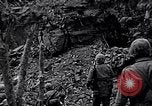
U.S. Marines seek out remaining Japanese defenders in final days of battle for Iwo Jima in World War II
Several U.S. marines approach possible Japanese defensive position at a cave during final days of the battle for Iwo Jima in World War 2. Debris on the ground, including a tin can and Japanese rocket (or mortar shell) with fins. Japanese war supplies outside a destroyed fortification. A marine cautiously approaches the entrance of a Japanese cave fortification, and then walks away. Several marines below a ridgeline. One throws wire, from a spool, upward to the top of the ridge, to connect a demolition charge. Later the charge ignites with a huge explosion, destroying part of the ridge.
Rabbi Chaplain Leon Rosenberg conducts services for Jewish Marines on Iwo Jima in World War II
Rabbi, Lieutenant Leon Rosenberg of the Chaplain Corps, conducts services on March 11 (D-day + 20) for Jewish Marines of the 4th Marine Division, on Iwo Jima, during World War 2. He stands in front of a makeshift altar containing a pair of candles and a cloth displaying the Star of David. He reads aloud from a small book. Marines are seated on the ground in a group. A truck in background drives away as a Marine photographer in background takes a picture of the seated marines. While Chaplain Rosenberg is reading, a jeep and another vehicle drive past in background. After break in sequence, the seated marines are seen with individual prayer books containing Hebrew script. They refer to the books during the service. In final sequence, the Chaplain continues to lead the service, with the marines now standing. (Note: Chaplain L. W. Rosenberg was the first Jewish chaplain to see actual combat with the Marines.. He went overseas with the Fourth Marine Division and was the, only Jewish chaplain to receive the Purple Heart, having been wounded on Tinian, 25 July 1944. Chaplain Rosenberg was in more Marine amphibious landings than any other chaplain. Among these were,assaults on Saipan, Tinian, and Iwo Jima.
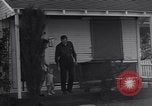
A family poses in a garden of the house and the man pushes furniture in veranda in United States.
A family in United States. A man stands in the garden of a house. A woman stands with a child in the garden. Man and woman pose with the child. Man pushes furniture in veranda of the house.
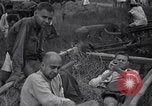
American Prisoners rescued from Japanese prison camp near Cabantuan City, during World War II, arrive at 92nd Evacuation Hospital
American prisoners rescued from the Japanese prison camp near Cabantuan City, Philippines, near the end of World War 2, are seen arriving at the 92nd Evacuation Hospital, in Guimba, Luzon. Opening scene shows some less able to walk, in a straw lined bamboo cart. Behind them Filipino youths are seen. Some former prisoners, who are stronger, walk amongst their rescuers and local Filipinos. (The rescue was accomplished by 121 members of the 6th Ranger Battalion and 286 Filipino guerrillas and Scouts.) Sequence contains many scenes of freed prisoners posing for the camera, smoking cigarettes, resting on the grass, and siting on log benches. One is carried from the porch of a building, on a stretcher. Several relax on rustic chairs. Closeups of some, including Colonel James Duckworth with his arm in a sling. One hobbles with help of a makeshift cane. Freed prisoners open packages containing cigarettes and treats. A full Colonel, in perfect uniform, and steel helmet (possibly commander of 75th Ranger Regiment) speaks with one of the 6th Battalion members. Freed prisoners relaxing and smoking cigarettes. Lieutenant Colonel Henry Mucci (with moustache) who accompanied the mission, conversing with Battalion members.
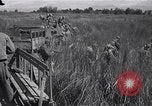
U.S. Army Rangers, Alamo Scouts, and Filipino Guerrillas rescue Allied POWs from Japanese Cabanatuan World War II prison camp
Scenes from the successful World War 2 Mission that rescued more than 500 Allied prisoners of war from the Japanese prison camp near Cabanatuan, Luzon, the Philippines. U.S. soldiers of the 6th Ranger Battalion are seen as they leave their transport trucks, check their weapons and commence their 30 mile trek to the camp. They start down a dusty trail. In view from a hill, above, they are seen fording some streams,. One Ranger looks up and waves his hat at the camera, but all the others keep moving without distraction. The scene shifts to the next day, after the successful rescue of the prisoners. Alamo Scouts, Filipino Guerrillas, and U.S. Rangers mingle with rescued prisoners. Some of the rescued sit in carabao carts provided by local villagers. Former prisoners are interviewed by Rangers, who make notes of their accounts. Several Army ambulances are parked at the site. Some Filipino women and children are seen, around the edge of the gathering. A Ranger helps one former POW to a carabao cart. During all this post-mission activity, beginning at TC: 02:28, the mission commander, Colonel Henry Andrews Mucci, is seen debriefing others around him, and referring to a map and gesturing with a pen, as he does so. He has a growth of beard and mustache, and wears a "booney" hat. View of rescued prisoners resting near a large haystack. A medic seen in midst of others, some of whom sit in carabao carts.
CRITICALPAST.COM: About Us | Contact Us | FAQs - How to Order | License Agreement | My Account | My Lightboxes | Shopping Cart | Advanced Search | Featured Collections | Website Terms & Conditions | Privacy Policy ©2026 CriticalPast LLC.
License Agreement |
Terms & Conditions |
Privacy Policy
©2026 CriticalPast LLC.