


 Francais
 Deutsch
 Italiano
Refine Your Search
Yokohama Japan 1945 stock footage and images
- Showing 337 to 342 of 7988 results more
more Hide
Hide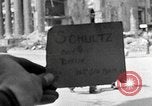
World War II Damage to French Cathedral in Gendarmenmarkt, Berlin, Germany
German civilians seen walking, from time to time, in Gendarmenmarkt, Berlin, during summer of 1945, after end of World War 2, in Europe. Behind them is the bombed out remains of the Französischer Dom (French Cathedral). The walls have collapsed in places and Statuary in niches have been severely damaged, including one seen headless. Camera pans up the side of the cathedral, to the base of the dome, and then to an iron fence with a makeshift sign (in beautiful script) reading "Französischer Dom." A man walks past the camera, wearing a back pack. Camera shows fallen brick and other rubble at steps, below the iron fence and sign. Glimpse of American military cameraman holding makeshift slate, with Camera equipment behind him.
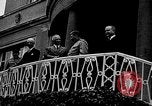
Allied National Leaders hold numerous conferences to plan and coordinate their efforts during World War II
First scene shows President Harry Truman shaking hands with Joseph Stalin on a porch of the Cecilienhof ( home of Crown Prince Wilhelm) in Potsdam, Germany. The two leaders are accompanied by their respective foreign ministers, James F. Byrnes, U.S. Secretary of State, and Soviet Minister of Foreign Affairs, Vyacheslav Molotov. Stalin descends steps from the building followed by Truman. View of the back lawn at Cecilienhof. View of its front entrance. Various views of the house and grounds. American, Soviet, and British flags flying from the building. Cars carrying the leaders on road to the Cecilienhof. President Truman and James Byrnes entering outside gate, followed by other attendees. Then Stalin is seen entering followed by Soviet officers and officials. U.S. General Dwight D. Eisenhower, Supreme Commander Allied Expeditionary Force (SCAEF) in Europea and U.S. Army Chief of Staff. George Marshall are seen walking together in a wooded glade on the meeting grounds. British Field Marshal Bernard Law Montgomery, entering the grounds for the meeting. British Prime Minister Winston Churchill, President Harry Truman, and Joseph Stalin stand on a step before an entrance to Cecilienhof. Truman places their hands together in a mutual handshake, at which Churchill and Stalin laugh. Views of the Kremlin and St. Basil's Cathedral, in Red Square, Moscow, Russia where foreign minsters of the United States, Britain, and the Soviet Union are seen meeting meeting in conference at the Spiridonovka Palace in October, 1943. Closeup of Soviet Prime Minister Vyacheslav Molotov, British Prime Minister, Anthony Eden, and U.S. Secretary of State, Warren Hull, successively signing a document. Scene shifts, to a C-47 transport aircraft flying over great pyramid of Giza in Cairo, Egypt. Next, the front of the Soviet Embassy in Teheran, Iran, is shown. The "Big Three" (Stalin, Roosevelt, and Churchill) sit on the porch of the building. Military officers from their countries stand behind them. Narrator (Franklin D. Roosevelt) says they agreed to launch a gigantic attack on Germany. Scene shifts to Germany, where German military is paraded on public display, showing artillery, Panzer I tanks carried aboard army trucks, Heinkel He 111 bombers in formation overhead, and marching troops giving Nazi salute silhouetted against bright pavement. View shifts to the Livadia Palace, in Yalta, Crimea, Russia. Brief view of the "Big Three" and their staffs sitting around a conference table. Change of location to San Francisco, California, where flags of many nations are displayed along with a United Nations Logo. Representatives of the many nations sign the Charter of the United Nations, founding the U.N. organization on 26 June 1945. Film shifts to Germany where victorious American, British and Soviet troops shake hands and celebrate victory. They share drinks and toast victory.
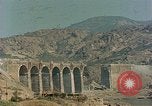
Aftermath of World War II. A wrecked bridge and abandoned United States Army gliders in France.
Reminders of World War 2, in France, 1945. A high bridge of about eight masonry arches with two bombed out, in mountainous region of France. Camera pans right, showing a number of substantial homes scattered across the valley, with tall mountains behind. Scene shifts to a different, flatter landscape, where about a dozen U.S. Waco CG-4A gliders are seen abandoned in a field, in various states of disrepair. Writing in chalk on the side of one glider reads, "Whispering Yoddles, Fort Worth Texas, Little One Alice". There are no D-day stripes on these gliders, indicating they were probably used subsequent to the Normandy invasion, in other operations such as "Bluebird & Dove" in the South of France, in August, 1944.
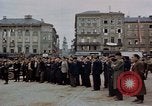
German forces depart Linz, Austria, at the end of World War II
Opening scene shows local citizens as they stand in the main square (Hauptplatz) of Linz, Austria, watching surrendered German troops depart at the end of world War 2. The troops climb over barriers at the base of the Trinity Column (Dreifaltigkeitssäule) and march in loose formation out of the city. A group of American troops watch from atop an M10 tank destroyer. View through a building archway as the German soldiers march past. The long column continues along a road looking down on the Danube River. Another view shows two U.S. soldiers with slinged rifles strolling at the head of the column. The departing German soldiers are all disarmed and carry their personal kit and gear. A group of German officers pass the camera, and one takes particular notice of the filming. A Sherman tank passes going in the opposite direction. A civilian man, carrying a brief case walks past the departing troops. (Note: Today, the Trinity Column looks different than in this film. In 1943 all removable statues and parts were taken from the column and safely stored in central cellars on Kapuzinerstrasse. They were recovered in 1945 and restored to the column, along with other changes, that were completed in December, 1947.)
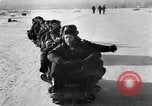
U.S. Army Air Forces operations at Juvincourt Airfield, France, during World War II.
Operations of the U.S. Army Air Forces 394th Fighter Squadron, 367th Fighter Group, at Juvincourt Airfield (Advanced Landing Ground A-68) in France, during Winter of 1944, World War 2. The entire field is covered in snow. Pilots ride to their P-38 aircraft on a train of sleds, pulled by a Carl Eliason Motor Toboggan (Made by Four Wheel Drive Auto Company of Clintonville, Wisconsin). Pilots playfully brush some snow toward the camera as they pass. They stop to let a pilot off at his P-38 (reportedly the pilot is Jack Hallett). Next, P-38 aircraft are seen taxiing for takeoff over the snow, and then, flying very low over the field. The sound of gunfire is heard in the background. An abandoned (crash-landed) RAF Avro Lancaster bomber is seen collapsed on its left wing and elevator, in the snow. (It has been suggested that this might be Lancaster serial no ME850 LS-D of XV squadron RAF that crash landed on January 1st, 1945 or Lancaster VN-G of 50 SQN that crashed there on the same day.)
3rd Armored Division soldiers examine damaged tanks in Sterpigny, Belgium during World War II.
U.S. Army 3rd Armored Division advance in Belgium during World War 2. U.S. Army Captain examines a snow-covered disabled M4 Sherman tank, with shell holes in it, in Sterpigny, Belgium. Damaged buildings all around. American soldiers look at a damaged German Panther tank. View of jeep approaching on road. Shattered trees along the roadside. (Note:This footage was shot in the town of Sterpigny, Belgium just after 16 January 1945. The 2nd Battalion, U.S. 330th Infantry Regiment was attached to the 3rd Armored Division and fought alongside tank units of the 3rd Armored Division against elements of the 9th SS Panzer Division to capture the town on 16 January.)
CRITICALPAST.COM: About Us | Contact Us | FAQs - How to Order | License Agreement | My Account | My Lightboxes | Shopping Cart | Advanced Search | Featured Collections | Website Terms & Conditions | Privacy Policy ©2026 CriticalPast LLC.
License Agreement |
Terms & Conditions |
Privacy Policy
©2026 CriticalPast LLC.