


 Francais
 Deutsch
 Italiano
Refine Your Search
Yokohama Japan 1945 stock footage and images
- Showing 433 to 438 of 7988 results more
more Hide
Hide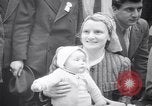
Displaced Persons, refugees, and former prisoners of Nazi concentration camps arrive by ship in New York City
Views of men, women, and children aboard the steamship "SS "Marine Flasher" docked at a pier in New York harbor after a voyage from Bremen, Germany. Her passengers include many refugees and former prisoners of Nazi concentration camps. Many benefited from U.S. Presidential Directive No. 29, issued on December 22, 1945, giving preference to Displaced Persons in obtaining visas. A woman with her child smiles. A boy waves at friends and relatives on shore. A young brother and sister in the ship. An older and younger woman, likely mother and daughter, show the prisoner number tattooed by Nazis on their arms. The tattoos are sequentially numbered, A-26587 and A-26588. Reuniting people hold each other with warmth and weep. A family of 7 children spanning a range of ages, with no parents evident. (Note: this is the Weber family ranging in age from 4-18. In order of age from oldest to youngest they are Alfons, Senta, Ruth, Gertrude, Renee, Judith, and Virginia (Ginger) nee Bela. The family settled in Chicago. All married and had 24 children and now numerous grandchildren. The children and grandchildren live in across the U.S. in Chicago, Maryland, Texas, Alabama, California, Virginia, Minnesota and in London, England. This Information provided in 2014, by Lynn Chapman daughter of Gertrude.) (World War II period).
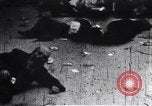
Atrocities committed by Nazis against Jews in Germany, submitted as evidence "Exhibit USA-280" during the Nuremberg Trials
Portions of a damaged film. Excerpted from original shown during the Nuremburg trials and submitted as "Exhibit USA 280." Nuremberg trial transcripts of 13 December, 1945 include the following excerpted descriptions of the footage spoken by U.S. Commander William J. Donovan: "This is a strip of motion pictures taken, we believe, by a member of the S.S., and captured by the United States military forces in an S.S. barracks near Augsburg, Germany...We have not been able to establish beyond doubt in which area these films were made...The film offers undeniable evidence, made by Germans themselves, of almost incredible brutality to Jewish people in the custody of the Nazis, including German military units. It is believed by the prosecution that the scene is the extermination of a ghetto by Gestapo agents, assisted by military units...This film was made on an eight millimetre home camera...The pictures obviously were taken by an amateur photographer...it is burned...This is a silent film....I wish to...direct the Tribunal's attention to certain of the scenes. Scene 2: A naked girl running across the courtyard. Scene 3: An older woman being pushed past the camera, and a man in S.S. uniform standing at the right of the scene. Scene 5: A man with a skull-cap and a woman are manhandled. Scene 14: A half naked woman runs out of the crowd. Scene 15: Another half-naked woman runs through the house. Scene 16: Two men drag an old man out. Scene 18: A man in German military uniform, with his back to the camera, watches. Scene 24: A general shot of the street, showing fallen bodies and naked women running. Scene 32: A shot of the street, showing five fallen bodies. Scene 37: A man with a bleeding head is hit again. Scene 39: A soldier in German military uniform, with a rifle, stands by as a crowd concentrates on a man coming out of the house. Scene 44: A soldier with a rifle, in German military uniform, walks past a woman clinging to a torn blouse. Scene 45: A woman is dragged by her hair across the street.
Judge Louis E. Goodman dismisses Justice Department's civil action to denaturalize ILWU President, Harry Bridgers.
Opening scene shows dimly lit hallway of Federal District Court building in San Francisco. Camera focuses on a courtroom door inscribed as " U.S. District Court, 258, Louis E. Goodman." Officials are seen escorting International Longshoreman's Union (ILWU) President, Harry Bridgers, along a hallway, accompanied by many photographers. Bridger's lawyer, Carol Weiss King and her co-counsel, wearing dark rimmed glasses, are seen standing in the hallway. Closeup of them. He holds up a copy of legal papers. View from further down the hall as Bridgers stops briefly to converse with them. Another closeup of Bridger's lawyers. (Note: Harry Bridgers was prosecuted for his labor organizing and supposed subversive status by the Justice Department in the 1930s, 1940s, and 1950s, with the goal of deportation. This was never achieved. Bridges became a naturalized citizen in 1945. A final effort by the Justice Dept. to deport Bridges ended in 1955 when Judge Louis E. Goodman dismissed the department's civil action to denaturalize him)
United States and Russian troops in Germany after World war 2; division of West Germany and East Germany
Bomb damaged and ruined buildings of Nazi Germany in 1945, including the Reichstag. Nazi Eagle symbol of Third Reich pulled down from building and crashes to the ground at end of World War 2. United States Army of occupation marches into city as German population lines sidewalks and watches them parade. Sign on a shop reads "Gaststatte Schosser." Many buildings in view are damaged or destroyed from bomb attacks during World War 2. American soldiers occupying German give candy to German children who at first hide from them. Nazi leaders including Hermann Göring, Rudolf Hess, Joachim von Ribbentrop, and Wilhelm Keitel, seen on trial in the Nuremberg war crimes trials. German people struggling to rebuild. women and children trying to gather wood from stumps of trees for fuel. A woman sawing a log. Women and children scraping food from inside trash cans and refuse bins, to stay alive during scarcity and shortages after the war. Americans providing food assistance and feeding German children in relief lines. Close up of a smiling boy as he receives food or drink. Soviet Russian Army soldiers occupying East Berlin and marching in formation. Russians removing an industrial lathe and other machinery and tools from Germany as the Soviet Union continues to strip Germany of resources after the war. A map of Germany and Berlin seen with divided regions as American, British, French and Soviet zones. Views of empty streets and heavily damaged buildings of Berlin after the end of the war. Children play amidst the desolation and destruction in East Berlin. View of Kammergericht, Headquarters of the Allied Control Council. Leaders seen meeting inside include American General Joseph T. McNarney, French General Marie Pierre Kœnig (Marie-Pierre Koenig), Soviet General Georgy Konstantinovich Zhukov,. British Field Marshal Bernard Law Montgomery. View of Spandau Prison guarded by troops of occupying powers. Soviet and American troops drill and march on the grounds of Spandau Prison. An American soldier relieves a Soviet soldier at a watch post. Soviet blockade of West Berlin begins in June 1948. View of a man shutting down power in a power plant and lights going dark in Berlin. Blackout conditions in Berlin during the blockade. Germans plant vegetables in city to survive. Germans exchange goods in black market setting. A man plants vegetables in view of the Brandenburg Gate. The Berlin Airlift operations underway. U.S. Air Force C-54 aircraft flying low and arriving in Berlin, bringing supplies to West Berlin. C-97 landing. U.S. military forces unloading relief supplies and food from airlift aircraft. American C-47s and C-54s in the Berlin Airlift. Soap and milk being unloaded from airplanes. German children gather on a hill and watch low-flying American airlift planes as they approach to land at Tempelhof Aerodrome in Berlin. An Air Force airman throws a package out of the aircraft. It is a very small parachute with candy that drops from the American airplane to the waiting children. Children run to retrieve it and they share and eat the candy. Blockade is lifted in 1949 and rebuilding of West Berlin resumes. View of railroad tracks being re-linked, a locomotive running on tracks, and trains cross between East and West Berlin. Ships loading goods onto trains for Berlin. A coal processing factory running again in Germany. German workers producing industrial parts and goods again in production factories. West German construction workers rebuilding structures in West Germany. German people cast votes, establishing Federated German Republic (West Germany). Figures seen include U.S. General Alfred B. Gruenther with Konrad Adenauer, President of the new German Republic, together in Bonn, Germany. Soviet Russian troops marching on parade in East Germany. East German workers rioting in 1953, in protest of increased production quotas in Communist controlled East Germany. Soviet forces in armored vehicles patrol the streets and disperse the crowd. A large electronic billboard banner flashes West German messages and propaganda to those who can view it in East Berlin. Citizen refugees from East Germany arriving in a processing center in West Germany, carrying bags and luggage. East German refugees laying on the ground on blankets in a crowded immigration processing center of West Germany. A woman irons clothes in the immigration center, while a child plays with dolls.
Worldwide operations of United States Coast Guard in World War 2
Overseas activities of United States Coast Guard in World War II. U.S. Landing Craft Infantry, LCI(L) 617, part of LCI Flotilla 22 in World War 2. She is seen underway in rough waters of the Pacific ocean during 1945. Coast Guardsman ordered to Battle stations. A Coast Guardsman observes approaching enemy aircraft through binoculars. Coast guard gunner fires Antiaircraft guns using foot trigger. Enemy aircraft crashes in ocean. A Coast Guardsman signals using semaphore flags. Beachhead supply operations. Coast Guard Picket Boat, CG-42022, seen patrolling around U.S. transport ships in a Persian port, while they carry lend lease supplies to the Soviet Union. Coast Guard combat patrol in jungle using canines (dogs). The Cactus (A) Class 180 foot buoy tender, USCGC Tupelo placing a buoy at sea. Releasing a weather balloon. A Coast Guard wooden 83 foot cutter ("83 footer"). Loading a Coast Guard B-24 aircraft on Guam. The plane takes off. Invasion task force of U.S. warships underway. Coast Guard crews at various duty stations aboard their ships during the war. The former luxury ocean liner, SS Manhattan underway, her decks crowded with troops, following her conversion into the U.S.Coast Guard-manned USS Wakefield (AP-21). U.S. Navy attack transport USS Arthur Middleton (APA-25) at sea in the Pacific. Coast Guard operating transport ships unloading cargo for Allied invasion forces and running inter-island shipping service in the Pacific, during World War II.Landing Ship Tank (LST-788) arriving at the beach next to Landing Ship Medium, LSM-242, on Iwo Jima. A Landing Vehicle Tracked (LVT) being driven off LST-760. USS LCI(L)-87, Flagship of LCI Flotilla 10. Her Captain, M. E. Imlay, USCG, is seen on her bridge, before departing from England for the Normandy invasion. U.S. Landing Craft Infantry, LCI(L)-668 at beach and troops wading ashore.
USAAF XX Bomber Command B-29s attack Japanese positions on Formosa in World War II
U.S. Army Air Forces XX Bomber Command Operations during World War 2. A Boeing B-29-10-BW Superfortress, number 42-6347, named "King Size," of the 462nd Bombardment Group, 769th Bombardment Squadron. It is seen here, at their forward operating base on Kiunglai Airfield, China. Tents are seen near the flight line. Numerous bombs are lined up on the ground ready to be loaded aboard the bomber. A B-29 taking off at nightfall. A formation of B-29s in flight. Bombs being dropped over Japanese installations at Hatto, Formosa (aka Taiwan). View of B-29 landing after the mission. (Note. Formosa was a Japanese colonial territory from 1895 to 1945.)
CRITICALPAST.COM: About Us | Contact Us | FAQs - How to Order | License Agreement | My Account | My Lightboxes | Shopping Cart | Advanced Search | Featured Collections | Website Terms & Conditions | Privacy Policy ©2026 CriticalPast LLC.
License Agreement |
Terms & Conditions |
Privacy Policy
©2026 CriticalPast LLC.