


 Francais
 Deutsch
 Italiano
Refine Your Search
Yokohama Japan 1945 stock footage and images
- Showing 451 to 456 of 7988 results more
more Hide
Hide
The United States demobilizes following World War II
Opening illustrated slate shows reduction of Amercan Armed forces personnel from more than 12 million in 1945 to only a little over 1 and a half million in 1947. U.S. Navy submarines are seen docked in storage. Men work spraying protective coatings over guns on Navy ships as they are placed in storage in the "Mothball Fleet." A lone sailor is seen on the deck of a ship with vast number of mothballed Navy destroyers in the background. A B-24 Liberator bomber being dismantled and a B-17 parked with engines removed, seen through stack of propellers in foreground. Airman sets a demolition charge. Views of several bomber aircraft being blown up as junk. Stacks of junked and scrapped American war materiel rusting. View inside a mill where molten metal is being processed (ostensibly recycled from junked war materiel). Narrator speaks of beating guns into plow shares. Several views of molten metal being poured into and from ladles. Views inside post-war factories returning to peace-time production, where industrial heavy equipment, railroad wheels, kitchen appliances, home appliances, rubber tires, and new 1946 Ford automobiles are assembled (looking exactly like the 1942 models).
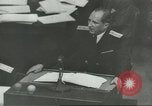
Hans Frank describes the atrocities inflicted on prisoners by the Nazis; Hoess testifies; footage of atrocity evidence.
During Nuremberg trial Hans Frank describes the Nazi policies of exterminating Poles and others. Atrocities inflicted on prisoners in Ourador Sur Glane, France in Bande, Belgium in Catacombe, Italy and in Czechoslovakia. Nazi German soldiers engaged in destruction following massacre of many residents in town of Lidice, Czechoslovakia in 1942 (retaliating for the assassination of SS officer Reinhard Heydrich.) Dead bodies in Nazi concentration camps, including Auschwitz, in 1945. Bones visible in crematory ovens. Victims inside crowded barracks including women prisoners who have been liberated. Large piles of items taken from victims before their deaths, including luggage, hair locks, toothbrushes, shaving cream brushes, shoes, clothing. Bones of victims piled at a concentration camp. Rudolf Franz Ferdinand Höss (sometimes spelled Höß or Hoess or Hess) describes concentration camps at Auschwitz in Poland during testimony. Victims in hospitals are shown, as words of Hess describe medical experiments include lowering the body temperature, injecting the body with poisons and infectious diseases and subjecting victims to high altitude pressure chambers. View of mutilated corpses. Sign that reads, "Arbeit Macht Frei" over the Auschwitz concentration camp gated entrance. Corpses of victims in the concentration camps.

Network of United States Veterans Administration offices serving veterans of World War 2
United States Veterans Administration's role for the war veterans of World War II. War veterans of World War 2 exit a separation center building with smiles on their faces, holding up discharge papers in 1945 at the end of World War 2. Veterans at United States Veterans Administration office. A map of United States depicts the 13 cities in which the Veterans Administration offices have been set up. Map of U.S. depicts the network of Veterans administration offices and traveling Veterans Administration representative locations across the United States. A traveling V.A. representative enters the "John Dyson" grocery, feed, fertilizer, and general store in a small town. Sign outside the building reads "Attention Veterans" and describes the weekly visit scheduled at that location.
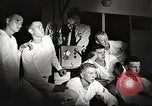
United States Navy sailors watch a movie about naval warfare in the United States; some scenes from World War 2 Pacific battles
A dramatized film about the training of U.S. Navy recruits at various naval training centers in the United States. The training and life of United States Navy recruits at U.S. Navy training center in Bainbridge, Naval Station Great Lakes in Illinois and Naval Base San Diego in California. The sailors watch a movie which depicts historic navy sailors on old masted sailing ships as they fire naval guns at another ship. The reenactment is of a 18th century or 19th century naval battle. The ship being hit by the enemy begins to sink. Sailors from the two ships in combat aboard a ship. Men jump into the sea and try their best not to give up the ship. A tall masted ship sinking. The naval gun canons aboard a ship being fired on another ship. Scene shifts to a mix of both authentic footage and several dramatized World War 2 combat footage scenes in the Pacific, circa 1943, 1944, or 1945, with U.S. Navy sailors on board ships firing at incoming Japanese aircraft. The enemy aircraft being shot down and they fall into the sea. A sailor clicks a picture of Japanese girls against a statue of Buddha. Narrator speaks about Navy recruitment. Sailors lined up on an open field during a ceremony at the U.S. Naval Academy.
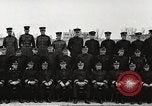
Naval officers photographed at The Naval Operating Base, Hampton Roads, Virginia in 1925.
The Naval Operating Base, Hampton Roads, in 1925 (re-designated "U.S. Naval Station Norfolk," in 1945). Opening scene shows Senior Naval officers (mostly captains plus a couple of rear admirals) seated in front row, and two rows of others officers standing behind them. At one point, they all remove their caps. Behind them is a concrete wall. But tops of some some buildings can be seen behind in the background. Closeup of a seated young rear admiral flanked by captains. In change of scene, all the officers are seen standing at attention, side-by-side on a gravel waterfront area, with a river and numerous buildings on the opposite shore visible in background. The camera pans across the assembled officers. Next, officers are seen on the waterfront, marching in white hats and carrying swords. (In these scenes, the motion is too fast, due to lack of compensation for low hand cranking speed of source camera.) The officers stop and stand in formation, and then march away.
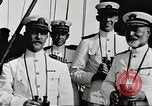
Chief of Naval Operation, Vice Admiral Edward W. Eberle at The Naval Operating Base, Hampton Roads, Virginia in 1925.
Vice Admiral Edward W. Eberle at Naval Operating Base, Hampton Roads in 1925. (The base was re-designated "U.S. Naval Station Norfolk," in 1945). Opening scene shows Admiral Eberle, Chief of Naval Operation, standing on deck of a ship with a captain, a Commander, and a Lieutenant Commander. They are pointing and peering through binoculars at objects (likely aircraft) passing overhead. Next, a Navy launch is seen entering a channel and moving toward the camera. It arrives at a dock is made secure by sailors. Vice Admiral Eberle then steps to the dock, followed by a Captain, a Commander, and several other naval officers, who line up on the dock They exchange salutes with the Admiral, who then ascends stairs followed by his retinue. The last scene is reconstituted and re-filmed. This time, naval staff officers are lined up beside the launch. They salute as Admiral Eberle steps from the launch, followed only by a staff Lieutenant Commander. The admiral then proceeds up steps, followed by officers on his staff. Another scene shows Admiral Eberle, standing on the dock with senior members of his staff behind him.
CRITICALPAST.COM: About Us | Contact Us | FAQs - How to Order | License Agreement | My Account | My Lightboxes | Shopping Cart | Advanced Search | Featured Collections | Website Terms & Conditions | Privacy Policy ©2026 CriticalPast LLC.
License Agreement |
Terms & Conditions |
Privacy Policy
©2026 CriticalPast LLC.