


 Francais
 Deutsch
 Italiano
Refine Your Search
Yokohama Japan 1945 stock footage and images
- Showing 4591 to 4596 of 7988 results more
more Hide
Hide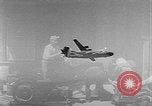
Scenes from movie about tests of incendiary bombing at the Eglin Field before use against Japanese cities in World War II.
Tests of incendiary bombing, before employing it against Japanese cities in World War 2. Planes in flight. Exterior of a building. A sign reads: 'Headquarters Army Air Forces Proving Ground Command'. Sign reads: 'Proof Department building no 8'. Hands open an envelope. U.S. Actor Lee J. Cobb, playing an Army Air Forces Captain, reads the document. The document contains information derived from tests of incendiary bombing, conducted at Eglin Field, Florida. He goes to chart and describes those tests. Scene shifts to the field where a set of Japanese-style houses has been erected. Typical fire-fighting means are shown: water tanks and sand buckets. Two types of incendiary bombs are shown. A bomber drops incendiary bombs on the Japanese-style houses. Crews on the ground attempt to extinguish the fires. But fire consumes the test village.
U.S. Air Force tests effectiveness of incendiary bombs on a test village built at Eglin Field, Florida, in World War II
Tests before incendiary bombing of Japanese cities during World War 2. The tests being conducted at the Eglin air field in Florida. A plane in flight. The plane drops numerous small indendiary bombs on the huts in the test area. High altitude view of the bombing. Smoke arises due to the bombardment. A conflagration ensues. Air Force personnel put out the fires with hoses.
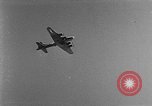
Bombing tests using conventional and incendiary bombs against wooden structures, at Eglin Field, Florida, in World War II.
Tests by the U.S. Army Air Forces to assess the effectiveness of incendiary bombs against wooden structures (typical of Japanese homes) during World War 2. Tests conducted at Eglin Field, Florida. B-17 bomber drops conventional bombs on test village, producing considerable damage where they strike. In contrast, bombing with incendiaries produces fire and smoke engulfing the entire complex, and greater destruction and confusion on the ground.
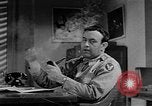
Testing various types of bombs against Japanese-style wood construction, at Eglin Field, during World War II
U.S. Army Air Forces tests of conventional and incendiary bombing of Japanese-style wooden structures, at Eglin Field, Florida, during World War 2. An Army Air Forces Captain (portrayed by actor, Lee J. Cobb) discusses bombing tests conducted at Eglin Field. He holds a pipe in his hand. B-17 bomber takes off over the camera. The plane in flight over the test area. Clusters of small incendiary bombs fall on the test village, causing it to be engulfed in flames. Immediately, thereafter, conventional bombs are dropped on the smoking test village, causing large explosions. The Air Force Captain (Cobb) discusses the results.
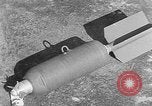
Optimum mix of fragmentation and incendiary bombs is determined during tests at Eglin Field, Florida, during World War II
Conclusions of tests conducted by U.S. Army Air Forces, at Eglin Field, Florida, seeking best way to attack Japanese homeland during World War 2. Actor Lee J. Cobb, portraying an Air Force Captain, smoking a pipe in his "office." Views of M-41 fragmentation bomb and a bundle of M-69 incendiary bombs. The Captain holds a model of a B-17 bomber and uses it to discuss bombing techniques. B-17 in flight. Views of effects of fragmentation bomb, showing numerous small holes produced by it. Aerial view of the test area houses. Mixture of M-69 incendiary bombs and M-41 frag bombs being dropped by the plane on the test area. Various views of resulting damage and effects. Test report is shown, concluding that demolition bombs are not effective against congested wooden structures; that M-41 frag bombs deter early firefighting efforts; and that a mix of 80 percent M-69 incendiaries and 20 percent M-41 frag bombs is optimum. Views of Japanese cities burning, from such bombing, during the war.
People line the railroad tracks as the funeral train leaves Warm Springs, Georgia.
Shows the Capitol building in Washington, D.C., as Franklin D. Roosevelt's voice is heard in the background. American flag flying at half mast. American flags on other buildings. Women on wheelchairs outside building. People line rail road tracks as the funeral train leaves. British and Soviet flags at half mast.
CRITICALPAST.COM: About Us | Contact Us | FAQs - How to Order | License Agreement | My Account | My Lightboxes | Shopping Cart | Advanced Search | Featured Collections | Website Terms & Conditions | Privacy Policy ©2026 CriticalPast LLC.
License Agreement |
Terms & Conditions |
Privacy Policy
©2026 CriticalPast LLC.