


 Francais
 Deutsch
 Italiano
Refine Your Search
Brest stock footage and images
- Showing 49 to 54 of 64 results more
more Hide
Hide
German Auxiliary Cruiser, "SMS Möwe" (Seagull), torpedoes British Steamer, "Georgic" during World War I.
Gun crew of the German commerce raider, Auxiliary Cruiser 'SMS Möwe (Seagull)' preparing to torpedo British steamer "Georgic, " during World War 1. The Georgic was bound from Philadelphia to Brest and Liverpool with cargo of munitions. The Moewe intercepted her in the Atlantic sea, and after removing her crew, prepares to sink her. Crew of the Möwe fire a torpedo which hits the Georgic. Explosion seen at waterline. The Georgic begins to sink and then capsizes and goes down. View as she slips below the surface of the sea.
Funeral of United States General George Patton and key moments and accomplishments during his life.
On the life of U.S. General George S Patton Junior (with narration by Ronald Reagan). Fight at the Siegfried Line during World War 2. U.S. 3rd Army cross the Siegfried Line. General Patton with his officers. Patton's troops cross the Rhine. American soldiers in the streets of Germany. Patton presents the Medal of Honor to a soldier. Patton sees dead people at a concentration camp in Germany. Patton's army moves towards Denube Valley. Civilians in the streets. Patton with officers. Written on a wall 'Hitler is kaput'. Trucks loaded with soldiers. A gun thrown on a pile of guns on the ground. Patton in a barge. A welcome ceremony for General Patton on his return to US: A parade along Broadway in Los Angeles on June 9, 1945, as over 1 million citizens welcome General Patton home and cheer. Shops and offices on Broadway in Los Angeles. Patton waves at the people from an open jeep. Patton and General Doolittle in Los Angeles. General Doolittle makes a speech at a ceremony and introduces General Patton. Patton addresses the gathering and talks about the war and the accomplishments of the Third Army. He notes that from aerial view, Germany and Austria "look like hell from the top." And "that's what any place that the 8th Air Force and the Third Army worked on looks like." Also Patton says, "You must remember this. That from Brest, to various towns in southern Germany and Austria whose names I can't pronounce, but whose places I have removed," (laughter in crowd), "the trail of the Third Army and the 19th Tactical Air Command and the 8th Air Force is marked by more than forty thousand white crosses; forty thousand dead Americans." View of a military cemetery graveyard. General Patton lays flowers at the grave of one of his soldiers. Patton watches a race at Soldiers Field Academy. He shakes hands with the winners. Soldiers carry Patton's coffin wrapped in American flag. Patton's grave with flowers on it. Two soldiers stand beside it. Patton's statue at the West Point Military Academy.
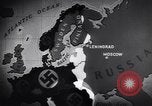
German Operation Barbarossa on the Eastern front in World War II
Animated map shows extent of German controlled areas in Europe following their conquest of the Balkans in World War 2. Norway is under their control and German forces threaten Leningrad and Moscow. A soviet defense line is shown on the map. The German attack is shown to come from 5 directions on June 22, 1941, with the launch of German Operation Barbarossa. A sky filled with German Heinkel He 111 bombers is shown. German Panzer III tanks with 75 mm guns. Army trucks carry German troops into battle. German soldiers on motor cycles and infantry advance under fire. Animated map shows principal German targets as Leningrad, Moscow, and Kiev. It then shows beginning a drive from the North to encircle Leningrad. Arrows show where German Marshal Fedor von Bock's forces drove 480 miles into Soviet territory. Slates identify cities being overrun by German invaders, including: Pskov, Novgorod, Brest-litovsk, Minsk,Mogilev, and Vitebsk. On July 17, 1941, a German tank is seen entering Smolensk, past the Dnieper River threatening Moscow, itself. To the south, German forces, under Marshal Gerd von Rundstedt, cut deep into the Ukraine. Newspapers world-wide consider the Soviet forces close to defeat. Slate shows communique from the German High Command stating: "The issue in the East is already settled. Smolensk is the last halt on the road to Moscow." German infantry marching. Scene shifts to heavy artillery being fired by Soviet forces in a snowy scene clearly later in the year. Animated map shows German forces very close to Moscow on October 15, 1941, forcing the Soviet Government and all foreign missions to move to Kuibyshev, 700 miles to the east. Adolf Hitler, in a speech on October 3, 1941, states that the enemy is broken and will never rise again. Animated map shows 500 thousand square miles of Soviet territory occupied by German forces. Views of fires burning in Russia. Damaged and abandoned Soviet industrial plants. A German guard atop a hill looks down on thousands of Soviet people in the occupied areas of Russia. Damaged and abandoned Soviet T-26 tanks. Glimpse of damaged Soviet aircraft and field artillery. Headline in New York World Telegram newspaper reads: "Berlin Admits Russ War May Last Winter." Another headline reads: "Red Army Holds Push On Moscow." Weary German soldiers traveling in horse-drawn wagons, pulling field artillery. Soviet and German war planners are seen at work. Slate quotes Adolf Hitler saying: "A single blow must destroy the enemy, without regard for losses... A gigantic all-destroying blow." German armor moving along a road. Animated map shows this technique in the German invasions of Poland, France, the Balkans, and Yugoslavia. In contrast, the Soviet planners are seen, as map illustrates how they intend to take advantage of the vast area of their land by holding lines of defense an falling back as necessary to keep engaging the invaders across interior of the Soviet Union. Soviet infantry are seen marching along a road. German troops riding atop their tanks. Soviet troops forcing German invaders into close combat in her cities. Soviet soldiers running in a city and firing heavy machine guns. Bomb damage and rubble inhibit German armor mobility in cities. Cities where this kind of Soviet resistance prevailed were: Rostov, Kharkov, Kiev, Kursk, Smolensk. German troops leaving a city with heavy black smoke rising in the background. More views of cities where Soviet troops are engaged German forces in House-to-house battles, including: Odessa, where the Old Opera Theater building is shown sandbagged and relatively undamaged. The Odessa NI tank, created from an STZ-3 agricultural tractor.
German Operation Barbarossa on the Eastern front in World War II.
View of the city, Pskov, on the Veilakaya river. A steel bridge is seen and city across it with smoke rising. German troops march in loose formation over a bridge in Novogorod. Views of German camouflaged tank (with shrubbery) and other armor and troops entering Soviet cities of Brest-litovsk, Minsk, Mogilev, and Vitebsk. View of German Panzer III tank heading toward the camera as it enters a narrow street in Smolensk. Animated map shows progress of these German advances and highlights German forces under German Field Marshal Gerd Von Runstedt cutting deep into the Ukraine. Headline on Chicago Daily News reads: "Nazis Claim Knock-out Victory" with subtitle line reading,"Moscow line cracks." Other newspapers reflect conviction that Soviet forces face imminent defeat by Germany. Slate shows communique issued by the German High Command, stating: "The issue in the East has already been settled. Smolensk is the last halt on the road to Moscow." More views of marching German troops. A battery of Soviet artillery firing from a snow-covered field. Animated map shows German forces moving close to Moscow. Foreign diplomats are moved from Moscow to the city of Kuibyshev. Hitler speaking on October 3, 1941, saying "This enemy is broken and will never rise again." Animated map depicts 500 thousand square miles of Soviet territory occupied by December, 1941, and compares it to the entire west central United States encompassing the states of : South Dakota, Iowa, Nebraska, Kansas, Missouri, and Oklahoma. Fires raging in agricultural area of the Soviet Union. Destroyed Soviet industrial plants, and huge numbers of Soviet citizens under German occupation. Views of destroyed Soviet armor, aircraft and artillery pieces. As season changes, German forces are seen in rain gear moving slowly through cold rainy weather. Some walk beside horses and other ride on horse-drawn caissons along with artillery pieces. Segments of film show contrast between the German military strategies. The German forces would plunge deep into enemy territory and create an area of conquest. This is illustrated by a slate bearing Adolf Hitler's statement that, "A single blow must destroy the enemy, without regard for losses, a gigantic destroying blow." An animated map illustrates the success of this approach by the Germans in Poland, France, and the Balkans. German Generals seen planning the same "Blitz" strategy against the Soviets. Film shifts to the Soviet strategy, showing their idea of building stronger defense, as they fall back, taking advantage of the great size of their territory. Views of Soviet troops on the move. View of Shells knocking out a German tanks. Panzer III tanks advancing. Panzer VI tanks completely covered by German troops catching rides. Soviet field artillery and machine guns firing in cities, forcing German soldiers to leave their vehicles. Soviet cities bombed out and burning, with debris and obstacles limiting the ability of armor to navigate in them. Montage of battle scenes cities of Rostov, Kharkov, Kiev, Kursk, Smolensk, all thwarting the Nazi blitz into the Soviet Union. Battles being waged in cities. (World War II; WW II; World War 2; World War Two)
Preparations in England for the D-Day invasion of Normandy in World War II
World War 2 invasion of Normandy, France. President Franklin D. Roosevelt, Marshal Joseph Stalin, and Prime Minister Churchill, meeting at Tehran, Iran, in December 1943. U.S. Generals George Marshall and Hap Arnold, at conference table. Closeup of General Dwight D. Eisenhower. Map showing defense areas of the German 7th, 15th and 19th Armies in Europe. Map showing ports at Brest, Cherbourg, Le Havre, Dieppe, and Calais. Cherbourg is highlighted. U.S. Army trucks, tanks, and artillery, stockpiled in England. Railroad train carrying M3 Stuart tanks. U.S soldiers leaving troop ships and marching to their camps in Britain. Allied troops practicing amphibious assaults on Southern coast of England. Formation of B-26 bombers. View from Allied aircraft flying low over German-occupied area. B-17 aircraft dropping bombs over Germany. Bombs away view seen as bombs drop toward enemy targets. German fighter planes attacking B-17 bombers beginning in February 1944. Gunner in turret of B-17 firing at them. Dogfight views with German fighter aircraft. A B-17 exploding in the air. German fighter downed by B-17 gunner. Gun camera footage of German Bf 109 attacked from rear by gunfire. Just as it is hit it releases its drop tank. American soldiers in trucks, DUKWs, M4 tanks, and M8 armored Cars. Troops receive gas masks, waist life belts, field rations, and French money. May 30, 1944, American soldiers board tanks, trucks and other vehicles bound for embarkation points in England. Seen are Stuart M3 light tanks, jeeps, and M7 Priest tanks. M7 tanks are seen, equipped with intake and exhaust ducts. (At TC:11:39, U.S. M7 Priest tanks, equipped for deep wading, are seen passing the base of the Jubilee clock on the beachfront at Weymouth, on their way toward Castle Town in Portland for embarkation.) Transport ships are loaded at the embarkation ports. Trucks being backed onto LCT-453. U.S. Army infantry marching and boarding transport ships. Troops marching into LST 376 at Plymouth, England. Higgins Boats, from the USS Samuel Chase (APA-26) bringing troops to board her. Troops on deck of Attack transport, USS Joseph T. Dickman (APA-13). Barrage balloons overhead. Soldiers shooting craps on a troop ship deck. Coastguardsmen playing with a puppy dog. Gun crews on U.S. Navy warship being briefed. Soldiers field-strip and check their weapons.
German troops overrun the Russians and take prisoners as troops destroy various installations in Soviet Union (WW2)
German troops advance against Russians on the Belorussian Front in Soviet Union during World War II. German troops advance on Brest Litovsk (in present day Belarus). German troops in small boats. Troops loaded on a tank as they march forward. A ship sails from a distance. Smoke arises from artillery fire. Troops on tanks march forward in meadow. A German soldier with a bicycle. A destroyed piece of artillery. German artillery in front of a building. Men running. German forces overrun Soviet soldiers and take prisoners. German soldier fires a machine gun. Troops sailing in a boat. Burning tanks in a village. German troops enter a Russian village and destroy a railroad station, homes and kill horses. Smoke rises due to an explosion. Troops advance on foot along with Russian prisoners. Soldiers in a boat and on tanks. Russian prisoners hold their hands up after surrender.