


 Francais
 Deutsch
 Italiano

Refine Your Search
Columbia-football stock footage and images
- Showing 433 to 438 of 599 results more
 Hide

Views of the center court of the Pentagon and the Potomac River in Virginia, United States.
Center court of the Pentagon building in Arlington Virginia, as seen from roof of Pentagon looking inward. View of the Potomac River and the Washington Monument. Columbia Island Marina filled with boats in the Potomac River adjacent to the Pentagon grounds. Jefferson Memorial in the distance. Cars and trucks passing by on George Washington Memorial Parkway. The Washington DC skyline. A twin propeller passenger aircraft in the sky overhead, departing or landing at Washington National Airport.
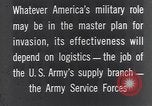
Commanding Generals of U.S. Army Services Forces and their missions are reviewed in this World War II film
Film starts with view of the U.S. military headquarters Pentagon building in Virginia, as seen from Columbia Island, across the lagoon, in World War 2.. Closeup of the building. Inside, Lieutenant General Brehon Burke Somervell , Commander of the Army Service Forces (ASF) is seen presiding over a staff meeting that includes seven Major Generals, who head the ASF technical services. Flag of the Quartermaster Corps seen in closeup. Officers of that organization are seen meeting. Scene shifts to a warehouse where military supplies are being moved on trailers pulled by small tractors. Carts filled with equipment are seen. Men prepare some for transport to America's allies overseas. Men fill packages with articles of clothing. A sign reads: "Maj. Gen. Reybold, Chief of Engineers." Engineers officers at a conference table rise as their Commander, General Reybold, enters. He sits and they begin their meeting. Closeup of staff officers in the meeting. Officers walk through a section of the Army Map Service, where cartographers, draftsmen and others are busy at tables creating maps. One of them is seen fitting several aerial photographs together to form a detailed map. A cartographer at the mapping service is seen annotating a map of the Marseille area of France. Views of high speed offset presses printing large scale maps for the military. A sign identifies the office of the Chief of Ordnance. Staff officers of that office are seen at work. Closeup of small arms being placed in a shipping box. An open yard filled with M24 Chaffee light tanks. A vast yard at a railroad siding, containing countless tanks on one side and building materials on the other. Sign inside the Pentagon at office of Major General H.C. Ingles, Chief Signal Officer. Closeup of General Ingles at his desk. Members of his staff consult with him. Sign at office of the Chief, Chemical Warfare Service. Major General William N. Porter, the Chief, looks over maps with several staff. Troops training under gas attack and smoke screen conditions. The entrance to the office of the Surgeon General of the U.S. Army. Inside, Major General Norman Thomas Kirk , Surgeon General, confers with a Colonel. Maps of areas where disease poses a threat to U.S. military forces. Office of Major General C.P. Gross, Army Chief of Transportation. Inside He holds a meeting with members of his staff. View of a pier where military supplies are being offloaded by means of derricks.
Dwight D. Eisenhower arrives to meet U.S. Secretary of War, James Forrestal at the Pentagon in Virginia.
Opening scene shows a dozen newsmen and photographers lining steps to the U.S. War Department Pentagon building, in Arlington, Virginia. A 1947 Packard Custom Clipper Club Sedan pulls up to the curb. It displays a 5-star general's insignia on its bumper.A military policeman salutes as an Army officer opens the rear door and exchanges salutes with retired General Dwight D. Eisenhower, who is now dressed in civilian clothes. (Eisenhower is the President of Columbia University, in New York, at this time. He is here to meet with U.S. Secretary of War, James Vincent Forrestal.) Closeup of Eisenhower as he walks toward and up the Pentagon steps, accosted by photographers along the way. He pauses as he goes up the steps to allow the picture taking. At the top of the steps, he removes his overcoat. More closeups as he reaches the top step and enters the building. Scene shifts to closeup of photographers, including an Army one, taking pictures. (Note: The War department was renamed the Department of Defense when President Truman signed the National Security Bill on August 10, 1949.)
Dwight D Eisenhower visits U.S. Secretary of War, James Vincent Forrestal in the Pentagon, Virginia.
Retired 5-star General, Dwight David Eisenhower (now President of Columbia University in New York) enters the office of the U.S. Secretary of War, James V. Forrestal, in the Pentagon. The two men shake hands and begin conversing. (Note: The War department was renamed the Department of Defense when President Truman signed the National Security Bill on August 10, 1949.)
Sights including Chesapeake and Ohio (C&O) Canal, Mount Vernon and Christ Church in Washington DC.
Film on Sesquicentennial of Washington DC, released in 1950. Film segments created for presentation by Treasury Department at meeting on April 25, 1929. A portrait of the first President of the United States George Washington. Animated maps of the original 13 colonies and the 10 square mile Federal District of Columbia. View of the Chesapeake and Ohio (C&O) Canal. George Washington's landmark plantation home, Mount Vernon. Christ Church in Alexandria. Old houses on a street and a hill in Georgetown. Sketch of Suter's Tavern. Animated map shows the L'Enfant development plan and the location of principal buildings. The first section of the U.S. Capitol built on Jenkins Hill. The U.S. Capitol building designed by William Thornton and Benjamin Henry Latrobe. Sketch of the White House designed by James Hoban. Sketch of Capitol Building in 1827 with dome constructed by Charles Bullfinch.

The American flag flutters in wind from a flagpole atop the Old Patent Office Building in Washington DC.
Landmark buildings reviewed during sesquicentennial in Washington DC. The Old Patent Office Building built in 1835. The American flag flutters in wind from a flagpole atop the building. The City Hall occupied by the Supreme Court of the District of Columbia.