


 Francais
 Deutsch
 Italiano
Refine Your Search
Columbia-football stock footage and images
- Showing 589 to 594 of 599 results more
more Hide
Hide
Contributions of African Americans in various fields in the United States.
(See also clip 65675078146 from different film transfer). Famous African American men and women citizens in the United States. Clip opens with of Booker T. Washington at Tuskegee University. Scene in a laboratory with African American scientist and inventor George Washington Carver, as an elderly man, working with another scientist in the laboratory. African American judge of New York city court. African American explorer Matthew Henson is seen looking at a globe (he was with Admiral Peary planting the American flag at the North Pole in 1909), and an unnamed African American surgeon at work in an operating room in New York. Next scene shows famous "father of the blues" musician and composer W.C. Handy (William Christoper Handy) smiling. Next is seen the financier and publisher of the Amsterdam News, Dr. C.B. Powell (Clilan Powell) greeting three uniformed African American women during a World War 2 war bond drive, and handing them a check (close up is shown) for 25,000 dollars, dated January 4, 1942, for the war bond drive. It is from the account of the Victory Mutual Life Insurance Company which Dr. Powell also owned. The check is signed by C.B Powell and Philip M.H. Savory (Dr. Savory was co-owner of the New York Amsterdam News). The next scene shows Elise Johnson McDougald, better known as Gertrude Elise Ayer, who was the first black full-time public school principal after the consolidation of New York City schools in 1898. She was also a noted woman writer during the Harlem Renaissance. She is seated in her office at her desk, likely in P.S. 119 in Harlem, since this is approximately year 1945 and she was at P.S 119 at that time. Her name plaque is visible on the front center of the desk. Principal Ayer smiles as a woman delivers a document to her. Next is seen the African American historian, author, and professor, Lawrence D. Reddick, serving in his role as the curator of the Schomburg Collection of African American Literature. In an art studio is seen the famous African American sculptor and painter Charles Alston, at work on a sculpture. Next scene shows the famous African American contralto singer, Marian Anderson, receiving a bouquet of flowers and smiling after a performance. This transitions to a view of African American orchestra conductor Dean Dixon leading an orchestra in a performance of Beethoven's 9th Symphony. Several views of different sections of the orchestra performing under Dixon's direction. Clip closes with brief shots of campuses of several historically black colleges and universities in the United States like Howard University, Hampton, Tuskegee, Fisk, Prairie View. An American college football game underway at the stadium of one of the colleges.
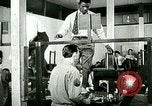
African American recruits in U.S. Army are issued uniforms and begin basic training in World War II
African American recruit sits in a chair with feet on a measuring device. A sergeant gives him a pair of shoes. But before he wears them the Sergeant tells him to stand, in the measuring device, holding two 20 pound weights. He then tells him to put on the shoes and go into the next room, where other African American recruits are lined up. They are instructed to remove all civilian clothes and begin dressing in army clothing. Next, completely dressed in their army uniforms, the recruits carrying duffel bags as they leave the snow-covered camp to board a train. Views of steam locomotives pulling trains in various places in the country. A convoy of army trucks carrying the new soldiers into a military base. The trucks park side-by-side in a line and the soldiers jump out with their gear to begin their basic training. A sergeant instructing the new soldiers on how to make a bed and other responsibilities. The new African American soldiers assembled in formation outside their barracks, on the snow, practicing close order drill, and making mistakes in the process. Next they are seen in a cross country march, carrying rifles. they take a 10-minute break. Soldiers in an infirmary, being visited by army doctors and African American nurses. Newly recruited soldiers being tended in an army dental clinic by African American dentists and hygienists. Soldiers shooting rifles on a firing range. Targets moving up and down on the range. Soldiers participating in sports, including football, baseball, boxing, and ping pong. A woman in the base library reading poetry aloud from a book entitled: "An Anthology of American African American Literature." African American members of the Women's Army Corps (WAC) are seen at another base, engaged in close order drill. Next these WACs are seen driving and riding in jeeps over rough terrain. A soldier shines his shoes, on Saturday night. African American soldiers and women dancing to music from an orchestra. The soldiers performing calisthenics in the open air. Rifles are held in some of the exercises. (World War II; WW II; World War 2; World War Two)
Achievements of African Americans in art, literature, music science, and medicine in the United States, in the late 1930s and 1940s.
A film about achievements of various African American men and women citizens in the United States. A statue of Booker T. Washington, founder of Tuskegee University in Alabama. View of African American scientist and inventor George Washington Carver, as an elderly man, working with another scientist in a laboratory. African American judge of New York city court. African American explorer Matthew Henson is seen looking at a globe (he was with Admiral Peary planting the American flag at the North Pole in 1909), and an unnamed African American surgeon at work in an operating room in New York. Next scene shows famous "father of the blues" musician and composer W.C. Handy (William Christoper Handy) smiling. Next is seen the financier and publisher of the Amsterdam News, Dr. C.B. Powell (Clilan Powell) greeting three uniformed African American women during a World War 2 war bond drive, and handing them a check (close up is shown) for 25,000 dollars, dated January 4, 1942, for the war bond drive. It is from the account of the Victory Mutual Life Insurance Company which Dr. Powell also owned. The check is signed by C.B Powell and Philip M.H. Savory (Dr. Savory was co-owner of the New York Amsterdam News). The next scene shows Elise Johnson McDougald, better known as Gertrude Elise Ayer, who was the first black full-time public school principal after the consolidation of New York City schools in 1898. She was also a noted woman writer during the Harlem Renaissance. She is seated in her office at her desk, likely in P.S. 119 in Harlem, since this is approximately year 1945 and she was at P.S 119 at that time. Her name plaque is visible on the front center of the desk. Principal Ayer smiles as a woman delivers a document to her. Next is seen the African American historian, author, and professor, Lawrence D. Reddick, serving in his role as the curator of the Schomburg Collection of African American Literature. In an art studio is seen the famous "Harlem Renaissance" African American sculptor and painter Charles Alston, at work on a sculpture. Next scene shows the famous African American contralto singer, Marian Anderson, receiving a bouquet of flowers and smiling after a performance. This transitions to a view of African American orchestra conductor Dean Dixon leading an orchestra in a performance of Beethoven's 9th Symphony. Several views of different sections of the orchestra performing under Dixon's direction. Clip closes with brief shots of campuses of several historically black colleges and universities in the United States like Howard University, Hampton, Tuskegee, Fisk, Prairie View. A football game underway in one of the colleges, and view on the field as quarterback throws a pass.
Training of United States Army African American recruits in the United States during World War 2.
A film in the United States about achievements and role of African American soldiers during World War II. A dramatization depicts an African American priest at a church as he addresses people about the contribution of African Americans in every branch of army like quartermaster corps, infantry. A woman gets up and says that her son is serving in the infantry. She reads out a letter from her son Robert. Army recruits at a railroad station. Elevated view of men walking in organized lines in the train station. Robert bids goodbye to his mother. A train arrives at an army training camp with snow on the ground and icicles hanging from the train station. Recruits being addressed by an officer. Robert being interviewed about his past life. An officer teaches the recruits the correct manner of saluting. The recruits remove civilian clothing and put on military uniforms. They undergo physical examination by U.S. Army medical staff. They board a train and leave for a replacement center. The recruits arrive at a camp and get off trucks onto snow covered ground. In a barracks area, they learn to make their beds and march. The recruits march across training grounds. Ill soldiers and recruits at a hospital as doctors examine them. The recruits undergo a dental check up. They learn to fire rifles at rifle ranges. The recruits play football, baseball, boxing and ping pong. They listen to poetry. African American women WACs ( Women's Army Corps) march at a training academy. They drive jeeps over a rough terrain. A recruit polishes his shoe. The African American recruits dance with girls at a dance ball. They perform exercises during a drill.

The Washington Huskies win 44-8 against the Wisconsin Badgers in the 1960 Rose Bowl.
WS Rose Bowl in Pasadena, CA. The Wisconsin Badgers punt is returned 53 yards by Washington Huskies George Fleming. Wide shot of crowd cheering as Huskies score more with Fleming rushing. Huskies win 1960 Rose Bowl 44-8. (College Football)

Georgia Bulldogs win 1960 Orange Bowl.
Quarterback Fran Tarkenton leads the Georgia Bulldogs to a 14-0 victory in the 1960 Orange Bowl again the Missouri Tigers. Tarkenton throws nine-of-16 passes for 131 yards. (College Football)