


 Francais
 Deutsch
 Italiano
Refine Your Search
Fort-monroe stock footage and images
- Showing 661 to 666 of 771 results more
more Hide
Hide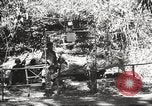
Allied soldiers on a field at a camp set up in a Burmese jungle during World War II.
A camp set up in a Burmese jungle by Allied soldiers during World War II. A sign reads 'Fort Stinker Main Gate'. A soldier drinks coffee. Mortar crew cleans its weapon. Various Allied soldiers and native men on a field.
U.S. Army airborne infantry training before and after World War II
U.S. Airborne forces in World War 2. U.S. Army Air Forces C-47 aircraft, painted in invasion stripes, take off as darkness falls, on June 5, 1944 (night before D-Day) and assemble in large formation headed toward France. Airborne troops seated inside cabin of a C-47. Some smoke cigarettes. One has "Rocky" stenciled on his helmet. One smokes a cigar. An officer stands in doorway of plane and then jumps, followed by his "stick" of troopers. View from ground of parachutes filling the sky overhead. Momentary view of troopers on the ground in Normandy. German troops, taken prisoners of war, marching in a town under guard, with their hands on their heads. Scene changes to post war training of U.S. Army airborne troops. They are seen practicing how to hit the ground. They practice use of static lines in wooden mockups of aircraft; and jump from towers, and engage in actual airborne exercises, at Fort Benning, Georgia. View of war materiel being airdropped from rear of an aircraft. Special parachutes being used to drop jeeps and artillery pieces.
United States Army Airborne worldwide activities in the 1950s, following the Korean War
U.S. airborne troops training in hand-to-hand combat; scaling obstacles; crawling under barbed wire; and parachuting from C-130 aircraft. Paratoopers jump from aircraft and view of sky filled with parachutes and aircraft. Paratroopers landing on the frozen tundra in Alaska, and jumping from U.S. Air Force C-124 Globemaster aircraft, over the ice cap in Greenland. In February, 1956, U.S. Army paratroopers jump from Air Force C-119 aircraft during SEATO Operation "Firm Link," in Thailand. Civilians in Thailand watch the demonstrations, in which one of the paratroopers is forced to use his auxiliary chute when his main chute fails. Military General officers of Southeast Treaty Organization nations watch the demonstrations. U.S. Army airborne units practicing assault resupply techniques with NATO forces in Germany, supported by helicopters and light utility airplanes. Supplies being airdropped with parachutes to the resupply location. At Fort Bliss, Texas, a radio controlled drone plane equipped with a parachute (possibly a Radioplane OQ-14 or similar from slightly later generation), acts as a target for tank crews. When hit, the drone parachutes to earth. A different U.S. Army reconnaissance drone is launched from a catapult as a U.S. Army soldier stands nearby controlling its ascent with remote control joystick. Aerial footage shot by the drone is shown, revealing scenes on the ground useful to field commanders. The drone, with it's camera, returns to base and gently parachutes to be recovered.

History of U.S. Army 3rd Infantry Division and its role in the Korean War.
Sergeant Stuart Queen of the U.S. Army introduces a film about the 3rd Infantry Division. He turns to Audie Murphy, the most combat decorated soldier of World War 2, seated beside him, who is now a film star, but still active as a Captain in the 36th Infantry Division of the Texas National Guard. Captain Murphy speaks about the U.S. 3rd Infantry Division. View of the Division parading for the Joint Chiefs of Staff, at Fort Benning Georgia, in Summer, 1949. Animated map shows Korea and surrounding countries of China and Japan, on June 25, 1950. View zooms in on the 38th parallel marking separation of North and South Korea. Views of North Korean troops moving against South Korea. Buildings being blown up. Armed troops of the People's Army of North Korea prodding civilians out of their homes. South Korean troops riding in an American-provided army truck, join others organizing to resist the invaders. South Korean troops in battle gear preparing to engage the North Koreans. Next, as part of United Nations response to the North Korean aggression, elements of the U.S. 3rd Infantry Division are seen arriving in November, 1950, and deploying along the East Coast of the Korean peninsula, to engage the North Korean army along its left flank. Battery of American M114 155 mm howitzers firing. American troops advancing along muddy road in snowy environment in December, 1950. Entry of Chinese forces into the conflict causes Americans to assume a defensive posture. Korean troops preparing to move elswhere.Smoke rising from battles in the background. Views of American defensive positions on the perimeter of the coastal city of Hungnam, to cover the withdrawal of units and equipment the U.S. 10th Corps, seen entering landing craft from the USS Montague (AKA-98) for evacuation from the beachhead
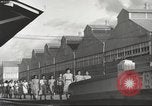
Filipino people going about their routine activities in the Philippines; Filipinos trained by American soldiers.
Part of a 1944 film showing scenes of Filipino people circa 1940, before World War 2. At opening, Filipino women are seen walking alongside a row of factory buildings. A factory room filled with Filipino women dressed in white caps and white uniforms engaged in production at individual individual work stations in a factory. A machine shop filled with Filipino men engaged in metal work. Several people at the window of an office, conducting business with a woman inside. A stock or commodities market office with quotes on tote boards. Women working alongside a moving production line. A woman operating a fabric processing machine. Filipino miners pushing hopper cars of mined ore across a bridge. Miners riding on an engine pulling a train of hopper cars filled with ore from a mine. Filipino longshoremen handling cargoes on a wharf. Scene shifts to an open field where a number of Filipino men are being trained to use firearms during World War 2. One is being coached by an American soldier as he works with a Browning M 1917 water cooled machine gun. Lines of Filipino men firing rifles under supervision of U.S Army trainers. A contingent of uniformed Filipino soldiers, led by an American soldier, marches past a sign, in an camp of tents, reading "A-T Company, 1st Filipino Infantry." Filipino soldiers at a tent camp, being instructed by an American soldier, using a large set of maps. Camera pans over a camp of many tents laid out in order. A formation of Filipino soldiers marches between tents. An American soldier opening his foot locker at his quarters. An illustrated portrait of General Douglas MacArthur. A formation in a field with a Filipino band playing and a Color Guard carrying the American and Filipino flags. A large group of Filipino children walking along a path. A Filipino boy lying on the floor in his home, reading a large book. Filipino school girls seated at benches next to tables. Women doing laundry at an outdoor pond. Next, an actor in khaki clothing sits in a tent and speaks as if addressing American soldiers regarding the Philippines. Among other things, he says,"These people aren't natives. They aren't beggars. They have cities and farms and industries.They have schools and courts and a Constitution. They also have pride and patriotism and self-respect. They love freedom They'll die for it." He cautions American soldiers about their behavior vis-a-vis Filipinos. He states that "Filipinos are American." He alludes to messages received from American and Filipino defenders in Fort Mills, at the fall of Corregidor on May 5, 1942. View of radio towers and worker in radio studio. Morse code messages heard as an American army radio operator with a headset transcribes the messages. Scene shifts to an amphibious invasion fleet attacking a Japanese held island in the Pacific.
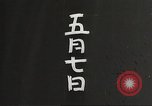
Japanese soldiers advance and give victory banzai in Corregidor Island, Philippines (WWII)
Japanese victory at the Battle of Corregidor during Japanese occupation of Philippines in World War II. Japanese troops land on Corregidor Island (also known as Fort Mills during the American Colonial Period). Japanese troops disembark from boats during their landing at the island of Corregidor. Japanese soldiers climb their way up the island. Soldiers advance on Corregidor Island. Japanese troops march past destroyed buildings. Captured American and Filipino prisoners of war are taken away. Japanese soldiers stand near gun batteries and give victory banzai. View of the Mile Long Barracks of Corregidor. The soldiers advance and walk past a destroyed building. The Japanese flag is raised. Japanese soldiers take down the United States flag in Corregidor.