


 Francais
 Deutsch
 Italiano
Refine Your Search
Fort-monroe stock footage and images
- Showing 25 to 30 of 771 results more
more Hide
Hide
Women work as the members of a community in the United States.
The role of women as active community members in the United States. An aerial view of the suburban town. View of the houses, buildings, snow covered area and roads. A railroad train arrives at a railroad station. Close views of the locomotive with sign "Erie" on the front. Men discuss a town zoning map on a wall. A garbage man throws garbage into a garbage truck. A post man delivers postal mail. He walks outside a house. He delivers a mail to a woman. The woman standing outside the house and takes the mail. Interior of the house. The woman sits with her family. A man reads a newspaper. Children have their breakfast. The woman opens the mail and views a sample ballot sheet listing the candidates of local elections. Little girl spills glass of milk on table. Her mother cleans up the spill. A woman shops in a grocery shop. View of small town grocery counter and shelves. The post man delivers mail to a woman in the grocery store. A woman sitting with her children gets mail from the postman. A man takes out a mail from a letter box. A woman stands with him. She reads the mail. Exterior of a school building. Interior of a class room. HIgh school or college age students studying. A young woman views a sample through a microscope. A post man walks on a road and vehicles move past, including a bus with sign "Lake Region Bus Co." Women come out of the bus after it comes to a stop. Destination sign on side of bus reads, "Monroe" (most likely Monroe New York). People stand in a line outside firemans hall to vote in local election.
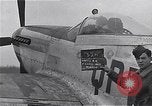
Pilot and Intelligence Officer of the USAAF 334th Fighter Squadron at Debden Airfield, England, during World War II
Pilot of USAAF 334th Squadron, 4th Fighter Group, Captain Shelton W "Shell" Monroe, of Waycross, GA. in the cockpit of his P-51, during World War 2. He starts the airplane, but shuts down and gets out to talk with Intelligence Officer, Captain Ben Q. Ezzell, who is dressed in Class A uniform, and carrying some sort of document. They talk and Ezzell gives Monroe a cigarette to smoke. Shelton W. Monroe was later killed in Korea after his plane was shot down on April 17, 1951.

Stories of LSD victims Frank Olson, Harold Blauer and James Thornwell in the United States.
Administration of LSD (Lysergic acid diethylamide ) by the CIA (Central Intelligence Agency) as part of Project MKUltra. News reporter Paul Altmeyer talks about harmful effects of LSD. Best known case is of Frank Olson, chemist employed by the Army Chemical Corp who ended his life by diving through the10th floor window of Statler Hilton Hotel in New York. Frank Olson with his wife Alice Olson. She visits Dr. Sidney Gottieb, the man who administered the drug. Robert V. Lashbrook, Assistant Chief of the Chemical Branch, was in the room when the incident occurred. Alice Olson talks about the incident. Inspector General Lyman B. Kirkpatrick talks about Olson case, which slowed down the testings of CIA LSD drug. Harold Blauer, a tennis player, with his daughter. The Psychiatric Institute and Hospital in New York where he was admitted and died after being given five mescaline derivatives which were injected and tested secretly by the Army Chemical Corps. Paul Altmeyer looks at 5000 documents released by the army. Dr. James Cattail who administered the mescaline derivatives was unaware of his actions due to the secrecy of the army experiments. Blauer's daughter Elizabeth talks about the death. Test conducted at Tulane Medical Center. Chief researcher Dr. Russell Monroe talks about experiment. A project report written by Dr. Monroe. One of the reports in which electrodes were implanted in the brain of a woman and she was given LSD. She became agitated and cried. Paul Altmeyer questions Dr. Monroe about LSD. James Thornwell, a African American soldier in France, given LSD in 1961 when he came under suspicion of having stolen documents. He was secretly given LSD for several days by his interrogators during which time he was forced to undergo aggressive questioning, replete with racial slurs and threats.
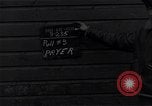
Pilots of the USAAF 334th Fighter Squadron celebrate their victories at Debden Airfield in England, during World War II
Three pilots, Major Gerald Montgomery, Major Howard D. (Deacon) Hively, and Captain Shelton W. "Shell" Monroe, of the U.S. Army Air Forces 334th Fighter Squadron, 4th Fighter Group, discuss a map during World War 2.. Logos of the Eagle Sqadron and the 334th Fighter Squadron displayed above a wall containing small painted German crosses representing enemy aircraft destroyed, probably destroyed, and damaged. Airman stencils two more under the destroyed column. Major Howard D.Hively of Athens, OH.,with another Major looking at record of aerial victories on the wall. Hively holds a sign reading "300 destroyed." He hands it to the other Major who tacks it onto the wall using the butt of his .45 caliber automatic pistol as a hammer. They smile and shake hands. Then Lieutenant Timothy Cronin stencils three more crosses in the destroyed column, under the 300 sign, as Lieutenant Victor Rentschler looks on smiling. The two men each recorded kills on Christmas Day 1944, one of which was the 300th kill for the squadron. (Shelton W. Monroe was later killed in Korea after his plane was shot down on April 17, 1951. )
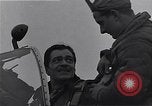
Pilots, of 334th Squadron,USAAF 4th Fighter Group, and their P-51 aircraft in England during World War 2
Major Howard "Deacon" Hively, of Athens OH, 334th Squadron, 4th Fighter Group (formerly Eagle Squadron) in cockpit of P-51 aircraft at Debden Air Base, England, during World War II. Crew chief helps with his shoulder harness. Pilot waves and closes canopy. Captain Sheldon.W. Monroe, of Waycross, Georgia, talking to crew chief, S/Sgt Paul Fox, sitting on nose of P-51, as he performs maintenance. (Note: Captain Monroe was reportedly killed in action in 1951, during the Korean War.).

Historical views of The White House grounds and interiors, in the United States.
The White House past and the present. Aerial view of The White House in Washington DC in the late 1950s. Scene with 1950s cars parked and moving in parking areas and roads in front of the White House. Visitors walking on the White House grounds near the North Portico. View of a Birch tree planted by wife of President Calvin Coolidge and Magnolia trees by President Andrew Jackson. View of the south portico entrance and the north entrance of the White House. Plans and sketches of of The White House. Portraits of President John Adams and his wife Abigail Smith. Portrait of President Thomas Jefferson. Plan of the east and the west wing of The White House. Illustration of British attack on The White House. Portraits of President James Madison and his wife Alley. Portrait of President George Washington. Portrait of President James Monroe. Picture of President Abraham Lincoln. Footage of President Lincoln's study room, and his bedroom with its custom bed over 8 feet in length. Sketch of President Benjamin Harrison taking oath. Still images of ornate furnishings in the White House during Harrison's tenure. Still images of more simplified furnishings in the White House under Theodore Roosevelt. Picture of President Theodore Roosevelt with sons. Aerial view of the new west wing area enlarged for White House office use. Still photo of Theodore Roosevelt writing. Footage of President Woodrow Wilson signing a bill at his desk, with a crowd of officials standing by. Footage of United States Military officers and French General Ferdinand Foch and other French military officers entering the White House to meet with President Harding on October 29, 1921. (Foch was touring the U.S. and being officially thanked for his leadership in World War I.)