


 Francais
 Deutsch
 Italiano
Refine Your Search
Fort-monroe stock footage and images
- Showing 505 to 510 of 771 results more
more Hide
Hide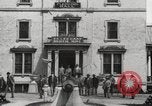
American Civil War veterans pose outside the Confederate Soldier's Home in Richmond, Virginia.
The R. E. Lee Camp No. 1, Confederate Soldiers Home Memorial Building is a National Historic Landmark, Civil War Historic site in Richmond, Virginia. Confederate Veterans who fought in America's Civil War pose outside 'Fleming Hall', the R.E. Lee Camp No. 1, Confederate Soldier's Home Museum building and headquarters. The next scene shows all the Camp's veterans assembled for the cleaning a civil war artillery cannon. 'Fleming Hall' can be seen in the distance on the left. It was established as the first Confederate Soldiers Home in December 1884. In the center distance is the 1885 'Pegram Hall' barracks, named to memorialize two brothers who were killed in battle. Behind the veteran in the next scene, is the meeting hall named 'Randolph Hall' on the left, which was built in 1885 and appears with 'Cooke Hall' barracks built in 1894. The latter has a two-story balcony used as first and second floor rocking chair porches, facing the Boulevard to the right. (The United Daughters of the Confederacy national headquarters now stands on the site, facing the Boulevard, where 'Cooke Hall', the 1893 'Soldiers Home hospital' and 'Pegram Hall' once stood.) The President Jefferson Davis Monument seen, is located on Monument Avenue. Confederate monuments and memorials grace each intersection throughout its entire length, to honor fallen Confederate officers, as prescribed in the code of the City of Richmond at the request of the Stonewall Jackson Camp Number 981, Sons of Confederate Veterans. Last segment shows Richmond's Star Fort number ten of the Inter-city-defenses that guard the left flank of old Deep Run Turnpike (now named Broad Street). The canon seen to the right behind the Star-fort breast works is the Monument Avenue landmark for the site that exists today just east of President Davis' Monument.
Aviation history; historic early flight scenes; first hand accounts from persons who knew and worked with the Wright brothers.
Views of traffic on a city street around the turn of the 20th century. A mix of horse and buggies and motorcars and bicycles. People waiting for a trolley car. Reenactment of persons using an early telephone and of early filmmakers at work with camera on motion picture film. The Wright brothers home at 7 Hawthorne Street, West Dayton, Ohio. The Wrights' former housekeeper, Carrie Grumbach, recalls December 17, 1903, a telegram arriving about the Wright brothers successful first powered flight. Glimpse of Wright brothers machine shop. Charlie Taylor, who had worked in their shop, speaks of being pleased at their accomplishment. View of the Wrights flying gliders at Kitty Hawk, North Carolina. Charlie Taylor describing how he machined and built the motor for the Wright brothers airplane. Glimpse of that motor or a facsimile. Men positioning the Wright brothers airplane for launching, and French citizens gathered to watch a demonstration of their airplane in France. French aviation pioneer, Henri Farman with two other men in his Voisin-Farman I airplane. They begin takeoff. Closeup of Brazilian aviation pioneer, Alberto Santos-Dumont. Other early aircraft in flight. A Wright Flyer passing over the Fort Myer drill ground in Virginia. An Army balloon in the background. Retired United States Air Force Brigadier General, Frank P. Lahm, walks across the tarmac on an airport and speaks for interviewer (unseen). He speaks about the difficulty the Wright brothers had in convincing the U.S. Army of the value of their airplane. He tells that in December, 1907, Wilbur Wright was finally granted an interview with the Board of Ordnance and Fortifications, which led to a contract, in 1908, with the Signal Corps. Moving imagesof Orville Wright and assistants bringing a Wright Flyer to Fort Myer, Virginia, to conduct flight trials for the Army. Views of the airplane being flown all around the area, watched by spectators. (This footage is a mix of 1909 footage where the aircraft shows two half-rounds of canvas in the front elevator, and 1908 footage, taking off and flying, where the aircraft has a single half-round of canvas in the front elevator.) After landing on the 9th of September, 1908, then, Lieutenant Lahm, accepts Orville Wright's offer to fly with him. Lahm climbs aboard the airplane, sits next to Orville Wright, and they are seen taking off and flying about for six minutes and forty seconds. (Lahm is the first. military officer to ever fly in an airplane.) The next scene shows the wreck of a Wright Flyer, in which Army Lieutenant Thomas Selfridge was killed and Orville Wright injured, on September 17, 1908.
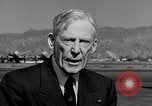
Lieutenant Law and Igor Sikorsky talk about their experiences and experimental aircraft in flight in the United States.
Part of a series of films about the history of aviation in the United States.Retired United States Air Force Brigadier General Frank P. Lahm is seen speaking about his aviation pioneering days, when Orville Wright taught him and Frederick E. Humphreys of Army Engineers (both Lieutenants at the time) how to fly the Wright Flyer airplane. Views of a Wright Flyer maneuvering in the air above Fort Myer, Virginia. Somewhat later, two are seen in flight at Fort Myer. An early Curtiss airplane.is maneuvered on the ground to face away from the camera. Russian, Igor Sikorsky in an early rear propeller airplane. Igor Sikorsky at a desk in a modern engineering office. Sketch of a helicopter on drawing board behind him. He talks about the early days of experimental flight in 1909 and 1910. View of Louis Bleriot sitting in the open cockpit of his airplane, and then of him flying overhead in his famous flight across the English Channel. Obeservers watching his progress through binoculars and a telescope. Sikorsky standing next to his first helicopter (which didn't fly).
A group of school children on mountain expedition and campers across footbridge to further ascend mountain in Taiwan.
A film shows the geographical features of Taiwan mountains during Japanese colonial period. A view of the mountainous area. Japanese soldier with a bag on his back looks at the mountains. A mountain fort in the mountains with Japanese flag flying on flagpole. A view of clouds over the mountains. A group of civilian campers wake in morning and look at cloud formations below them. The campers with bags hanged on their back climb steps on the mountains and set off across footbridge to further ascend mountain. A camper heading towards the footbridge. Flowers that grow in mountainous ranges of Formosa. A group of school children on mountain expedition. Girls climb up the mountain. They walk on a footbridge. A view of the mountainous area. Fort surrounded by the mountains.
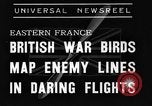
British pilots take off to photograph enemy lines, an airfield is prepared and personnel celebrate in Eastern France.
British pilots fly over the West Wall to photograph enemy (Germans) forts and troop concentrations in Eastern France, early during British Expeditionary Force involvement in France, during World War 2. British fliers stand near aircraft of the Royal Air Force. They look at a map. British pilots get into aircraft. An obstacle in front of the wheel of an aircraft is removed. The aircraft takes off over the West Wall to photograph enemy (Germans) forts and troop concentrations. Trucks in a forest. Men work in a trench. A British personnel holding equipment in his hands smiles. Airfields are prepared: Trees are cut and a bulldozer passes along a road to level the land. The aircraft lands. The pilot goes into a tent. He looks at photographs. One British personnel inspects holes in a wall. British soldier carries a live goose away. A British soldier pushes a cart loaded with drums or barrels. A French woman stands outside a house and then quickly turns and runs back in the house. British military personnel read newspapers. They congregate at a bar and reach for bottles of alcohol on the bar.
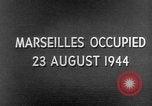
Docks, warehouses and port facilities damaged during the Liberation of Marseilles, France following Operation Dragoon
Allied Invasion of Marseilles, Southern France following Operation Dragoon during World War 2. French forces enter Marseilles and engage any remaining Germans. French Algerian soldiers of the 3rd Algerian Division in firing positions. French Algerian soldiers walk into Fort Saint Nicolas. Body of executed civilian man in Fort Saint Nicolas with his hands tied behind his back. Dead and wounded soldiers. Street defenses set up by German soldiers are seen abandoned, including artillery gun emplacements and machine gun nests. Views of rubble at docks, warehouses and port facilities that had been deliberately destroyed by retreating German forces. Part of ship with swastika visible just above water line. Bomb damaged hangers and aircraft at airport. Wrecked French planes with German markings. Liberated French civilians in Marseilles cheer Algerian troops. General Joseph de Goislard de Monsabert walking down street during parade as civilians cheer. Mosabert is congratulated by General Jean de Lattre de Tassigny and French politician André Diethelm who is described as French minister of war by the narrator.