


 Francais
 Deutsch
 Italiano
Refine Your Search
Hideki tojo stock footage and images
- Showing 19 to 24 of 43 results more
more Hide
Hide
Modernization of Japan in 20th Century leading to World War 2
Opening scene shows cartoon depiction of a samurai and a Meiji-era soldier. A cartoon depicts the Bakufu opening Japan to the Western world. A Japanese communications worker is seen climbing a pole to install communications lines. A steam locomotive moves along railroad tracks being installed in the country. Glimpse of European style Japanese calendar (October 1856) being adopted. A Japanese photographer using flash powder and hooded camera. Men walking on a sidewalk in European style fashions. Cartoon showing Japanese inviting outsiders to help them build up their military power. View of three Japanese officials posing for camera. View of a British sailing vessel displaying the British Red Navy Ensign. Japanese troops on maneuvers with realistic smoke and battlefield conditions, supervised by French military advisors. Reenactment of French fighting Prussians in the 1870 Franco-Prussian war. Impressed by the German victory, the Japanese solicited German advisors for their army. View of German troops goosestepping and then of Japanese troops also goosestepping. National Diet building in Chiyoda City (1-7-1 Nagatacho, Chiyoda-ku, Tokyo 100-0014, Japan). View of Japanese legislators and then of the entire legislature (Diet) in session. Views of Japanese military leaders, including General Hideki Tojo, who also served as Prime Minister of Japan. Views of several such military leaders in uniform, exiting automobiles. Japanese soldiers marching through Torii gates.
Japanese 1931 aggression in Manchuria condemned by the League of Nations. Continued Japanese aggression in the Pacific, through World War II
Japanese international activities during 1931-1945. Opening scene shows Japanese troops embarking on ships bound for an invasion of Manchuria, in 1931. Officers walking on the dock, amongst the departing troops. Scenes of explosions and destruction. Views of Shanghai during Japanese attacks in 1937. Destroyed buildings. Civilian dead lying in the streets. Japanese soldiers racing along a street in a three wheeled motorcycle vehicle. Change of scene shows Japanese diplomat Yosuke Matsuoka addressing a League of Nations meeting in 1933, after that body adopted a report blaming Japan for events in Manchuria. He objects to that action and then leads his delegation in walking out of the meeting. View of Japanese delegates in top hats and bowler hats exiting the building. Scene shifts to Japanese forces firing artillery and machine guns in Manchuria.They wave large Japanese flag victoriously after a battle. The next scene shows Italian forces occupying Ethiopia and raising the flag of the Kingdom of Italy, as Italian troops salute, presenting arms of rifles with fixed bayonets. Axis leaders celebrate the 1940 Tripartite Pact between German, Italy and Japan. The festivities take place in a hall displaying the three nation's flags on the walls. A large number of persons attend including Japan's Prime Minister, General Hideki Tojo, seen with two celebrants. Scene reverts to China with Chinese civilian people trying to escape from invading Japanese forces. The refugees carry their belongings as they flee. Occasional shell burst is seen among advancing Japanese troops as Chinese soldiers put up resistance. Chinese soldiers firing artillery. In the U.S., Japanese envoys Kichisaburō Nomura and Saburō Kurusu are seen walking together into a building and entering a room inside. Next, are views of the Japanese attack on Pearl Harbor, with huge plumes of smoke obscuring the bombed U.S. battleships in the harbor. U.S. battleships in line formation in the Pacific during World War 2. Aerial view of U.S. warships moving in parallel. British ships augmenting the U.S. warships. Naval guns firing. U.S. amphibious assaults on Japanese held islands in the Pacific. Prisoners of the Japanese who suffered in the Philippines. General Douglas MacArthur mingling with former prisoners and internees upon his return to Manila in 1944. Aerial views of Iwo Jima. Naval bombardment and amphibious assault of Iwo Jima. Numerous fallen Japanese soldiers. The iconic American flag raising by U.S. Marines on Iwo Jima. View of Lieutenant General Simon Bolivar Buckner Jr. during the campaign on Okinawa, where he was killed in action. A Soldier being carried on a stretcher. Another throwing a hand grenade. U.S. soldier firing at a Japanese defender who falls out of his bunker. Large numbers of Japanese prisoners of war assembled in a field. Japanese Kamikaze attacking U.S. warships off Okinawa. The sky filled with antiaircraft flak clouds. View of 40mm Bofors antiaircraft cannon firing and a Japanese plane falling and exploding on impact in the ocean.
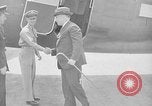
Frank Knox arrives at Patuxent River; assorted other scenes of Japanese military leaders and allied military leaders
A government official arrives by a plane and greeted by military officer during World War 2. Next scene is unrelated and shows Japanese General Hideki Tojo and an aide seated at a ceremony, with Imperial Japanese navy pilots seated behind and others including civilians in the audience. Next scene shows officers of Navy of Imperial Japan in conference as they examine a map on a ship deck. Scene shifts to another greeting of unnamed Allied officials meeting and greeting at an airstrip. Next scene shows a Pacific Island battlefield with both dead troops on beach area and live American troops walking nearby. Next scenes shows U.S. Secretary of Navy, Frank Knox, as he arrives at Patuxent River Naval Air Station in a plane. Frank Knox and other officials leave. Various views of radio towers are seen in between scenes in the clip.
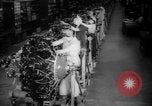
War production manufacturing workers busy at the Douglas Aircraft Factory in Long Beach, California during World War 2
Factory workers at A-20 (Fighter-Bomber Army plane) engine line in Douglas Aircraft Factory, Long Beach, California during World War 2, supplying aircraft for the war effort. Women factory workers make adjustments to engines in a Pratt-Whitney engine line. Close up of a woman worker at work on an aircraft engine. African American workmen stack plexiglass parts for bomber aircraft gun or bombing sights. Ex-sailor works on wing of aircraft. Shirtless worker removes an aircraft tire from a rack of tires and rolls it by hand. Propaganda cartoon poster above the rack shows a frightened Hideki Tojo up a tree and reads 'Tokio Kid Say' and shows an attack dog below, keeping him in the tree, and wearing a collar that says, "Conservation," encouraging workers to conserve and use factory resources wisely for the war effort in order to beat the Japanese.
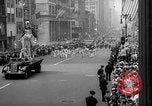
Infantry units march, and floats are seen, during War Parade on Fifth Avenue in New York City, United States (WW2)
War Parade on Fifth Avenue, in New York City, United States during World War II. United States flags raised on the buildings. The first float in the Parade is called "Death Rides" and is an effigy of Death, as a cloaked skeleton, astride a gray horse, beating Nazi swastika drums. Another float , entitled: "Pearl Harbor", depicts a Japanese man (Hideki Tojo) stabbing Uncle Sam in the back prodded by other Axis leaders, German leader Adolf Hitler and Italian fascist leader Benito Mussolini. A Boy Scout Band marches and plays. Boy Scouts of America carry massed American flags. A huge crowd of spectators gathered on the sidewalks. Jeeps and tanks take part in parade. Units of Army and Navy participate in parade. A band of bagpipers in Scottish garb. British and American flags lead contingents of British troops. Unit of U.S. Womens Army Corps (WAC) parades. Policemen all along the line of march.
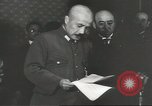
Japanese people in all walks of life supporting their war efforts in World War II
Japanese leader, Hideki Tojo addresses members of the legislature (Diet) saying their task is to set the Emperor's mind at ease. View of vast field full of Japanese soldiers performing supervised calisthenics. A kitchen preparing meals in boxes for Japanese soldiers. Soldiers hanging, one arm at a time, from a horizontal bar in a gymnasium. Radio antennas and smoke stacks are seen in Japanese industrial sites. Factory workers, all dressed alike, enter a war plant in Japan. Scientists seeking to invent new weapons of war. Japanese men and women workers in war production factories producing ammunition. Workers assembling artillery in a factory. Others building a new ship in a shipyard. Japanese boys and girls in school uniforms working on a farm. Women carrying harvested crop suspended from poles. Others threshing harvested grain and working in fields. Men and women operating Japanese fishing boats and hauling nets filled with their catches.