


 Francais
 Deutsch
 Italiano
Refine Your Search
Italy airfields stock footage and images
- Showing 1993 to 1998 of 3777 results more
more Hide
Hide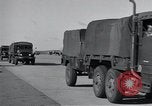
Soldiers of 101st Airborne division carry luggage as they move to board C-124 plane in Arkansas.
Trucks and planes parked in the airfield. Soldiers of 101st Airborne Division in the airfield. A Sergeant with check-off list. Soldiers carry their luggage as they move to board a C-124 plane.
German military aircraft of World War II seen in operation during World War II
German aircraft of WW 2. A German Heinkel 100 prototype fighter takes off, with rocket assist. (The smoke is visible only as it passes dark trees in background.) The aircraft retracts landing gear and makes high speed pass over the Airfield. Two Messerschmitt Me 109s fly low over the Airfield. Focke-Wulf Fw 190 parked on grass with engine running. Pair of FW-190s make formation takeoff. Me-109s, Ju-87's and FW-190s in various formations and maneuvers. A Junkers 188 with Technician working on it, then making a high speed pass and climb. A Focke Wulf 200 Condor Taxis by through puddles.
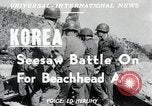
The Battle of P'ohang-dong and the Pusan Perimeter in the Korean War
Opening slate of August 1950 newsreel refers to Seesaw battle on beachhead. It shows several U.S. soldiers manning a 105mm howitzer field piece on sandy ground beside a steep hill. A small American flag marks their position. Scene shifts to a bivouac area of large tents and vehicles on flat ground. A body of water and higher ground is seen in the background. Next, an American flag flutters in the breeze, on a makeshift flagpole, atop a hill, where several soldiers are maintaining a lookout. A large radio antenna is installed on the hill. Back down on the flat land, American troops are breaking camp, pulling down the large tents. At Pohang Air Base (K-3) American troops are pulling down tents and packing up to leave. A C-46 transport plane sits nearby and a C-47 transport is in the background. Troops burn papers in 55-gallon drums. Troops load Army trucks with tents and equipment. Aerial glimpse of the area showing high hills surrounding it. View from a farm field where farmers are working, as four USAF F-80C jet fighter planes take off from the nearby airfield. View from aircraft flying above, as an F-80 attacks a ground target. Gun camera view of American aircraft strafing an installation at the base of a mountain. Explosions from striking rounds. Pilot pulls up abruptly to avoid the mountain. Gun camera view of rockets being fired from attacking aircraft on lines of communication, including rail and port facilities. Fires and smoke from the attacks. A strafing attack against a moving railroad train. The aircraft passes through heavy black smoke as the pilot breaks off the attack. Two views from aircraft making low passes over a major fire at a port facility. Both times the aircraft barely skirts heavy billowing black clouds. A line of white smoke arising from ground targets. Change of scene to the beach area shown at opening of the film, where an American gun crew is firing an M-101 105mm howitzer field piece, viewed from several angles. Change of scene shows U.S. troops working their way carefully along a mountain road in the Pusan Perimeter. Two soldiers run back from the front of the column. Troops pausing while staying close to the mountainside. Suddenly, a shell bursts just a short distance fron them, raising dense black smoke. Soldiers run across the road to seek protection close to the mountain. American soldiers moving carefully behind a parked M8 light armored car. Various vies of American soldiers operating in the mountainous area. Glimpse of fallen North Korean soldiers in the brush and foliage. American troops display a captured North Korean flag. South Korean soldiers on sentry duty outside fortified compound. Armed South Korean soldiers escort two ambulatory wounded North Korean prisoners. Wounded American soldier on a stretcher, being removed from a Sikorsky H-5 helicopter, at an airfield and being carried toward the aircraft flight line.
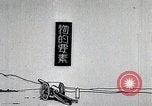
Japanese military airpower in early 1930s
Animated cartoon shows a Japanese soldier loading and firing an artillery field piece. The shell travels over a distant hill and explodes. Next scene shows large gathering of people with banners at a military airfield where aircraft and anti-aircraft equipment and guns are on display. A factory is at the edge of the field and its smoke stack is emitting dark black smoke. Viewed from beside parked Nakajima Army Type 91 Fighter plane, is seen some sort of table set up in the middle of the field. A photographer is taking a picture of it. Camera moves to tail of the airplane revealing an anti-aircraft search light parked next to it. Glimpse of Japanese red ball roundel painted on side of the airplane. General Sadao Araki, Minister of War, standing by a table, near a microphone, is given a rolled document. He presents it to a robed priest. Next, a shinto priest in white, waves a garland in front of a parked Type 91 Fighter plane to bless it. Two Japanese pilots place something on the table at center of the field. One is next seen in cockpit of a Type 91 plane and then taxiing and taking off on the field, as spectators watch from sidelines. A second Type 91 is then also seen taking off at the same time in formation on the right wing of the first. An animated cartoon shows many parked airplanes and several proceeding in a column from a hangar. These appear to be more modern (like single wing Type 91s) and dispel and replace all the other airplanes in the cartoon. Next, a squadron of Japanese Army biwing airplanes are seen taking off in loose formation from a dirt field. Aerial view of several biwings flying over a Japanese army airfield. Hangars and other buildings are visible on the ground below. Two of the aircraft are seen flying in close formation near the camera plane. Sunlight glints off their wings. View from above of biwing airplanes in formation below, flying over agricultural fields. A formation in flight viewed from below. Three Type 91 single wing aircraft flying in formation high overhead. Several aircraft maneuvering independently in the sky. The three Type 91 planes in formation heading straight toward the camera plane, and passing close overhead. Aerial view of a loose formation of Mitsubishi 2MB1 - Type 87, light bombers silhouetted in flight. A lone type 91 performing aerobatic maneuvers. Shadow of the camera-carrying bi-wing army plane being cast on the ground as it flies above it. The shadow grows larger as the airplane gets closer to the ground (apparently landing). Final scenes show several biwing airplanes taking off in loose formation. They have upper wing dihedral, smaller lower wings, backward slanted vertical stabilizers, and tail skids..
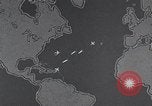
C-124 airplane flight during Cuban Missile Crisis
Flight plan on a map shows interception of three missiles. Trucks loaded on to a C-124 Globemaster 2 airplane. C-119. C-133 and C-130 aircraft seen in flight.. C-124 lands on airfield. Aerial view of air force base. Jet fighters parked on the airfield. Events during the Cuban Crisis.1962.
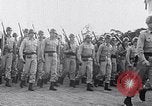
United Nations Security Council meeting to protect South Korea and preparation by US Marines and Army for Korean War.
United Nations meets to organize military action for protection of South Korea from Communist North Korea. United States troops in Tokyo, Japan prepare to advance to Korea. U.S. Army forces are seen passing in review before General MacArthur and General Omar Bradley in Tokyo, Japan. Back in the United States, a B-29 bomber, "moth balled" by being entirely encased in "cocoon" plastic since after World War 2, is rolled onto an airfield. Air force personnel remove the heavy plastic from the body and tires of the B-29, revealing its World War 2 nose art name "Lucky 13" (which had been among B-29 aircraft of the 25th Air Service Group in World War II). Navy Vought F4U Corsair aircraft with folding wings are unloaded from giant containers in aircraft hangars. A group of the F4U aircraft lined up at an airfield. Military equipment being loaded onto waiting ships, and carried by soldiers at a warehouse area. Units of the 1st U.S. Marines answer the call, are seen piloting amphibious vehicles in the ocean and onto the dock landing ship USS Gunston Hall (LSD-5) . Canadian sailors are seen boarding ships and Candian Navy destroyers leave British Columbia for Korea. Women and children wave form dock. Destroyers underway in sea. White, African American, and Hispanic young men in the United States are seen standing in lines at a United States Army enlistment office, answering the call to serve as new recruits in the Army. A group of new recruits raise their right hands and take an oath of service. U.S. President Harry S Truman speaks to a meeting of the Reserve Officers Association meeting, indicating that the only reason for this action is to hopefully arrive at the peace in the world that was hoped for when the United Nations was created. He leaves and shakes hands with officers. At Security Council meeting of the United Nations in Lake Success, New York, the President of Council, Arne Sunde, of Norway, invites Korean Ambassador to join table. Ambassador Chang comes and sits. The United Kingdom representative presents resolution which the body votes on (United Nations Security Council Resolution 84). It is passed by 7 to 0 in favor. The U.S. is asked to designate a military commander for the United Nations forces. The Korean ambassador, Chang Myon, expresses gratitude to the UN Security Council.
CRITICALPAST.COM: About Us | Contact Us | FAQs - How to Order | License Agreement | My Account | My Lightboxes | Shopping Cart | Advanced Search | Featured Collections | Website Terms & Conditions | Privacy Policy ©2026 CriticalPast LLC.
License Agreement |
Terms & Conditions |
Privacy Policy
©2026 CriticalPast LLC.