


 Francais
 Deutsch
 Italiano
Refine Your Search
Italy airfields stock footage and images
- Showing 2011 to 2016 of 3777 results more
more Hide
Hide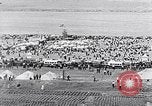
Russian helicopters at Tushino Air Show in Russia.
A huge gathering on flight line during Tushino Air Show in Russia. Views of train leaving grounds. A large cup of YAK-24 helicopters in flight over airport. A group of MI-4 helicopters landing on airfield. Helicopters land, troops debark from MI-4 helicopters. Views of crowd and houses near the airfield
Women Air Force Service Pilots train at Avenger Field in Sweetwater Texas during World War II
American flag flying over U.S. Army Air Forces Sweetwater Airfield (Avenger Field) in Texas, during World War 2. Above one building is seen the image of “Fifinella” on the logo of the Women Air Force Service Pilots (WASP). Women Pilots, in civilian clothes arrive by bus and enter the building. Next, they are seen in formation performing calisthenics, led by a male Air Force instructor. They also do pushups, and pullups, on horizontal bars. (Some have difficulty with this.) Next, a woman supervisor is seen blowing a whistle and the women, now dressed in fatigues, lining up in formation. In a classroom, a U.S. Army instructor explains an aircraft engine, using a cutaway engine. They take classes in map reading, navigation, and Morse code, and must pass exams in the various subjects. An Army Air Forces pilot holds a model plane while describing maneuvers. Next, a WASP is seen with an instructor as she enters a Link trainer, to learn and practice instrument flying. Several Link trainers are seen rotating with WASP trainees in them. Two WASP women, in flying suits, don seat pack parachutes. They and others head toward North American T-6 trainer aircraft on a flight line. They board the airplanes, in pairs, with one in the forward cockpit and one in the rear. (Narrator comments that on the next flight they will change cockpit positions.) Closeup from the front, as engine starts and prop turns. Other T-6s are taxiing out for takeoff. The two women pilots being followed by the camera, are next seen on the runway taking off. Views of various T-6 aircraft in flight, including some of two maneuvering in close formation in sky filled with white clouds. A T-6 peels off and dives. T-6s are seen landing back at the field. Closeup of one woman pilot in the cockpit of a larger aircraft, checking her appearance with a compact mirror. Women pilots in bathing suits go for a mass swim in a lake. Views of them swimming. They relax in the sun, afterwards. Women pilots helping one another fashion their hair. Several views of WASP pilots marching and passing in review during a graduation ceremony at the airfield. View from the rear of WASPs standing at parade rest during ceremony where they receive their wings from famous woman pilot, Jacqueline Cochran, founder of the WASP. Closeup of Ms. Cochran, in civilian clothes, on a speakers stand. Closeups of individual women pilots in the formation and of others as they receive their wings from Jacqueline Cochran. Film concludes showing WASPs with their baggage, boarding C-47 transport aircraft to take them to their various assignments. Closeup of U.S. Army Air Forces Air Transport Command logo on side of the C-47. Inside the airplane, the WASPs don parachutes. The aircraft takes off.
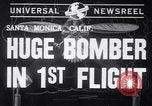
First flight of the Douglas XB-19, at Clover Field, Santa Monica, California
Huge single 8-foot diameter tire on the XB-19 bomber is seen rolling over airfield ramp at the Douglas aircraft company Clover Field in Santa Monica, California. Douglas engineers walk along beside the B-19 aircraft as it is being towed. U.S. Army Air Forces test pilot, Major Stanley M. Umstead, stands with a Douglas Aircraft Company executive, in front of the XB-19 wheel. A mechanic is seen on an engine nacelle, looking down over the propeller.The XB-19 is towed into position. View of the empennage, with rudder slightly turned. The airfield is crowded with Douglas company employees out to watch the aircraft's first flight. Baggage being loaded on the aircraft. Engines start and the XB-19 taxis and takes off and does not raise its landing gear. The XB-19 in flight,with landing gear still extended, seen from a chase airplane. It departs the coastline. View from beneath the XB-19 as it cruises, at low speed. The XB-19 coming in for a landing at March field, Riverside, California. The pilot rounds out high and porpoises a bit until touching down on main wheels, and slowly lowering the plane onto its nose wheel. The XB-19 rolls out on the runway showing full flaps. A crowd has turned out to watch the aircraft's arrival.Newsmen and photographers gather as the crew stand on the ramp. Major Umstead, with cigar in his mouth, is interviewed.
Battle of Los Negros in Admiralty Islands during World War II
On orders from General MacArthur, the 2nd Squadron (dismounted), 5th U.S. Cavalry Regiment, 1st Cavalry Division of the United States Army on a Reconnaissance in Force mission at Los Negros,Admiralty Islands. Prior to their landing, two Spitfire aircraft of No. 73 Wing, Royal Australian Air Force (RAAF) are seen attacking Japanese positions in the jungles near the beach. U.S. Navy warships bombard the area and U.S. B-25 bombers from the 345th Bomb Group , 5th Air Force, drop bombs along the beach. After landing, the Reconnaissance Squadron, reinforced with other U.S. 1st Cavalry Division troops, advances into dense jungles. Troops spray the area with machine gun fire. A Squad seen firing a mortar. U.S. troops firing a field gun with "Bataan" written in chalk, on the barrel. B-25 bombers fly very low over edge of Momote airfield and drop bombs. 1st Cavalry troops battle their way against hidden Japanese forces and capture the Momote airfield. General MacArthur comes ashore and congratulates the troops. A wounded soldier carried on a stretcher. U.S. medics tend to wounded soldiers. Wounded are given plasma. Dead Japanese soldiers on ground.
Ground and air crew of Allied aircraft work to bomb German held territory in France and Netherlands in Spring of 1944 during World War 2.
Allies bomb Nazi targets in France and Netherlands during World War II. An animated map shows France and Germany. Allied squadrons move towards the bombers. Martin B-26 Marauder aircraft taxi and take off from a British airfield in England, United Kingdom. Interior cockpit view of a B-26 A pilot in the cockpit as he puts on a steel combat helmet and wears a steel jacket. A formation of bombers drops bombs on a Nazi German controlled airfield in Holland. Ground crew watches as a bomber comes in for landing. An aircraft sends off flares shortly before landing, indicating to ground crews that there are wounded soldiers on board. The bomber lands on its belly. Ground crew moves towards the bomber. A row of bombers. Crew members work on the bomber. Multiple shots of more bomber aircraft as they take off (some shots from the side, and some with the aircraft approaching the camera position). View of bombs attached to the bomber with bomb bay open. Bombs away view as bomb clusters are released through open aircraft bomb bay doors. Bombs dropped on Nazi installations in France. Aerial view of explosions on the ground.
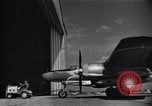
Use of artificial lightning equipment in Project Thunderstorm, and radar operations supporting project and its aircraft
Tug tows Northrop F-15 Reporter into hangar in Minneapolis, Minnesota to be instrumented for Project Thunderstorm. Various scenes of electrical equipment used in making man-made lightning, including a generator made up of hundreds of transformers, and a connected massive generator for producing high voltage. A large oscillograph is shown along with a smaller oscillograph designed for airborne use. A scientist is seen inside the giant generator. Artificial lightning tests are made on canopy of the F-15 occupied by a scientist, and the canopy remains intact following lightning strike. Lightning rods are attached to lightning-vulnerable nose, tail fin, and wing tip locations of the Project Thunderstorm aircraft. Pilot climbs into canopy of F-15. Airborne F-15 project aircraft seen in flight headed toward area of dark clouds. In Ohio at Clinton County Army Air Field, a project officer (AAF Captain) describes how search procedures of the pilot, weather observer, and radar observer are coordinated and key locations of radar and cooperating facilities at Jamestown and the Clinton County Army Airfield. Large radar antenna revolving on top of large tower, scanning for signs of thunderstorms. Radar antenna scanning vertically, near Quonset huts. Command center inside a quonset hut with project personnel at radar scopes and thunderstorm and aircraft positions plotted on large plexiglass screens. Technician adjust motion picture camera that photographs radar scopes every four seconds. Operator at vertical measuring instrument, showing reflected returns from targets, on July 18, 1947. View of operator at plan position indicator radar scope showing weather returns on June 6, 1947. Ground Control Approach (GCA) truck located near end of airfield to guide landings of Thunderstorm aircraft. Radio operators sitting at radar scopes inside the GCA unit. P-61 makes GCA approach and landing in good weather, to maintain skills needed when weather is bad. Briefing officer at blackboard cites radio channels to be used for various purposes. View of AAF aircrews in audience.
CRITICALPAST.COM: About Us | Contact Us | FAQs - How to Order | License Agreement | My Account | My Lightboxes | Shopping Cart | Advanced Search | Featured Collections | Website Terms & Conditions | Privacy Policy ©2026 CriticalPast LLC.
License Agreement |
Terms & Conditions |
Privacy Policy
©2026 CriticalPast LLC.