


 Francais
 Deutsch
 Italiano

Refine Your Search
Italy airfields stock footage and images
- Showing 2107 to 2112 of 3791 results more
 Hide
Color Sound

U.S. Army CH-47 Chinook helicopters drop ammunition supplies at Bien Hoa Air Base in Vietnam during the Vietnam War.
U.S. 1st Aviation Brigade Corps in Vietnam during the Vietnam War. A container is lowered to the ground and is unhooked from a U.S. Army CH-47 Chinook helicopter at Bien Hoa Air Base. A soldier holding a baggage gets off from the helicopter onto the airfield. Several army trucks in view. A square open area at the base of the helicopter and a sling hook in view. The helicopter in a low flight over an airfield where several loads are arranged. A soldier looking through the area. A sling load of ammunition supplies being hooked on to the helicopter. The helicopter in flight over fields. The sling is unhooked and is dropped on a field. The helicopter in flight over a wooded region and a few fields. A water body in the fields.

U.S. Army OV-1 Mohawk attack aircraft and CH-47 Chinook helicopter in Vietnam during the Vietnam War.
U.S. Army aircraft in Vietnam during the Vietnam War. A U.S. Army attack aircraft OV-1 Mohawk taxis at Vung Tau Army Airfield. A crewman walks up to the cockpit area of the aircraft and speaks to the pilot. U.S. Army 1st Aviation Brigade insignia on the aircraft. A U.S. Army CH-47 Chinook helicopter in flight carrying a UH-1 Iroquois helicopter in a sling. An OV-1 Mohawk aircraft and a CH-47 Chinook helicopter taxiing on a runway. A few ground men beside the OV-1 Mohawk during a preflight inspection. Two men on the top of the aircraft checking the engines. The engines of the aircraft are started. The aircraft taxiing on the airfield.
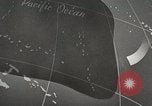
American Forces advance against Japanese held areas of New Guinea during World War II.
Animated map shows U.S. forces extending control in the Pacific the the Marshall and Gilbert Islands in the Pacific during World War 2. An American soldier sentry near a destroyed Japanese reinforced concrete bunker. Another looks at a destroyed Japanese coastal gun. More American soldiers looking over destroyed Japanese coastal defenses. A destroyed Japanese type 95 HA-GO tank. A U.S. troops look at a destroyed Japanese Mitsubishi G4M (Betty) bombers on a captured airfield. Animated map of New Guinea.showing Allied advance to Hollandia. U.S. aircraft carriers with their aircraft flying overhead. Closeup from behind of a Navy Grumman F6F Hellcat aircraft taking off from a carrier. Formations of U.S. Navy carrier-based aircraft in flight overhead. Escort aircraft carriers (called "Jeep" carriers by the narrator) are seen with decks full of airplanes. Douglas SBD Dauntless aircraft taxiing on a carrier deck. An F6F fighter plane taking off. A formation of Douglas SBD Dauntless airplanes viewed from above, flying over the sea. Gun camera films from U.S. aircraft strafing parked airplanes on Japanese airfields.
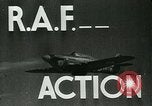
World War I Royal Flying Corps airplanes and flight crews shown during a historical retrospective on the Royal Air Force
Part of a British production, circa 1940, highlighting the work of the Royal Air Force during World War II, and discussing the history of the RAF while showing World War I Royal Flying Corps (RFC) images. The Royal Air Force in the United Kingdom. The flag of the Royal Air Force (RAF) on a mast. RAF personnel from all parts of the commonwealth march in a mass formation during World War II, including mainland Great Britain pilots and Indian RAF pilots and crews. A line of aircraft stationed on an airfield in the UK. History of RAF is discussed by narrator, with images from World War I of Royal Flying Corps (then part of British Army) airmen and their aircraft. Views of several World War I aircraft on an airfield and taking off, including the Sopwith Camel, the Royal Aircraft Factory S.E.5, the Bristol F.2 Fighter. Royal Flying Corps pilots and crews gathered for group photos.
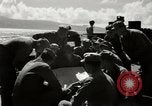
U.S. forces occupy military Naval Base in Japan, at the end of World War II
A group of U.S. Marines, aboard a ship, lean over a map and discuss their mission to occupy an airfield at Yokosuka, Japan, at the end of world war 2..The U.S.Destroyer, USS Allen M. Sumner (DD-692), is seen in the background. Scene changes to Marines crowded in a Landing Craft, Vehicle, Personnel (LCVP) near a troop transport ship. The craft displays a pennant bearing the number "7." Next, they approach a seaplane ramp at the Yokosuka Naval Base, where their craft lowers its door and they disembark. They march off in a formation. ( Many U.S. Marines are already seen on the base, having arrived in earlier landing craft.) Camera pans over hangars adjacent to Atsugi airfield, where debris is strewn about, including inverted remains of a Japanese transport plane and remains of two single engine fighter planes. U.S.. Marines enter a large hangar, showing blast damage on its doors. Others enter another large hangar. View from above of several Japanese Mitsubishi A6M2b Zero Fighter planes on a ramp outside a hangar. View from a high point overlooking damaged hangars, shows a bay of water with hills and some other installations at opposite water's edge. Camera pans back again to the Zero fighter planes and hangar seen earlier. Another view of fairly large body of water behind the damaged Naval base. Group of Marines marching past a hangar. Inverted Japanese aircraft in foreground. Closeup of U.S. Navy Fleet Admiral Chester W. Nimitz, U.S. Navy Fleet Admiral William Frederick Halsey, Jr. and and other officers.

Alexander Vandegrift and Clayton Vogel drive in a jeep and a Japanese sunken ship off the coast of the Solomon Islands.
Japanese ships smashed in Guadalcanal, Solomon Islands during World War II . Henderson Airfield at Gaudacanal. A U.S. aircraft in flight. A new runway built by U.S. soldiers. U.S. Marine Corps Major General Alexander Vandegrift at the airfield with other officers. A burning and sunken Japanese ship at the Solomon Islands. A pilot in the cockpit of a U.S. aircraft in flight. Vandegrift and U.S. Marine Corps Major General Clayton Vogel get in a jeep and move towards a jungle. Japanese troops in jeeps cross a bridge and enter a canal. Japanese infantry men walk on a dirt road. The marines bring supplies on amphibious tanks. A U.S. ship set on fire off the shore. Smoke rises due to the fire. The marines unload supplies from the ship.
CRITICALPAST.COM: About Us | Contact Us | FAQs - How to Order | License Agreement | My Account | My Lightboxes | Shopping Cart | Advanced Search | Featured Collections | Website Terms & Conditions | Privacy Policy ©2026 CriticalPast LLC.
License Agreement |
Terms & Conditions |
Privacy Policy
©2026 CriticalPast LLC.