


 Francais
 Deutsch
 Italiano
Refine Your Search
Italy airfields stock footage and images
- Showing 2131 to 2136 of 3777 results more
more Hide
Hide
U.S. troops capture Roi-Namur island in Kwajalein Atoll, Marshall Islands during the Battle of Kwajalein of World War II.
U.S. troops on Roi-Namur island of the Kwajalein Atoll during the Battle of Kwajalein in World War II. Marines at a 1.1"/75 caliber gun on the deck of a ship. A fleet of U.S. Navy transports and aircraft carriers underway at sea. The cargo deck of an LST (Landing Ship, Tank). Explosions due to bombardment on Kwajalein Atoll. U.S. Marines in boats heading towards the shore. Smoke due to explosions on the beach. Troops going down the side of transport ship using a cargo net into the LCVP (Landing Craft, Vehicle, Personnel). Ships at sea and clouds of smoke rising in the background. Marines getting down from LCVPs on the shore. A Marine fires a 3"/50 caliber gun. An amphibious craft on the shore. A U.S. Navy dive bomber SBD Dauntless in flight overhead. Explosions on the beach. An LCM (Landing Craft Mechanized) underway at sea. The Marines get off an LVT (Landing Vehicle Tracked) and advance across the beach. Marines and a few amphibious vehicles on the beach. An LVT coming up on the beach. Two GIs firing rifles on the shore. An LST with troops on the beach. Marines load and fire 75 mm howitzers. A combat cameraman operates a camera mounted on a tripod. Marines on an airfield. An explosion occurs and dirt and rubble fly all around. Marines inside a bomb crater firing carbines. A Marine looking under a concrete slab aiming his carbine. A Marine engineer constructing a yard grenade with one end in a hole and other Marines standing around taping a fuse on it. Two Marines run away from the hole. Explosions occur. Dead Japanese soldiers lying behind a wooden screen. A partially constructed Japanese hangar with burnt canvas. A part of the tail of a Japanese bomber in view. Two soldiers beside a wrecked aircraft. One of them looking into the fuselage of the aircraft. View of the tail assembly of a wrecked Japanese bomber on an airfield. A damaged Japanese bunker. An LCVP beside a U.S. Navy ship. Wounded men being transferred from the LCVP to the ship. Church services held on a beach at Kwajalein.
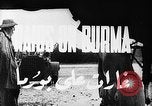
Royal Air Force bombers drop bombs over target areas in Burma during World War II.
The Royal Air Force bombs Burma during World War II. British airmen on an airfield in Burma. Bombs brought in on a bomb cart. An airman rolling a bomb to the underside of an aircraft to fix it onto the bomb rack. A few airmen fixing the bomb onto the bomb rack on the underside of the wing. A man in front of one of the wings of the aircraft and the pilot standing in the cockpit with the hatch open. The bomber aircraft taxis on the airfield and takes off. The aircraft in flight over the clouds. The pilot in the cockpit. Aerial views of the target areas in Burma. Bombs being dropped on the target areas. Explosions occur and smoke rises from the explosions.
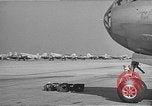
USAAF General Henry Arnold briefs a B-29 combat crew on Saipan, Mariana Islands before a mission to Tokyo, Japan.
A B-29 combat crew is briefed on Saipan island, Mariana Islands during World War 2. Several aircraft parked on an airfield. Few baggages in front of an aircraft. United States Army Air Force Generals Henry H Arnold and Lauris Norstad and another officers walking up to B-29 crew standing on the airfield. General Norstad introduces General Henry Arnold to the combat crew of B-29 Superfortress and the commandants who are on their way to Tokyo, Japan after joining the 21st Bomber Command. General Henry Arnold shakes hands with the commandants. The crew standing in a row beside a USAAF heavy bomber B-29 Super Fortress. General Arnold briefs the crew. The General says the 21st Bomber Command has been operating out of China and the crew has the best of the aircraft which could carry the heaviest of loads. The General tells the crew that the message which is to be conveyed to Japan, is to be written on bombs. A few members of the crew wheel a cart loaded with bombs beside the aircraft. One of the crew members writes a message on a bomb as the General dictates. The Generals, the commandants and the crew members beside the cart of the bombs. The General wishes the crew good luck and shakes hands with the commandants. The message on the bomb for the enemy reads 'To the Warlords of Japan, We have not forgotten - The B-29s will remind you again and again and again'.

U.S. President Kennedy is greeted by French President De Gaulle and other officials in Paris, France.
United States President John F. Kennedy and French President Charles de Gaulle in Paris, France. An aircraft arrives at Paris Orly Airport. Several people gathered on the airfield. U.S. President John Kennedy and his wife Jacqueline “Jackie” Kennedy come down the steps of the aircraft. President Kennedy is greeted by President De Gaulle and other officials. A French officer salutes and greets the President. The President shakes hands with the officials. President Kennedy, President de Gaulle, and the officials walking on the airfield. Aerial view of vehicles moving on streets. Several horsemen on the streets. The officials moving in an open carriage. Horsemen escorting the carriage. People gathered on both sides of the streets to the motorcade. U.S. and French flags hoisted on poles. Soldiers standing on sides of a path. President Kennedy and President Charles de Gaulle go up the steps of a building followed by their wives, Mrs. Kennedy and Madame Yvonne de Gaulle. The Presidents talk.
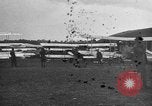
Pilots and mechanics work on DeHavilland DH-4 bombers at the 1st US Air Depot in Colombey-les-Belles, France during World War I.
Activities at the First Air Depot in Colombey-les-Belles, France during World War I. An early morning scene shows a large number of new De Havilland DH-4 bombers, painted in French colors, parked on the airfield. Pilots and mechanics begin to move amongst the aircraft and work on them. Extended panorama of hangars and buildings with clouds in the sky. New DH-4 and Spad XIII aircraft near canvas hangars. Some aircraft stripped for parts or repair. Mechanics and pilots near the aircraft. Men smooth parts of the airfield using horse-drawn wooden platforms. Pilots and mechanics near new and repaired parked aircraft.
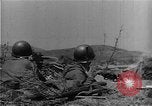
Information about unidentified airplanes is transmitted in the United States.
A public television program by the U.S. Army entitled 'The Big Picture.' U.S. troops are seen hunkered down and looking through binoculars in a defensive position in Korea, during the Korean War. American soldiers riding atop a Sherman tank on a city street in Germany, during World War II. Ski troops moving across snowy hill in Alaska. U.S. Army amphibious assault training on a beach in Puerto Rico. Army Master Sergeant Stuart Queen, narrator, speaks about America's defense against threat of atomic attack in these times of lukewarm peace. View of mountainous region in Alaska. A cluster of Cup'it Eskimo dwellings is seen on Nunivak Island, in the Bering Sea. Several of the local inhabitants are fishing through holes cut in the ice. Vapor trails are seen from Soviet aircraft flying at high altitude. A sign on a tarpaulin displaying logo of the Army Signal Corps, reads,"Alaska Communication System, Long Distance Commercial Telephone-Telegraph." A tracked vehicle carries a soldier to a facility posting a sign reading, "Alaska Communications System Receiver Station." Several tall antennas loom above the site. The soldier, dressed in arctic gear, steps from the tracked vehicle and walks past several snow shoes, standing upright in the snow, to enter a white wooden building. Inside, a man in civilian clothes works at a battery of telecomunications equipment. He transmits a message about the aircraft sighting, to the Alaska Communication System facility in Fairbanks Alaska (briefly shown) by means of a telegraph key. From there it is relayed to a Signal Corps facility, shown, in Washington, DC. A soldier is seen Inside that facility, in a room filled with computers and telecommunications equipment. A Sergeant handles paper tape messages being sent and received by teletype. Another soldier plugs connections into a communications switchboard. Next, the camera pans over the entrance to the Office of the Secretary of Defense, in the Pentagon. More views of soldiers attending banks of teletype machines. Animated map displays paths of orders being transmitted to U.S. Air Defense Centers in San Francisco, Chicago, Seattle, New York, and Atlanta. View from control room, of several U.S. Air Force F-94 Fighter Interceptor aircraft on an airfield ramp. A controller activates a Klaxon horn and pilots on alert, in the Fighter Interceptor Squadron ready room, jump up and scramble to their aircraft. A pair of F-94s taking off. One is number 51-5385. Next, a U.S. Navy F-9 fighter plane is seen taking off from an airfield. It displays tail code AE. It is followed by another F-9 aircraft.
CRITICALPAST.COM: About Us | Contact Us | FAQs - How to Order | License Agreement | My Account | My Lightboxes | Shopping Cart | Advanced Search | Featured Collections | Website Terms & Conditions | Privacy Policy ©2026 CriticalPast LLC.
License Agreement |
Terms & Conditions |
Privacy Policy
©2026 CriticalPast LLC.