


 Francais
 Deutsch
 Italiano
Refine Your Search
Italy airfields stock footage and images
- Showing 2431 to 2436 of 3777 results more
more Hide
Hide
Italian bombers from Sicily, attack British warships at sea.
An Italian military airfield in Sicily. A flight of 7 fighter aircraft in formation, abreast, flies over the field. A row of Macchi C.200 Saetta aircraft parked in front of a hangar (also variously called MC.200 or Macchi 200). A row of Savoia-Marchetti SM.79 Sparviero Trimotor bombers parked across from them. Ground crews loading torpedoes on the bombers. A Reggiane Re.2001 Falco II airplane being serviced. Ground crewman reports to pilots that their bomber is ready. They board and ground crew pulls chocks as the engines are running. View inside the S.79 cockpit with pilot's hand on the triple throttles. The bomber takes off raising lots of dust as it goes. Italian aircraft in flight. British ships sighted below. The Italian bombers attack. Flak bursts in the air. One S-79 skimming the water surface. Other S-79s dropping torpedoes from relatively high altitudes (perhaps 1500 feet). A British warship is struck with large explosion. Italian planes returning with at least two burning British warships left behind. (World War II period).
Nieuport 17 airplanes being built in a factory in France during World War I
Interior of a French aircraft factory during World War 1. Stacks of lumber in their receiving department. Men work on airplane framework stretched across wooden horses. Women in dresses and caps work on electric ignition wiring. men occupying an office area on the factory floor. Partially assembled aircraft lined up in the background. Men and women in a wing assembly area. Two scenes of men working in an engine assembly area. A man stands next to a LeRhone 9J,110 Hp rotary radial aircraft engine mounted on a mobile test stand. He rotates the engine. Another man displays one fitted with a long propeller shaft. A third man starts an engine fitted with a propeller. It runs on the test stand. A group of completed Nieuport 17 aircraft fuselages, lacking only wings and propellers. Larger view of that factory room, with men fitting the wings onto the airplane bodies. A line of airplanes with wings on the opposite side of the room. View of an airfield with a line of Nieuport airplanes parked in front of buildings. (WWI; WW1)
French signalman raises signal ball on a semaphore tower in France during World War I
French signalman raises large signal ball aloft on a semaphore tower at an airfield in France, during World War 1. One signal ball is already displayed on the tower, along with a flag and a weather vane. (WWI. WW1)
Scenes from the Dole Derby or Dole Air Race from California to Hawaii in August, 1927
Opening scene shows several aircraft and aircrews on an Airfield in Oakland, California, readying for the Dole Air Race to Hawaii. A modified Travel Air 5000 aircraft, NX869, named "Woolaroc," is seen in the near foreground. Behind it is another Travel Air 5000, named "Oklahoma." Next, the "Oklahoma" and the "Aloha"(NX914), a Breese-Wilde 5 Monoplane are seen with engines running and taxiing. The "Aloha" takes off and climbs sharply after gaining airspeed. Several Wickes-class destroyers are seen steaming underway. (Slate reports they patrol the course to be flown over the Pacific.) Scene shifts to wreckage of the "Angel of Los Angeles" a twin engine Bryant Monoplane, which crashed on a test flight at Montebello, California. (Pilot, Arthur V. Rogers, bailed out at the last minute but his parachute didn't fully open and he was killed.) Next is shown the wreckage of the "Pride of Los Angeles," an International CF-10 Triplane, after crashing into San Francisco Bay on August 11th. Pilots J. L. Giffin and Theodore S. Lundgren are seen stepping from the water, unhurt. A crane, on a barge, lifts the wreckage from the shallow water.
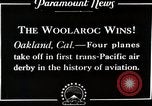
Scenes from the Dole Trans-Pacific Air Derby of 1927
Aerial view of airfield at Oakland, California. Pilot, Bennett Griffin, is seen with his wife and child, standing beside his Travel Air 5000 airplane,"Oklahoma." Registration number:"N-X 911" is stenciled on its tail. Pilot Martin Jensen, saying farewell to members of his family in front of his airplane,"Aloha" (that finished second in the race). Aircraft being readied for takeoff. Starter with checkered flag stands ready as nine men push the Travel Air 5000 "Oklahoma, the first to take off, forward into starting position, with engine running. Next scene shows starter holding stopwatch and flag. He signals start with the flag. Scene shifts to the second aircraft to take off, the Goddard Special metal monoplane, NX5074, "El Encanto." Camera tracks as the airplane has difficulty breaking ground, skipping several times in a long ground roll. Suddenly, it veers off the the right in a crab, wiping out its landing gear and breaking part of its right wing as it flips over in a crash leaving it tilted on its left wing facing backwards. Some smoke is seen but quickly disappears. Men and rescue personnel rush to the scene. (Reportedly the crew was unhurt.) Next, the prototype Lockheed Vega 1 monoplane, NX913, "Golden Eagle," is making smooth takeoff. Navigator Gordon Scott waves to spectators below as the plane climbs out. Aerial view of the plane in flight. The "Miss Doran," a Buhl CA-5 Air Sedan, number NC2915, is seen next on takeoff, past photographers and spectators, and then airborne. Next, the Breese-Wilde 5 Monoplane, NX914, "Aloha" is seen taking off. It climbs out very slowly. Navigator Paul Schluter waves as they depart. Pilot Arthur C. Goebel and navigator, Willian V. Davis Jr. are seen next by their plane "Woolaroc." A woman wishes them good luck, with a bouquet of flowers. Next, men are seen pushing the "Woolaroc" and it takes off and climbs. Pre-departure footage of Pilot Gordon Scott and navigator John W. Frost, with friends, near their airplane, "Golden Eagle." (Their aircraft vanished in the Pacific.) Pre-departure footage of pilot John Augie Pedlar, navigator Lieutenant Vilas R. Knopie, and their passenger, Mildred Doran, whose aircraft, "Miss Doran," was also lost in the Pacific.
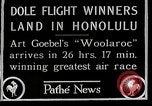
Winners of the 1927 Dole Derby Trans-Pacific air race land in Honolulu, Hawaii.
A huge crowd of people (including a number of U.S. Army personnel in uniform) converges on the airfield at Honolulu, Hawaii, to witness the arrival of the Travel Air 5000 airplane, named "woolarc," winner of the Dole Derby trans-Pacific air race. The aircraft taxis across a wide swath of grass, assisted by men at each wing. A small airplane taxis behind it. An Army officer walks past the camera. Pilot Arthur C. Goebel and navigator, William V. Davis Jr. are seen next with Hawaiian Leis around their necks as they are surrounded by congratulatory well-wishers. They are closely escorted by an Army officer into a tent, where some children, including one boy with a bandage and patch over his left eye. Outdoors, Pilot Arthur Goebel receives more flower leis and poses for closeups. Next, the Breese-Wilde 5 Monoplane, NX914, "Aloha" is seen taxiing after arriving second in the race. an Army officer waves some spectators away from the taxiing aircraft. Navigator Paul Schluter waves from the rear cockpit. He and pilot, Martin Jensen, are next seen with leis around their necks. In the final sequence, winners Goebel and Davis are seen with second place aviators, Jensen and Schluter, flanking James D. Dole, who has just presented each pair their award checks.
CRITICALPAST.COM: About Us | Contact Us | FAQs - How to Order | License Agreement | My Account | My Lightboxes | Shopping Cart | Advanced Search | Featured Collections | Website Terms & Conditions | Privacy Policy ©2026 CriticalPast LLC.
License Agreement |
Terms & Conditions |
Privacy Policy
©2026 CriticalPast LLC.