


 Francais
 Deutsch
 Italiano
Refine Your Search
Italy airfields stock footage and images
- Showing 2833 to 2838 of 3777 results more
more Hide
Hide
Scenes of U.S. Army Air forces operations on Adak Island during the Aleutian Islands Campaign of World War II
As film begins, organ music is heard. Camera pans across tops of tents showing sky above. Scene shifts to a Chaplain conducting Sunday services in the open. A soldier plays a field organ as soldiers and airmen participate in the service. Closeup of the Chaplain kneeling before a makeshift altar where objects are placed to facilitate communion in a mass or service. Complete change of scene shows airmen arranging bombs for loading aboard an open truck that then backs up to an airplane, into which they are loaded. Narrator notes that these are all purpose bombs weighing 250, 500, and 1000 lbs, respectively. Closeup of a 1000 lb bomb in foreground marked "GP 1000 lb AN-M44." Airmen arnorers install fins and fuses before loading the bombs aboard the aircraft. An airman loads belts of machine gun ammunition at a gun turret of the airplane. others load guns elsewhere on the aircraft. Closeup of pilots being given final briefing about the mission, before departure. Narrator notes that the mission will involve two flights of B-24s and one of B-17s. Planned altitudes and routes of the bombers are drawn on a map in colors. They are to attack a Japanese installation on Kiska Island. Fighter support is described. A Flight crew assembles near their B-24 Liberator bomber. Closeups of individual crew members waiting on the airfield ramp. Scene shifts to fighter pilots who will be accompanying the bombers. They converse in front of a row of fighter aircraft. They are wearing flotation gear over their flight suits. The area is paved with Marsden matting (pierced steel planking). Closeups of men in the group, including: Lieutenant George I. Rudell, Lieutenant Holy P. Mail, Lieutenant Lial A. Bean, Major Willson Aston, Lieutenant Henry J. Strencops and Colonel Jackson.
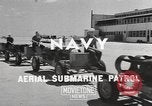
U.S. Navy PBM Mariner aircraft drop depth bombs during an aerial patrol in the Pacific Theater.
The film 'Aerial Submarine Patrol' shows aerial submarine patrolling in the Pacific Theater during World War II. A convoy of ships underway at sea. United States Navy Martin PBM Mariner aircraft fly over water. A half sunken freighter down at the stern. Pilots seated in a cockpit. A formation of PBM Mariner aircraft drop depth bombs or depth charges into the water to combat enemy submarines. Pilots and navigators mapping out a route. A dolly loaded with bombs moves towards PBM Mariner aircraft parked at an airfield Crew get in the aircraft.
U.S. Army Training film about Army Air Forces regulations for pilots training in Boeing Stearman PT-17 "Kaydet" aircraft.
As film opens, a number of U.S. Army Air Forces Stearman Boeing PT-17 “Kaydet” bi-plane trainer aircraft are seen taxiing on an airfield. One takes off and another lands and taxis into position on the flight line. A student pilot leaves the operations building and fastens the leg straps of his seat pack parachute before climbing upon the wing of a PT-17, where he checks the aircraft's Form One record. Closeup of the form. He climbs into the cockpit, fastens his safety belt. Glimpse of magneto switch. Glimpse of fuel gauge. With engine running the pilot activates the flight controls to check proper action. Glimpse of tachometer showing 1550 RPM. View of airplane taxiing in "S" movement because of low visibility with engine in front. Closeup of pilot pausing before takeoff to recheck wind and runway. Views of the aircraft on takeoff, tail wheel rising, and plane becoming airborne. Animated diagram shows precautions for turning out of traffic after takeoff and for avoiding collisions using right of way rule. Glimpse of PT-17 cruising above farmland. Views of the plane flying in vicinity of clouds but carefully avoiding them. Closeup of pilot in cockpit looking all around while in flight. View of cockpit instruments, including compass, airspeed indicator, Needle and ball, and altimeter. Closeup of engine oil temperature gauge. View of the airplane flying close to another and follow rule to prevent collision. Next, the aircraft makes a shallow dive and then executes a spin. Closeup of the pilot signaling everything is OK. (World War II; WW II; World War 2; World War Two)
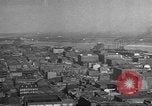
Men work in a factory and iron ore is transported to industries in the Midwestern United States.
Industries in the Midwestern United States. Aerial view of industrial and manufacturing buildings. Men punch in to a time clock using punch cards in a time clock. Men operate machines in a factory that makes machine parts. Coal transported in rail cars. A giant crane shovel loads iron ore in hopper cars in northern Minnesota. Hopper cars transport ore to shipping area at Lake Superior. Barges at docks on Lake Superior. Aerial view of barge underway on Lake Superior, still near land port. Side view of locomotive engine of Illinois Steel Company South Works, with conductor leaning out window, as it pulls away carrying iron ore. View inside plant as iron ore is converted to iron and then to steel for use in industries. Ships underway in inland waters. Close up view of black locomotive train engine in marshaling yard as it moves slowly. A rail worker is climbing on a side ladder of the moving train. View from behind train of hopper cars as it departs the marshaling yard. Trucks at a loading dock area. A United Air Lines DC-3 aircraft parked at an airfield. Passengers ascend ladder into the DC-3. The DC-3 United Airlines aircraft taxis, and number NC 25613 is seen under its left wing. Animated map show rail network, concrete highways and air network in the Midwestern United States.

Aircrews of the 303rd Bombardment Group take delivery of new B-17s during World War II.
The United States Army Air Force (USAAF) 303rd Bombardment Group (Heavy) 'Hell's Angels' taking delivery of new B-17 bombers at Kellogg Field, Battle Creek, Michigan. (Between 11 September and 2 October the 303rd BG took delivery of 35 new B-17Fs, 33 built by Boeing and two by Douglas. The 303rd flew missions out of Molesworth Airfield in England, during the war.) Several aircraft parked on the ramp in a row. Airmen around the aircraft. Airmen on a tug nearby. Some names and artwork on the B-17s. Hunga-Dunga painted on a B-17. Officers and airmen move under the aircraft wing. 'Garbage' painted on an aircraft. Officers stand nearby. Three crewmen laugh and pose. Additional notes: From Brian O’Neill’s “303rd Bombardment Group” here is the fate of the name ships shown: Serial No. Name Original Pilot Aircraft Fate 41-24588 Hunga Dunga J.E. Haas MIA 18 Mar 43 41-24563 Garbage A.I. Adams force landing and collision 11 Nov 43 41-24562 Sky Wolf C.H. Morales MIA 11 Jan 44
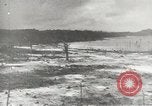
Steel meshes are laid for construction of airstrips and airplanes take off from Pacific islands.
Earth moving equipment on Pacific islands. A rough terrain and a later view of the same area as an airfield is constructed by equipment. Airplanes fly over a Japanese island. Beaches and pontoon bridges. Steel meshes are laid for construction of airstrips on Bougainville and in the Aleutians. An aircraft lands. Airplanes take off from a runway constructed by earth moving equipment.
CRITICALPAST.COM: About Us | Contact Us | FAQs - How to Order | License Agreement | My Account | My Lightboxes | Shopping Cart | Advanced Search | Featured Collections | Website Terms & Conditions | Privacy Policy ©2026 CriticalPast LLC.
License Agreement |
Terms & Conditions |
Privacy Policy
©2026 CriticalPast LLC.