


 Francais
 Deutsch
 Italiano

Refine Your Search
Italy airfields stock footage and images
- Showing 3181 to 3186 of 3791 results more
 Hide
Color Sound
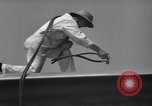
Painting and mothballing B29s and B-17s in the United States
U.S. Army Air Force B-29 Superfortress bomber aircraft at an airfield in United States during World War II. A civilian spray paints the wing of a B-29. A painter uses a roller around the wing insignia. Several civilians using ladders, paint a B-29 Superfortress. Man on forklift empties 55 gallon drum of mastic liquid into power sprayer. Sprayer nozzles are shown. Operator sprays mastic material on fuselage of mothballed B-29, to seal it. B-17 with mastic sprayed on tail section of fuselage. A Wright 3350 radial engine from a B-29, on a stand and series of views as it is gradually mothballed. View of sealed B-29 airframe, with engines removed, and hosing connected to various openings.
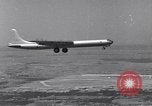
A U.S. Air Force B-36 Peacemaker bomber aircraft lands at Carswell Air Force Base in Texas, United States.
XB-36 first flight on August 8, 1946, at Fort Worth, Texas, with Convair Chief test pilot Beryl Erickson and copilot Gus Green, at the controls. The XB-36 flying over airfield, with landing gear extended. Views from side and below. Views from above, from the side, from below and from the rear, as it flies some distance from the field, with gear still extended. XB-36 on final approach crossing a river, and touching down on first part of runway as it lands.

American aviator Howard Hughes finishes his trip around the world in a Lockheed L-14 aircraft and lands in New York, U.S.
American aviator Howard Hughes completes his trip around the world and is greeted by a crowd in New York, United States. A Lockheed L-14 Super Electra passenger aircraft in flight. The aircraft lands and taxis on an airfield. Aviator Howard Hughes is surrounded by a crowd and is interviewed by newsmen.

Howard Hughes is greeted by a large crowd as he lands in New York, U.S. after the completion of his trip around the world.
American aviator Howard Hughes completes his trip around the world and is greeted by a crowd at Floyd Bennett Field in New York, United States. A crowd await the arrival of Howard Hughes. Hangar with sign for "Erickson & Remmert" pilot school and airplane repair facility on building. A Lockheed L-14 Super Electra passenger aircraft banking overhead for landing. The aircraft taxis on an airfield. The crowd and newsmen surround the L-14 aircraft as Howard Hughes emerges from it. Hughes at a microphone. He moves past the crowd in a car.

U.S. Army Signal Corps uses radio beacon system to guide transport planes dropping paratroopers during exercise in the Philippines
U.S. Army paratroopers are seen heading toward C-47 transport planes and boarding them for a planned post-war airborne exercise in the Philippines. A large number of C-47 transport aircraft are seen with engines running on an airfield. They begin to taxi out for takeoff. View of a C-47 plane in flight, carrying an advance trooper who parachutes out carrying a radio beacon which he is next seen setting up the "Eureka" part of Signal Corps "Rebecca/Eureka" system. Closeup of the equipment and the trooper setting it up. He assembles a long radio antenna attached to the transmitter. View of three C-47 aircraft in flight heading toward the paratrooper drop zone. Animated drawing shows how the aircraft, carrying the "Rebecca" airborne interrogators, home in on the Eureka signal from the ground. Next, paratroopers are seen exiting aircraft over the drop zone. View from another airplane of the troopers' chutes opening and them descending from the C-47s. Parachutes are silhouetted against cloudy skies. Paratroopers landing, some roughly, on the ground.

A still photograph of a Curtiss NC-4, the first aircraft to fly across the Atlantic Ocean.
A still photograph of a U.S. Navy Curtiss NC-4 Aircraft. It was the first aircraft to fly across the Atlantic Ocean in a 1919 flight to Lisbon spanning 19 days with multiple stops. Civilian men and women standing near the airplane on an airfield.
CRITICALPAST.COM: About Us | Contact Us | FAQs - How to Order | License Agreement | My Account | My Lightboxes | Shopping Cart | Advanced Search | Featured Collections | Website Terms & Conditions | Privacy Policy ©2026 CriticalPast LLC.
License Agreement |
Terms & Conditions |
Privacy Policy
©2026 CriticalPast LLC.