


 Francais
 Deutsch
 Italiano

Refine Your Search
Italy airfields stock footage and images
- Showing 3313 to 3318 of 3791 results more
 Hide
Color Sound
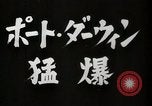
Japanese bombers strike Port Darwin, Australia, during World War II.
Japanese bombing of Darwin, Australia in World War 2. Animated map showing line of Japanese attack from the RyukYu Islands to Darwin, Australia. Japanese MitsubishiG4M1 (Betty) long range bombers being readied at a Japanese air base. They take off on mission to bomb Port Darwin.Those on ground wave goodbye to them. View through nose greenhouse of a bomber. Bombers in formation. View of pilot and copilot in cockpit. More views of formation flying over clouds. Pilot with hands on control yoke. A note in Japanese fastened to the cockpit window. Crew members take lunch break while underway. Crew of bomber seen in warm clothing and on oxygen, as they proceed at a higher altitude.Radio operator keys message. Gunner at his station. The bombers begin their bomb run over Port Darwin. Bomb seen dropping from the aircraft, and striking the airfield of the Australian Naval Base on the coast.

Japanese military operations against Chinese coastal areas during second Sino Japanese war (WW2)
Japanese military operations in the 2nd Sino Japanese war (World War II). A rough wartime Japanese airfield with several Mitsubishi G3M "Nell" bombers. One has engines running. Japanese pilot wearing flying helmet and flotation vest, is standing by a communications tent. Group of Japanese fliers being briefed before a mission. Closeup of pilot in cockpit of bomber as engine starts.Pilots or navigators of two crews comparing notes and charts, as other crew members stand nearby. Another closeup of an engine running. The number 22 seen on tail of one plane. Bombers taxiing and taking off. Closeup of right engine and prop of one bomber viewed from inside the plane during takeoff. Glimpse of another bomber, ahead and below, as the formation flies over populated area. Formation of these Japanese type 96 "Nell" bombers (Mitsubishi G3M) in flight directly overhead. Closeup of one in the formation, with number 15 on its tail. Another closeup of engine and turning prop. A bomb falling. Irregular coastline area of china. Bombs exploding on coastal towns. Imperial Japanese Naval ensign displayed on mast of a ship. Japanese marines descend side of troop transport and enter landing craft. Closeup of marines in landing craft. several landing craft proceeding toward shore. Nakajima E8N naval scout floatplane is seen in flight overhead. Japanese marines climbing a hill under fire. Marine firing a Japanese Type 11 Light Machine Gun atop a hill. The Japanese flag flying near the top of a hill.
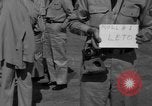
Film shot by U.S. Air Force personnel during visit to Cuban Air Force base at Campo Columbia near Havana, Cuba in January, 1953
Scenes of Cuban Air Force Base and headquarters, at Campo Columbia near Havana, Cuba, and aircraft acquired from the United States Air Force. Film opens with U.S. Air Force sergeant photographer holding a slate marked roll #1, LETO. He is dressed in starched khaki uniform. Other U.S. Airmen stand behind him. Scene shifts to a North American T-6 trainer airplane, Number 119, with skin removed from forward fuselage. A maintenance stand and tools are positioned in front of the aircraft. Hangar number 3 sits behind the T-6. The camera pans right showing two bubble-top P-47Ds parked on the ramp. The first displays number 458 (One of twenty-nine P-47s purchased from the USAF in the period, May, 1952 through June 1953). Work is being performed on the engine of the other. Camera panning right shows another T-6. Also seen is a Lockheed C-56 Lodestar (Lockheed Model 18) that was purchased in 1950 and numbered CU-EDU 2. It is parked in front of a low building with parapets and a flag flying atop it. A large multistory Headquarters building, topped with a control tower is seen in background. Closeup of another P-47 parked on edge of ramp, with its tail in the grass. Camera is moved back showing P-47s and T-6s on ramp in front of the headquarters building. Next, several U.S. Airmen are seen walking across the ramp towards the operations office on ground floor of the Headquarters building. More views of P-47s and T-6s plus a Consolidated PBY 0A-10 Catalina amphibious aircraft parked on the airfield. Several C-47 (DC-3) transport aircraft are seen at the end of the film.
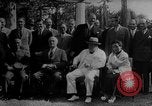
Mixture of scenes from Cairo and Teheran converences with glimpses of Soviet troops on the move and views of bombers and landing craft as well as an atomic test in the Pacific ocean.
Opening scene shows Chinese Generalissimo Chiang Kai-shek seated with U.S. President Franklin D. Roosevelt, British Prime Minister Winston Churchill, and Madam Chiang in their Cairo meeting at a residence of the American Ambassador to Egypt, Alexander Kirk, on November 25, 1943, during World War 2. Foreign ministers of the countries stand behind their leaders. Closeups of the three Country's leaders. Scene jumps to Teheran, with Soviet Leader, Joseph Stalin, President Roosevelt, and Prime Minister Winston Churchill, seated on a veranda of the Soviet Embassy. Suddenly scenes of tanks, trucks, and Soviet troops moving on the Eastern front are seen. Some of the troops move by horse-drawn sleighs through the snow. A line of U.S. Army Air Forces B-17 bombers taxiing on an airfield. View from a B-17 in flight. View f as a cluster of bombs falls from B-17 and explodes on the ground. Animated map illustrating paths of aircraft attacks against the German Atlantic Wall from England. Landing craft underway in an amphibious assault. Brief view from a ship of a post-war test atomic explosion in the Pacific ocean
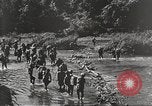
Preparation of parachute supplies to be dropped at observation posts in jungles of the China India Burma Theater.
A film titled 'Aerial supply to Burmese outposts' based on establishing and supplying observation posts of the Allies in jungles of Assam-Burma frontier during World War II. Native workers carry equipment and cross a river followed by U.S. soldiers. Troops reach a camp site and native workers are paid off by a soldier. Shacks are being built by a native labor. U.S. soldiers at camps in forward post bathing and shaving. Once the observation post is set up, the soldiers climb up a lookout post ladder on the top of which a warning system is maintained. Native laborers make baskets at a supply post which will be used as containers for parachute supplies dropped. Ration crates are being brought at an airfield depot from a quarter master depot for shipment. The crates are weighed and the containers are packed with straw. Parachutes are attached and the containers are ready for shipment. The material is taken to a U.S. Army Air Force C-47 Skytrain transport airplane and is loaded aboard. The pilot is briefed at a map which indicates the locations of the camps where the supplies are to be dropped.

Air Sea Rescue operation for U.S. 8th Air Forces B-17 Flying Fortress bomber in European Theater during World War II.
A dramatization detailing ASR (Air Sea Rescue) of U.S. 8th Air Forces crew members in European Theater during World War II. Rescue aircraft P-47 Thunderbolt fighters take off from English airfield. Airborne time is imposed on status board in control room by an officer. Same procedure is followed for PBY Catalina flying boat as it taxis and takes off from runway. Officer over phone notifies ASR. Planes head for their prearranged patrol points. High speed launchers and motorboats of British Royal Navy underway. Shows U.S. 8th Air Forces B-17 Flying Fortress going down on water after being hit. Pilot contacts ASR in England and speaks about ditching of B-17. Fixer station located on the English coast. Electronic Position Indicator (EPI) antenna mast used in Bering Sea operations and antenna receiving bearings on B-17. Door sign reads Triangulation Room. Officers in room plot the bearings on B-17 on a circular map. Last position of B-17 is determined by the triangulation process. ASR controller giving out ditching position on radio to crew member of PBY Catalina. PBY Catalina flies low over water. Crew members of B-17 on raft underway. PBY Catalina overhead. PBY lands on water for rescue of B-17 crews. PBY takes off after the crew boards the plane. Rescue operation for another 8th Air Force plane shows a plane descending over water. Parachute descends over water.
CRITICALPAST.COM: About Us | Contact Us | FAQs - How to Order | License Agreement | My Account | My Lightboxes | Shopping Cart | Advanced Search | Featured Collections | Website Terms & Conditions | Privacy Policy ©2026 CriticalPast LLC.
License Agreement |
Terms & Conditions |
Privacy Policy
©2026 CriticalPast LLC.