


 Francais
 Deutsch
 Italiano
Refine Your Search
Italy airfields stock footage and images
- Showing 3349 to 3354 of 3777 results more
more Hide
Hide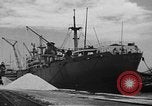
People get work and production increases in different sectors after the implementation of the Marshall Plan in Europe.
A documentary depicts the effect of the Marshall Plan on the lives of people during the first year of its implementation in Europe. A ship at a dock. Men unload sulphur from the ship. A framers sprays sulpahte in a field. A boat underway. Norwegian fishermen aboard the boat are fishing. A fishing net in water. Fishes in the net. A fisherman empties a box containing fishes. People at work in fish canning industry. Women working in Norway put fish in tins. Women packing fishes in cans. The packed cans on display in a shop. A woman buys packed fish cans. The packed cans on a table of a shop in Britain. A man selling spaghetti at a store in Italy. Cattle at a dairy. Tractors in front of a house. A farmer man sits on a tractor. Animated map shows export of tractors from the U.S. to France. Animation depicts contribution of the people for the recovery program. A man ploughs a field with the help of a tractor. A power plant in France being built (appears to be the Roselend Dam hydroelectric complex in the French Alps at Savoie. View includes what may be the penstock gallery leading down to the La Bâthie power station. French Men at work building the power plant. Men construct highways with the help of modern machinery in Greece. Men at work. Construction of new houses for homeless people. Men at work. A man makes shoes. People at work in a shoe factory. Shoes at display in a shop. A man looks at the displayed shoes in a store. Increase in production in different sectors after the implementation of the Marshall Plan. Food kept on a table. Coal production increased to 11%. Coal being shoveled by hand. Textile production increased to 18%. Steel production increased to 40%. A railroad train moves on tracks. Man in Italy plays bocci ball with his unemployed friends. A British family eating food in their kitchen. A French family gathered for a meal. Woman taking a roasted meat from oven and putting it on table for large family in France to eat. Members of a union seated around a table. A coal miner works in a mine. A man plows a field.
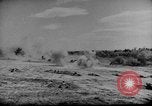
U.S. Army Quartermaster Corps prepare mortars, fire anti aircraft guns, and provide supplies during World War II.
Clip opens with brief World War I scene, circa 1917, of new American army recruits receiving army uniforms being issued by a U.S. Army Quartermaster. Clip then covers U.S. Army Quartermaster Corps' combat operations in various Theaters of Operations during World War II. Quartermaster Corps soldiers with rifles under the cover of a military truck during battle. Troops in trucks. An aircraft in low flight over a field. A U.S. Army truck. A Quartermaster fires an anti aircraft gun. Explosions occur and smoke rises. A British tank in a field. Soldiers beside a truck. Cans and barrels stacked on the ground. An enemy German tank in a field. Soldiers take cover. Quartermasters with guns in a trench. They come up the trench in prone positions. Dramatized battle scene with several Quartermaster corps casualties beside a wire fence. Soldiers prepare a mortar gun. An anti aircraft gun on an army truck. A soldier takes aim and fires a rifle during training. The Quartermaster flag hoisted on a pole. Actual footage shows aerial view of Bataan, and then ground views of groups of remaining U.S. Army soldiers around time of surrender of Bataan in April 1942. American soldier seen with their hands up and under guard of Japanese soldiers during Bataan surrender. Landing crafts arrive at a beach in North Africa. Supplies being offloaded at various battle fronts of World War 2. Soldiers and supplies off-loaded on the beach. Quartermasters seated on supplies boxes. Landing crafts arrive at a beach in the South West Pacific. Troops move across the beach. Troops disembark from landing crafts and move across a beach in Sicily, Italy. The Quartermasters unload boxes of supplies during various beach landings. They unload supplies and fire artillery on a beach head in Italy. Troops in trucks. A convoy of trucks loaded with supplies. Ammunition, ration and personnel in trucks move from Algeria to the front in Tunisia. Explosions occur and smoke rises. Trucks advance through smoke at night and in difficult conditions. Quartermaster General Major General E. B. Gregory speaks about the Quartermaster Corps. He says that the Quartermasters distribute goods to the army during training and combat. The movement of the Corps should be so regulated so as to deliver the goods at the right time in the right quantity.
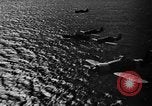
German and Italian aircraft dive through intense flak to bomb a British convoy underway in the Strait of Sicily.
A naval-air battle in the Strait of Italy during World War II. A formation of Italian and German bombers over the Strait of Italy. Ships of a British convoy underway. British ships fire antiaircraft guns at Italian aircraft. Flak bursts in the sky. Italian bombers bomb the ships. Explosions near and on the ships. British ships are heavily bombed by a large number of Italian bombers. Many ships sink after exploding. Smoke billows up from the ships afire. Italian MASs (torpedo armed motorboats) head for a British convoy. British ships are torpedoed. Smoke rises after explosions on the ships. The bombing of the convoy continues at night. Interiors of an Italian submarine shows its crew members at work. A list of claimed British losses includes HMS Furious (47), HMS Eagle, HMS Manchester (C15), HMS Cairo (D87) and HMS Foresight (H68). Victorious Italian MASs underway and Italian aircraft in flight overhead. View of letter from Mussolini congratulating the Axis forces, read by narrator. View of Italian attack boats moving at high speed in ocean.
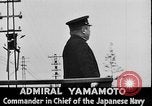
Axis powers vision for conquest at onset of World War II
Invasion plans of the Axis power in the European Theater during World War 2. Film opens, ostensibly, showing Japanese Admiral Isoroku Yamamoto speaking at a podium. (There is some question whether this is actually Yamamoto.) The U.S. Capitol and the Pennsylvania Avenue in Washington DC, with marching Axis troops superimposed as if marching in conquest. Axis troops parade in Berlin, Germany. Animated diagram shows 'divide and rule' ambitions of the Axis powers. Animation showing radio signals emanating from radio towers with propaganda and "LIES". A German speaker delivers a propaganda message from a broadcast studio in Germany. Young women are seen gathering in groups. A woman in Italy receives an award for having many sons. Group of young men and women in Italy walking arm in arm which narrator describes as an effort to boost marriages and encourage having children. Cover of "Der Hammer" magazine in which German Dr. Willband Hentschel writes: "Round up a thousand German girls. Isolate them in a camp. Then let them be joined by a hundred German men. If a hundred such camps were set up, you would have 100,000 thoroughbred children in one stroke." Next scene shows a maternity ward with many (perhaps 30 or more) newborn infants laying on a large surface and being powdered, diapered, and swaddled by a team of German nurses. Narrator states: "Of course the children from this assembly line belong to the State, to be scientifically claimed for conquest."
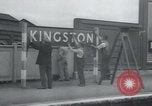
Workmen take down station signs off a platform in London, England during World War II.
Views in London, England after the declaration of war by Italy during World War II. Workmen take down 'KINGSTON' station sign off a platform. A train passes in the background. The workmen take down another sign. A workman paints out another sign. A sign of Quaglino's restaurant being put up after the declaration of war by Italy.
U.S. shuttle-bombing of German positions and military installations under Operation Frantic during World War II.
Film title slate indicates "Operation Titanic" but it, in fact, depicts "Operation Frantic" with U.S. shuttle bombing operations over Germany from bases in Great Britain, Italy and Russia during World War II. United States Army Air Force B-17 Flying Fortresses in flight. Aerial view of bombers in flight with several aircraft flying in formation leaving behind contrails. View inside bomber aircraft with bombardier preparing to drop bombs. View of bomb bay door opening and closeup of hand near bomb drop switch. Bombs awawy view as bombs are dropped from American aircraft. German defenses are bombed along the invasion coast of France (just prior to D-Day) on June 2, 1944. Aerial views of B-24 and B-17 bombers also in flight bombing German military installations in German-occupied northwestern Europe. Aerial view of a target area. Smoke rising up from bombardment. Two different U.S. Army Air Force B-17 Liberator aircraft are seen falling from the sky toward crashes after being hit by German enemy fire. One of them has smoke trailing from it, and the other is in a free fall. Railroad and marshaling yards are also bombed over Debrecen, Hungary on June 2, 1944, with aircraft continuing on (shuttle bombing) rather than returning to base. United States Army Air Forces B-24 Liberator flying in formation on June 21, 1944. Aerial view as they bomb the Focke-Wulf Fw 190 engine aircraft factory near Basdorf, Germany. German factories are bombed. B-17 aircraft on the same date are seeing in formation and bomb railway stations, freight yards, and factory targets, along with the Nazi German Ministry of War, Ministry of Propaganda, and Gestapo headquarters in Berlin, Germany. Heavy flak bursts seen in the air near the aircraft. Dogfight scenes as several German airplanes are shot down. Machine gunners aboard U.S. bomber aircraft firing at German fighter aircraft and shooting down 43 of them, according to narrator. Aerial view of ball turret rotating below bomber and firing guns at German fighter aircraft. The B-17s and B-24s bombing the targets. Synthetic oil plants and refineries are bombed at Ruhland Germany, east of Leipzig. Planning for the operation was done on December 7, 1943. A document about the operation is typed. Animated map shows Nazi positions and method of shuttle-bombing, allowing American aircraft to bomb from Soviet bases, and allies broadly to bomb German targets from bases in the United Kingdom, Italy, and Soviet Ukraine.