


 Francais
 Deutsch
 Italiano
Refine Your Search
Italy airfields stock footage and images
- Showing 3409 to 3414 of 3777 results more
more Hide
Hide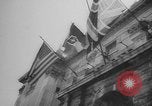
Pope Pius XII addresses a large crowd after the liberation of Rome from German control during World War II.
Liberation of Rome from German control during World War II. United States, British and Italian flags flutter in wind on a building in Rome, Italy. United States Army General Mark Wayne Clark, Major General Alfred Maximilian Gruenther, General Lucian King Truscott and Lieutenant General Geoffrey Keys and French Army General Alphonse Pierre Juin. A military band plays during the welcoming ceremony of American troops. A large crowd of civilians gathered to cheer the troops. Buildings on either side of a street. A bell rings at Saint Peter's Basilica. Pope Pius XII addresses a large crowd in the Vatican City.
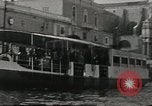
Views of Venice from Gondola moving along the canals
In Venice, Italy, point of view shots from a moving gondola as it travels along the canals of the city. Views of other gondolas and the men operating them (gondoliers). Bridges, buildings, and other gondolas and boats seen from the water. Ponte di Rialto (Rialto Bridge) seen from the canal. (Amateur home movie.)
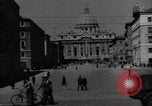
American soldiers and cheering Italian crowd on streets after liberation of Rome during World War II.
American troops move along streets of Rome cheered by Italian civilians after Liberation of Rome during World War II. Saint Peter’s Basilica as seen from the Via della Conciliazione. Italian carabinieri pass by on bridge. A speaker speaks to crowd at Piazza Venezia (Piazza Venezia, 00186 Roma RM, Italy). He is joined later by another man. Cheering Italians. Italian girl kisses and embraces an American soldier.
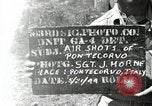
Aerial views of Pontecorvo from a U.S. Army Air Force aircraft in flight during World War II.
Aerial views of Pontecorvo, Italy during World War II. Aerial views of Pontecorvo village from a U.S. Army Air Force aircraft. Mountains in the background.
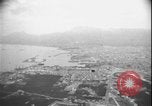
Aerial view of Palermo, Sicily harbor covered by mechanized smoke screen of US Army during Invasion of Sicily in WW2
Mechanized smoke screen surrounds the harbor of Palermo, Italy during World War 2. Thick smoke screen, provided by the 69th and 78th Chemical Smoke Generator Companies of the United States Army, covers the view of Palermo old town, the Gulf of Mondello, and the nearby Palermo mountain range.
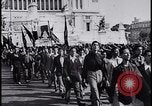
Benito Mussolini delivers declaration of war against France and United Kingdom from Palazzo Venezia balcony, Rome during WW2
Italian fascist supporters (also known as the “Black Shirts”) march with black flags in Piazza Venezia, the central hub of Rome, Kingdom of Italy, during World War 2. Behind the fascist rally is the Victor Emmanuel II National Monument (also known in Italian as the Altare della Patria or “Altar of the Fatherland”). Italian men in fashionable two-piece suits march down from the Via 4 de Novembre street towards Piazza Venezia. Italians marching towards Piazza Venezia in the Parco di Colle Oppio (Oppian hill) near the Roman Colosseum. Italian crowds with flags walk to Piazza Venezia in the Via dei Fori Imperiali near the Roman Colosseum, Roman Forum and the Capitoline Hill. Fascist supporters crowd the whole Piazza Venezia as seen from the Altar of the Fatherland. The Palazzo Bonaparte, Basilica di San Marco, Via del Corso and the Generali Assicurazioni Insurance Company Rome headquarters can be seen from the Altar of the Fatherland. Crowds waving the royal Italian flag cheer. Fascist supporters hold placards while marching in Via del Corso, the main shopping street in Rome linking to Piazza Venezia. Crowds cheer in front of the Palazzo Venezia, the office of Italian Prime Minister and il Duce, Benito Mussolini. Benito Mussolini emerges from his iconic balcony in the Sala del Mappamondo of the Palazzo Venezia. From his balcony in Palazzo Venezia, Benito Mussolini delivers his notable speech declaring war on France and Great Britain. Italians cheer on Benito Mussolini after he delivers his speech from the balcony. Royal Italian flag flies in the Altar of the Fatherland as crowds gather to listen to Benito Mussolini’s speech in Palazzo Venezia. Italians cheer on Benito Mussolini emerging in balcony with an Italian official. Mussolini’s balcony is flanked by two fasces, an ancient Roman weapon used as a symbol of Italian fascism. From his balcony, Benito Mussolini gives a Roman Salute to the cheering crowd.
CRITICALPAST.COM: About Us | Contact Us | FAQs - How to Order | License Agreement | My Account | My Lightboxes | Shopping Cart | Advanced Search | Featured Collections | Website Terms & Conditions | Privacy Policy ©2026 CriticalPast LLC.
License Agreement |
Terms & Conditions |
Privacy Policy
©2026 CriticalPast LLC.