


 Francais
 Deutsch
 Italiano

Refine Your Search
Italy airfields stock footage and images
- Showing 3577 to 3582 of 3791 results more
 Hide
The Rise of Japanese militarism in the 20th Century
Film opens showing reenactment of Japanese attack ostensibly against Formosa, in 1894. Japanese troops and artillery are shown. The event is depicted in a critical political cartoon. Next, Japanese Admiral Heihachiro Togo is seen in 1904, standing with other naval officers. Then, Japanese warships are shown, firing barrages of naval gunfire at the Russian fleet in Port Arthur, Manchuria. Huge black clouds arise from burning ships. Scenes of Japanese people celebrating their naval victory. Date shifts to 1910. Cartoon depicts Japanese annexation of Korea. Cartoon illustrates Japanese actions in World War I when, siding with the Allies, Japan acquired the German-held Shandong (Shantung) Peninsula of China, as well as German-held Marianas, Carolines, and Marshalls islands in the Pacific. Japanese representatives are seen participating in Post World War 1 international activities. They signed the so-called Five-Power,Four-Power, and Nine-Power treaties, and participated in the League of Nations. Glimpse of two Japanese officers, followed by cartoon depiction of the Mariana, Caroline, and Marshall Islands, that Japan insisted on keeping. Cartoon shows them being fortified. A Japanese military marching band parades down a city street while being cheered by spectators on the sidewalks. Next, Japanese military General, Baron Tanaka Giichi, is seen in uniform with other officers. Cartoon illustrates the so-called Tanaka Memorial document that Baron Tanaka allegedly presented to the Emperor, in 1927, outlining a strategy to conquer the world. Cartoon then illustrates plan of conquest by acquiring Chinese manpower; Manchurian iron and coal; Siberian timber, coal, wheat, and metals; Tin,oil and rubber from Malaysia and the East Indies. The United States is shown as the last conquest. Views of ordinary farm and factory activities in the U.S. Cars parked in the Ford Motor Company factory lot. Japanese officials and legislators meeting in the Diet (Parliament). Japanese theater patrons and a Japanese woman singing with an American-style band, are shown as examples of activities the Japanese Government sought to discourage. A Japanese female ensemble in traditional dress, playing traditional instruments, is shown as more desirable. Western dancing and western hollywood movies are shown and narrator states they were forbidden by the Japanese government. Japanese movie scene depicts ancient martial arts. A musical production on stage displays German Nazi swastika flag , Japanese rising sun, and symbol of Kingdom of Italy, celebrating the axis alliance. Japanese men are shown playing the ancient game of Chu Shogi, instead of playing Western card games. People are shown in a library, where Western books are replaced by more militaristic tomes, such as: "If we fight" by Admiral Shinsaku Hirata, March 15, 1930 (shown on film slate). Slate goes on to quote about attack on Hawaii as the first battle in war of the Pacific. Film cites another approved Japanese publication: "Arguments Against American Policies" by Kawashima Seichiro, Christmas Day, 1924. It discusses distruction of the American fleet and subsequent landing on the U.S. West Coast.
Communism growing over Central and Eastern Europe after World War 2, and development of Marshall Plan.
Events after World War II. Harvesting in U.S. farms. Closeup view as a tractor plows fields. Men on horseback driving sheep. Woman serves a Thanksgiving turkey dinner to her family gathered at a nice dining room table in the United States. Her children look at the food with smiles. Contrasting scenes show Europeans starving and living in poverty amid post-war ruins. Hungry women and children looking for food. A child in a soup line. Women wait in a line to receive grain that is weighed on a scale (possibly Soviet area). Globe spins. Joseph Stalin and other Soviet officials watch a military parade in Red Square in Russia. Retrospective scenes of the meeting of Russian and U.S. troops at the Elbe River late in World War 2. Communist rally in Paris. A protester holds up a hammer and sickle symbol. A demonstration of protestors in Athens, Greece, around time of Greek Civil War, and another Communist demonstration in Rome, Italy. Map depicts communist control growing over Central and Eastern Europe early in Cold War. High aerial view of Washington DC with a lower altitude airplane flying over the U.S. Capitol. Exterior view of State Department (Old Executive Office Building) in Washington DC. View of Secretary of State James F Byrnes working at his desk. Byrnes speaks of U.S. role in world affairs while at a conference in Stuttgart, Germany. Scenes from a meeting of the Big Four foreign ministers in 1947. Scenes changes to North Portico of White House. Swearing in ceremony of George C. Marshall as Secretary of State. President Harry S Truman shakes hands with Secretary George Marshall. Night view of London landmark buildings. View of door at No. 10 Downing Street in London. View of brutal winter conditions in Europe in February 1947. Citizens try to dig out a train stuck in snow. Women in line in Britain for a rationed good, still saddled with its own postwar reconstruction. Narrator relates that Britain was unable to continue to provide massive military and economic aid to the Greek regime and appealed to the U.S. to handle the situation. Secretary of State Marshall and President Truman seen talking together in front of a fireplace mantle. Marshall boards aircraft for a visit to Moscow. Truman in a White House meeting, seated at oval table with his advisors and cabinet. Truman addressing joint session of congress unveiling Truman Doctrine on March 12, 1947. He asks for funds for Greece and Turkey. Globe highlights USSR. Door sign reads 'Policy Planning Staff - George F Kennan - Director'. Director Kennan seen at his desk. He advocates a long term, patient but firm and vigilant containment of Russian expansive tendencies. Reconstruction in Europe. Ground level and aerial views of bomb destroyed European cities, and workers cleaning up rubble from bombing in World War 2. Brief scene from the meeting of 16 nations in Paris on July 3, 1947. Scenes from United Nations meeting held in Lake Success New York in September 1947. George Marshall at podium addressing delegates of UN. Russian delegate Andrey Vyshinsky commenting on Marshall Plan. Signing of Marshall Plan agreement by international delegates meeting in Paris in September 1947.
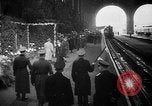
Premier Vyacheslav Molotov arrives in Berlin, Germany for German-Soviet Axis talks
Discussions between Germany and the Soviet Union in November 1940, about Russia joining the Axis together with Germany, Italy, and Japan. Diplomatic and military delegation stand at railway station in Berlin, Germany. A railway train arrives. Premier Vyacheslav Molotov of the Soviet Union arrives on the train at the railway station. German Foreign Minister Joachim Von Ribbentrop, German High Command and Japanese representatives greet Molotov. A band plays as the men come out of the railway station. German soldiers stand in lines and Molotov passes the troops in reivew. Delegation takes Molotov to the Reich Chancellery to meet Adolf Hitler, War Minister Hermann Goering, and other German officers.
Views of U.S. Forces in the Pacific and European theaters of operation during World War II
U.S. Troops in the Solomon Islands during World War II, load munitions and supplies aboard landing craft to be carried to the troopship, USS Frederick Funston (APA-89), sitting offshore. The equipment and troops are bound for Bougainville, New Guinea, to reinforce marines there. Next, the troops themselves, in full battle gear, enter Higgins boats, to be ferried to the troopship. Closeup of troops boarding one of the landing craft. View from a landing craft heading to the Frederick Funston, seen ahead. View from the Higgins boat approaching the troopship, and then of troops climbing aboard via a rope net. Closeup of soldiers climbing the net. Change of scene shows U.S. Field Artillery unit changing position on New Georgia. They employ caterpillar tractors to move the guns. One is seen bogging down in the soft earth, so another tractor assists by pushing on the gun (possibly damaging its barrel). After arriving at the new position, they are ordered to move again, because of movements of the Japanese forces. This time, the troops pitch in and use sheer manpower to move a howitzer. Scene shifts again, to Italy, where U.S. troops attempt to ford a river on the road from, Benevento, to Caserta, after German forces destroyed all bridges along it. A truck is seen successfully crossing after combat engineers created a path for it. Trucks and jeeps move through muddy paths. The last image shows a jeep equipped with a tall bumper-mounted wire cutter.
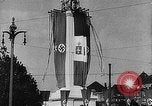
Italian fascist leader Benito Mussolini arrives by train at Munich Central Station where he is welcomed by Adolf Hitler
Italian fascist leader Benito Mussolini visits Munich, Germany. Flags of Nazi Germany and the Kingdom of Italy hang in the streets of Munich. Nazi flags hung from buildings. A Bundesadler eagle metal plate adorns a wall. Cars move along the roads. Italian leader Benito Mussolini arrives at Munich Central Station (München Hauptbahnhof, Bayerstraße 10A, 80335 München, Germany). He shakes hands with Adolf Hitler. Benito Mussolini and Adolf Hitler walk on the railway platform, the officers follow them. Military troops in formation on the platform. The two Axis leaders review formations of soldiers and sailors as military brass band plays the German and Italian national anthems (“Marcia Reale Italiana” and “Deutschlandlied”). Spectators line the streets. Benito Mussolini and Adolf Hitler enter open cars. Nazi banners and decorations adorn the Munich New Torn Hall and Marienplatz (Marienplatz 8, 80331 München, Germany). Hitler and Mussolini in Marienplatz. Crowds cheer and wave, as their cars drive down the streets of Munich, which are festooned with Nazi and Italian banners.

People demand re-election and resignation of British Prime Minister Neville Chamberlain in England.
Demand for resignation of British Prime Minister Neville Chamberlain in England. Graffiti on roads and walls. The writings on wall read 'Demand re-election', 'No pact with Fascist Italy' and 'Chamberlain must go'. The demand for re-elections and resignation of Prime Minister Chamberlain written on road and walls. Pedestrians cross the street. 'Chamberlain must go' written on the road. A woman with a pram passes by. An old man reads message painted on street as he walks by. Women with babies in arms and in prams.