


 Francais
 Deutsch
 Italiano
Refine Your Search
Japanese-martial-arts stock footage and images
- Showing 667 to 672 of 4336 results more
more Hide
Hide
Wounded people treated; bombed buildings and refugees flee for safety in Catalonia, Spain during the Spanish Civil War
Spanish Civil War in Catalonia, Spain. Aerial view of the region in Spain. Wing of aircraft seen while in flight. Troops on battlefield in battle between Republican and Nationalist forces. Troops walk in columns on road. The injured being carried into an ambulance. Injured men being carried on litters. Bombed out buildings. Ruins of the bombed out buildings. A wounded woman being treated by medics. Two guards in what appears to be a church guarding art works, paintings, sculpture and antiquities. Narrator mentions "Gaudi" (famous architect of the region). Refugees carry belongings and walk on a mountainous road. Car of Francisco Franco on road in a city being escorted by Moroccan Regulares cavalry soldiers (also called "Army of Africa") on horses. The troops wear traditional white cloaks and turbans. People cheer. Head of State of Spain Francisco Franco disembarks from a car. He waves towards people from balcony of a building.
Some U.S. Army soldiers focusing on leisure after World War 2, and some attend Army extension classes in the United States.
A post-war U.S. Army film (after World War 2) in 1945-1946 contrasts dice and pool playing soldiers with the soldiers who take Army extension classes to prepare for jobs in civilian life following demobilization and discharge from the Army. Group of U.S. Army soldiers in a room as they play pool at a billiards table. Soldiers in a barracks room seated on a bed and on the floor throwing dice in a game of craps. The soldiers play cards and smoke. Contrast is shown with U.S. Army students seated in a class. An officer takes lessons. A soldier takes notes. A young teacher or professor explains a concept with the help of a blackboard. View of the Hôtel Miramar in Biarritz, France (built in 1927 and demolished in 1978). Aerial view of a building with interconnected corridors. Street level view of the University of Calcutta Senate Hall in Calcutta (Kolkata), India (hall designed by Walter Granville; one time home to the Asutosh Museum of Indian Art; demolished in 1960). People walking in front of the Senate Hall as a car and a pulled rickshaw go by. In next scene, a sign reads 'Fox-Hole Campus'. An officer holds a mechanical model and explains a concept to students. A soldier works with equipment and an African American soldier stitches clothes at a sewing machine. A sign "Learn today; Earn tomorrow" as soldiers learn skills to help them in the civilian sector after separation from the armed forces. A solder works on a model. Pamphlets on a desk with the names of different subjects written on them that U.S. Army students can study to learn skills and jobs, including Automobile Repair Shop, Retail Bakery, Service Station, Grocery Store, Metal Working Shop, Shoe Repair Business, Small Sawmill Business, Beauty Shop.
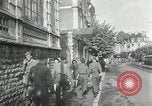
U.S. Army soldiers attend classes at Army University Study Centers, receiving job and skills training after World War 2.
A post-war film shows U.S. Army soldiers studying in barracks and in foreign universities immediately after World War II. Students at a campus in France as they walk on a pathway. Courses being offered to the soldiers. Several posters with the subject names in the background. The officers seated at a desk. A soldier takes books. Soldiers attend an animal husbandry class and examine livestock in a yard area. Students in an engineering class as they draw different drawings on paper at drafting tables. A chemistry lab. The students perform experiments and are seen working with test tubes and graduated cylinders. A woman works with clay and a U.S. soldier fashions sculpture of a dog out of clay. An officer seated on a desk and the students stand in front of him and make notes during journalism and correspondence classes. U.S. Army students in art classes. A woman holds a ball and poses. The students draw her form. The Geology class. Soldiers walk in trenches and a few stand as they make notes after observing a geologic sample. Group of U.S. Army soldiers play tennis. An officer seated in a chair. They play basketball. Soldiers seated on the field. Soldiers being awarded with diploma certificates after 4 or 8 week courses. They are gathered at a graduation ceremony receiving diplomas that they can use in applying for college credit. Students seated in a class. A French woman teaches them. Two soldiers walk among the buildings of a French campus.
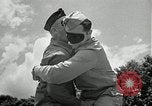
An officer demonstrates bear hug over the arms technique of gentle killing at a secret camp in the United States.
A documentary shows a training program of U.S. hand picked volunteer soldiers in a secret training camp for guerrilla warfare during World War II. An OSS (Office of Strategic Services) officer and a student wearing a mask at a field demonstrate the gentle art of murder technique with the help of slow motion sequences. The techniques include bear hug over the arms. The students wearing a mask watch the demonstration.
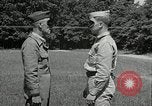
An OSS officer and a student demonstrate strangle hold technique for killing an opponent at a secret camp, United States.
A documentary shows a training program of U.S. hand picked volunteer soldiers in a secret training camp for guerrilla warfare during World War II. An OSS (Office of strategic Services) officer and a student wearing a mask at a field demonstrate the gentle art of murder technique with the help of slow motion sequences. The techniques include one hand strangle hold, two hand strangle hold and locking of opponents arm.. the students practice the same technique. The students practice the techniques.
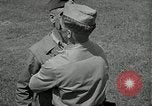
Demonstration of a bear hug from the front and from the rear bear hug to the students at a secret camp, United States.
A documentary shows a training program of U.S. hand picked volunteer soldiers in a secret training camp for guerrilla warfare during World War II. An OSS officer and a student wearing a mask at a field demonstrate the gentle art of murder technique with the help of slow motion sequences. The techniques include a bear hug from the front and from the rear bear hug. The students watch the demonstration.
CRITICALPAST.COM: About Us | Contact Us | FAQs - How to Order | License Agreement | My Account | My Lightboxes | Shopping Cart | Advanced Search | Featured Collections | Website Terms & Conditions | Privacy Policy ©2026 CriticalPast LLC.
License Agreement |
Terms & Conditions |
Privacy Policy
©2026 CriticalPast LLC.