


 Francais
 Deutsch
 Italiano
Refine Your Search
Japanese-martial-arts stock footage and images
- Showing 991 to 996 of 4336 results more
more Hide
Hide
High-ranking military delegation inspects Japanese navy contingent prior to World War II
Japanese Asashio-class destroyer Asagumo at anchor, just prior to World War 2. A battleship behind it fires guns in salute. Sailors, in dress whites, line foredeck of a ship. Nautical flags fluttering overhead. Marines on deck hold rifles in present arms salute. High-ranking military delegation steps from small boat onto dock and thence up a ramp to a pier, where sailors are standing in formation. They inspect the formation. View from dock upwards at a Japanese warship. A band playing on the foredeck. Anchor being weighed. Japanese battleship underway at sea. View from airplane of two Japanese battleships underway. Two Japanese destroyers underway.
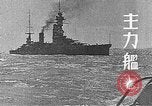
Japanese battleships, cruisers and submarines participate in a maneuver in the Pacific Ocean during the mid 1930's.
Japanese Navy maneuvers circa mid 1930's. Ships include battleship Fuso, and the aircraft carrier Akagi (While the Akagi still had its original three flight decks, before they were consolidated into one larger flight deck). Battleships, carrier ships and cruisers take part in a maneuver. A convoy of Japanese ships underway at sea. Naval guns aboard various ships. A landing craft at sea. Animation depicts an exchange of fire between the Japanese and enemy naval guns. The Japanese convoy underway during the maneuver. A Japanese flag aboard a ship. Water washes over the deck of a ship. The muzzle of a naval gun aboard a ship. A submarine breaks over the water surface.
A Japanese submarine torpedoes a cruiser underway in the Pacific Ocean during World War II.
A Japanese submarine underway in the Pacific Ocean during World War II. The bow of the submarine while it is underway. The stern of the submarine. Crew members operate turbine machinery board the submarine. A Japanese sailor sounds a bugle over an intercom system. Crew men come down a hatch at GQ. A Japanese officer at the superstructure gives orders to dive. The crew works on the controls and manipulates diving planes as the submarine dives below the surface. A Japanese officer at a periscope. The submarine begins to submerge below the surface. A sonar operator at work. A cruiser ships sail on the horizon as seen through the periscope. The Japanese officer looks through the periscope. A compass in the engine room. Torpedoes are fired and crew men listen for explosions. They cheer as the torpedoes strike the target. They pray in a shrine aboard the submarine.
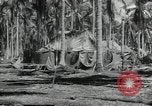
A U.S. Sergeant demonstrates Japanese uniform, rifles and climbing spikes in Guadalcanal, Solomon Islands during World War II.
A film about Allied campaign against the Japanese in Guadalcanal, Solomon Islands during World War II. A deserted Japanese camp. Tents in the camp area. A U.S. Sergeant shows a Japanese uniform that helped them to camouflage in a jungle. He holds American and Japanese rifles to show the difference between the two. The Sergeant puts on climbing spikes used by the Japanese. He climbs up a coconut tree.
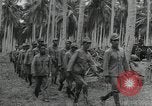
Japanese prisoners assembled and some given medical aid. Admiral Nimitz decorates Marines. Guadalcanal, WWII
Allied campaign against Quadalcanal and Solomon Islands during World War II. Captured Japanese Labor Battalion prisoners (called Termites by the Marines) and some Imperial Marines march and are lined up. Japanese prisoners seated behind a barbed wire fence. A Japanese soldier being given first aid. treatment by an American medic. Dead Japanese soldiers from a Regiment commanded by Colonel Kiyonao Ichiki, are seen on the beach at, 'Alligator Creek.' (They fell during a nighttime attack against entrenched U.S. Marines, on 21 August 1942. The ICHIKI Regiment lost 777 killed during their attack. Only six members of the regiment escaped.) Corporal Barney Ross (former U.S. boxing champion) receives a Japanese flag as a souvenir. U.S. Navy Admiral Chester W. Nimitz decorates Marine Colonel 'Red' Mike Edson, Commander of the 1st Marine Raider Battalion and U.S. Marine pilots: Major Smith, Captain Carl and Major Gaylor during the ceremonies. Brief glimpse of Marine Major General Alexander A. Vandegrift with Admiral Nimitz
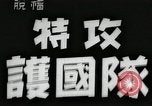
Japanese Kamikaze pilots are briefed before taking off for suicide missions during World War II.
Japanese Kamikaze pilots in Japan during World War II. A Japanese officer reads out from a paper as he addresses Japanese Kamikaze pilots. The lined up pilots listen. The pilots in flight gear as they drink a toast. They salute an officer. A pilot in the cockpit of an aircraft as it takes off. Officers wave to aircraft as they take off. Japanese Kamikaze pilots receive white head bands from an officer during a ceremony. View of Japanese rising sun image and writing on the head scarves. Kamikaze pilots in a briefing about their mission. An officer gestures with his hands to demonstrate how the pilots are to direct their aircraft straight down and impact the target in suicide mission. View of the pilots during this briefing. They get in cockpits of aircraft and take off for mission. Crews on ground wave to the pilots after the aircraft take off.
CRITICALPAST.COM: About Us | Contact Us | FAQs - How to Order | License Agreement | My Account | My Lightboxes | Shopping Cart | Advanced Search | Featured Collections | Website Terms & Conditions | Privacy Policy ©2026 CriticalPast LLC.
License Agreement |
Terms & Conditions |
Privacy Policy
©2026 CriticalPast LLC.