


 Francais
 Deutsch
 Italiano
Refine Your Search
Japanese-martial-arts stock footage and images
- Showing 1123 to 1128 of 4336 results more
more Hide
Hide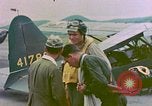
Japanese military and civilians with U.S. Navy fliers at airfield in Nagasaki after World War II
Activities at Omura Air Field in Nagasaki, Japan after the end of World War 2. Two U.S. Navy fliers converse amicably with a Japanese airmant, as they stand in front of a Stinson L-5 Sentinel airplane, in which the Japanese airman expresses interest. Camera pans to a tent set up nearby, under which several American military and Japanese civilian and military men ae seen. Damaged roof on a building in the background. Camera pans past skeletons of bombed out hangars and other buildings. Airport operations building appears intact. Small prefab quonset-style hangar nearby. Japanese soldier stands near car parked on ramp. Several U.S. Navy airplanes parked in background.
U.S. Army Air Force bombers strafe Japanese barracks and supply bases in Indo-China during World War II.
U.S. Army Air Force bombers strafe Japanese targets in Indo-China during World War II. U.S. bombers in formation drop 30 lb bombs Malaybalay on Mindanao in Burma. Explosions on ground create huge smoke cloud as the Japanese barracks get destroyed. U.S. 10th Air Force drops 500lb RDX bombs on Toungoo destroying the Mandalay-Rangoon railroad line. U.S. Bombers drop bombs on Japanese positions in Philippines. Japanese supply base in China Yungcheng destroyed completely by U.S. bombers strafing.
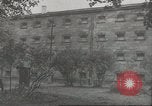
World War II war crimes trials; flashback views during World War 2; Nazi prison cells in Nuremberg; Japanese war criminals
Prison at Nuremberg, north of the Palace of Justice, where Nazi prisoners are held during Nuremberg trials in 1946. Cell of Nazi Admiral Doenitz is seen, with his name over the prison cell door. Nazi Admirals, Karl Doenitz and Erich Raeder, during the war. Views of war crimes at sea, with burning ships in flames at night. American soldier looks into prison cell of Joachim von Ribbentrop. Von Ribbentrop boarding an airplane, during the war. A German American Bund rally in the United States at Madison Square Garden in 1939, with Patriotic image of George Washington and massed American flags. Americans giving Nazi salute as Fritz Kuhn speaks. Fight or scuffle on the stage of the meeting. American military guard places food into cell of Nazi Julius Streicher. View of Julius Streicher giving a speech. Street scenes of Jewish shops being vandalized and boycotted in Germany. Boycott of Jewish-owned stores in Germany including posters and paint labeling Jewish businesses, and a poster that says, "Die juden sind unser unglück" (which means "The Jews are our misfortune"). Emaciated and thin liberated Concentration camp inmates being deloused. American soldier looks into prison cell of Hermann Goering. View of Goering in civilian clothes, sitting with companions, before the war. The Graf Zeppelin airship in flight over New York City. Officer on board Zeppelin shown plotting a course from the bridge. Shadow of the zeppelin air ship cast over an ocean liner at sea. Prison guard opens a door and goes in. Prisoners file out of the building, ostensibly to face firing squad. Airplane landing at Japanese airfield and scenes of military staff and military gathering of Imperial Japanese forces in Tokyo Japan during World War 2. Japanese General staff in a meeting. A Japanese military leader during a surrender meeting in World War II.
The invasion of the U.S. troops on the Marshall Islands and destruction of Japanese garrisons during World War II.
U.S. troops' invasion on the Marshall Islands and destruction of Japanese garrisons during World War II. An animated map depicts the location of Marshall Islands in the South East Asia. U.S. Navy ships proceed in order to take the island from their enemies. The animated map depicts the tactics of U.S. Navy. The soldiers attack the Kwajalein Island. Roi and Namur in the north are attacked by the U.S. Marines. The U.S. fighter aircraft. Soldiers in small boats approach towards the Marshall Islands. Aerial bombarding on the island by the U.S. fighter aircraft. The American soldiers take their positions on the island's coast. Soldiers with their weapons. An officer examines the bomb explosion through binoculars. The remains of a destroyed Japanese aircraft. American soldiers capture the Japanese base headquarter. The dead Japanese soldiers. The arrival of more American troops on the island.
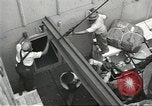
Swedish Liner M.S. Gripsholm prepares to depart Jersey City, New Jersey, to repatriate Japanese Nationals and Issei to Japan during World War II
Picture begins showing workmen using crane and cable to lower a bulkhead support into the cargo hold ot the Swedish ocean liner M.S. Gripsholm as it prepares for departure from Jersey City, New Jersey, to repatriate Japanese Nationals and Issei to Japan in World War 2. View from above of the men sorting large boxes containing passengers' property. Three small Japanese boys are seen on deck, looking at something in hand of the biggest of them. They walk away and smile when they see the camera filming them. Members of the ship's crew examine the boxes in the cargo hold, and fasten steel straps on a box without them. A Japanese official dressed all in white converses with several Japanese men on deck. View from rear of a passenger at the ship's railing looking at the Manhattan, New York City skyline across the Hudson River from Jersey City. The Swedish flag billows in the breeze nearby. Tugboats ply the river. Views of fresh fish provisions in large refrigerator locker. Crew member holds one up for the camera.
World War II Japanese attack on troop convoy at Port Moresby New Guinea; also Battle of Midway scenes aboard USS Yorktown.
American and Australian troop convoy underway at sea, and then arriving at Port Moresby, New Guinea. A Hudson bomber of the Royal Australian Air Force flys by the troop ship escorting them into the harbor. U.S. and Australian troops unloading men and supplies at Port Moresby. Japanese planes attack the dock area and troop convoy. Elevated land-based views of the harbor with explosions and smoke during the bombing. Anti aircraft guns fired at enemy planes. Soldiers and sailors on ships at harbor open fire on the Japanese aircraft overhead. Planes drop bombs and explosions occur. Complete change of scene to the USS Yorktown (CV-5) during the Battle of Midway on June 4, 1942. United States Navy sailors fighting fires aboard the USS Yorktown. Japanese airplanes overhead during the Battle of Midway attacking the Yorktown. Patterns of tracer bullets seen fired from the Yorktown. Japanese torpedo bomber aircraft is hit by gunners on the USS Yorktown.
CRITICALPAST.COM: About Us | Contact Us | FAQs - How to Order | License Agreement | My Account | My Lightboxes | Shopping Cart | Advanced Search | Featured Collections | Website Terms & Conditions | Privacy Policy ©2026 CriticalPast LLC.
License Agreement |
Terms & Conditions |
Privacy Policy
©2026 CriticalPast LLC.