


 Francais
 Deutsch
 Italiano

Refine Your Search
Japanese-martial-arts stock footage and images
- Showing 1351 to 1356 of 4337 results more
 Hide
Color Sound

Diego Rivera working on his Detroit Industry Mural in Detroit, Michigan.
Views of Diego Rivera working on his Detroit Industry Murals at the Detroit Institute of Arts. Details from the Detroit Industry mural sections. View of a single section of the wall blank, and then after initial mural sketch has been added by Rivera. Diego Rivera and another worker at the wall of one of the sections of mural.

Frida Kahlo seen sketching during the creation of Diego Rivera's Industrial Mural in Detroit, Michigan.
Mexican painter Frida Kahlo sketching during the construction of the Detroit Industrial Mural, designed by her husband Diego Rivera, at the Detroit Institute of Arts. She is dressed in a warm coat and seated on a wooden folding chair, while sketching on a note pad. She turns and smiles at the camera. A panel of the industrial mural is seen, depicting piping representative of the Ford Motor Company River Rouge Plant, with workmen standing above, and one down below.

Diego Rivera and his wife, artist Frida Kahlo, during painting of his Industrial Mural in Detroit, Michigan
Mexican painter Frida Kahlo and her husband Diego Rivera, during the painting of the Detroit Industrial Mural at the Detroit Institute of Art. Frida Kahlo is seen on a scaffold by an unpainted area, talking to a workman below. Later, she sits on the scaffold next to Diego Rivera, as he paints in this same section. She makes notes in a pad. She descends a ladder from the scaffold, throwing her note pad to an associate below, before coming down. View of the entrance gate of the room.

Sweeping view of the new Diego Rivera Industrial Mural in Detroit,Michigan.
The new Detroit Industrial Mural by Mexican artist Diego Rivera and views of the entire room showing paintings and sculptures. Spectators viewing sections of the Detroit Industry mural at the Detroit Institute of Art.
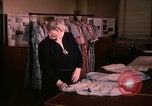
Researchers design functional house dresses and perform experiments for care of clothing.
Domestic arts and sciences and home economics research work by the Bureau of Human Nutrition and Home Economics Service (United States Department of Agriculture). Chief of the Bureau Dr. Hazel K Stiebeling talks about research in the field of textile and clothing. A woman researcher examines a garment on a table. Another researcher uses a machine to measure strength of various button holes. A machine is used to measure stitch strength. Fashion designers and tailors work on functional house dresses and aprons. The clothing specialist works out an idea with muslin on a dress from. She tries out the design on a live model. A designer cuts a pattern and another readies it for a final test. A functional house dress designed by the Bureau. Care of clothing: Testing of various soaps and detergents. A woman reaches for home laundry detergent in a cabinet. Women use a machine designed to soil fabric samples uniformly in order to compare detergents and soaps. Women cut the fabric into strips, light reflection. A researcher prepares the samples for laundry. She puts the samples into the laundrometer.

Home Economics and Family Economics functions, research, surveys, and publications; views of late 1940s homemakers
Research work by the Bureau of Human Nutrition and Home Economics Service (United States Department of Agriculture). Chief of the Bureau Dr. Hazel K Stiebeling talks about family economics research. Family Economics staff at work in downtown Washington. A staff member reads letters inquiring about money management techniques from families in the U.S. A staff member shows a homemaker mother how to use a food plan. They work out a weekly market list. A teacher gives a lesson in meal planning and food buying to high school seniors. Policy makers use family economic material on milk consumption during a meeting. A representative of the Bureau on a food survey. She talks to a woman at her doorstep, surveys the food in a kitchen. Information on food composition is recorded and evaluated on a sheet. A family eats a meal planned by the family economists. Dr. Hazel K Stiebeling displays various domestic arts and sciences publication for homemaker, housewife, and teachers that include food and housing research results. Other educational material includes information for the press, radio scripts, charts, film slides, motion pictures, and television programs.
CRITICALPAST.COM: About Us | Contact Us | FAQs - How to Order | License Agreement | My Account | My Lightboxes | Shopping Cart | Advanced Search | Featured Collections | Website Terms & Conditions | Privacy Policy ©2026 CriticalPast LLC.
License Agreement |
Terms & Conditions |
Privacy Policy
©2026 CriticalPast LLC.