


 Francais
 Deutsch
 Italiano

Refine Your Search
Japanese-martial-arts stock footage and images
- Showing 1369 to 1374 of 4337 results more
 Hide
Color Sound

United States First Lady Jacqueline Kennedy on a visit to India.
United States First Lady Jacqueline Kennedy arrives on a visit to India. Scene of a gate. A hilly region. People on a bullock cart. A man takes a small child in lap. A child on a woman’s shoulder. Farmers in a field. Statues carved at Khajuraho temple (VW2C+QJQ, Airport Area, Khajuraho, Madhya Pradesh 471606, India). Decorated and carved gates. Colorful paintings on walls. Women play sitar and tabla. A traffic policeman gives directions to traffic and shows 'Stop' sign. Students and teachers in a college. Carpenter and a mechanic at work. Large crowd. National emblem of India on a gate. Guards on horses. Dr. Rajendra Prasad, President of India in a horse driven chariot in the Parliament premises. Air India plane lands at New Delhi airport. Prime Minister Jawaharlal Nehru and his daughter Indira Gandhi meet Jacqueline Kennedy, her sister Lee Radziwill and the American Ambassador to India, John Kenneth Galbraith. Galbraith talks to Prime Minister Nehru. Children clap. United States Embassy in India. Ambassador Galbraith and Jacqueline Kennedy in Embassy. Prime Minister Nehru talks with Jackie Kennedy in a garden. Jackie Kennedy buys a silk sari. A girl welcomes her with garland in Benares. A man answers her questions during visit to an art gallery. She meets Indira Gandhi. Mrs. Kennedy meets Indian artists and addresses the people present. Jackie Kennedy puts a garland on an elephant's neck as a ritual.
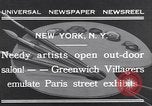
Large crowds attend outdoor exhibit by artists selling their work in Greenwich Village, New York City
A large crowd visits outdoor gallery of needy artists in Greenwich Village, New York City, during the Great Depression. The scene emulates a Paris street scene of people viewing and purchasing art. Crowd viewed from the street as they look at works of artists displayed for sale, on a wooden fence enclosing a construction site in Greenwich Village, New York City. Closeup of a painting depicting an Arab on horseback. View of crowd further along the street, where paintings are displayed on fences of residences in foreground and others on kiosks near trees in Washington Square park in the background. Closeup of a man at work on a canvas and another of a woman working on a still life with fruit. More visitors and paintings are seen and a view of Washington Square Arch at end of street in background. View from second story of a building, looking down on crowd looking at artwork displayed on easels set up in front of a building. A man making a purchase from a woman artist. He holds it up for the camera.
Recovering World War 1 injured soldiers perform therapy tasks which require the use of injured limbs at Ford Sheridan, Illinois.
Injured and disabled World War 1 U.S. Army soldiers are seen in a "curative workshop" at Fort Sheridan, in Lake County, Illinois, soon after the end of World War 1. Patients perform occupational therapy tasks which require the use of injured limbs. Patients are seen in a wood working shop, caning chairs, weaving baskets, and taking a course in commercial art. Patients work on paintings while lying in bed.
Traffic on Paris steets; Barbara Chase Riboud works on a sculpture at her workshop in Paris, France
Animation introduces five African American artists. Segment focuses on sculptures by Barbara Chase Riboud. Barbara drives a car on roads of Paris, France. Views of traffic in traffic circles, fountains, and landmark buildings of city of Paris in the early 1970s. Many cars and buses on road. Barbara comes out of a shop "Nickel Chrome" and talks to a man who has finished polishing one of her works of art. Barbara at a room takes out her coat. Various sculptures in the room. Barbara works on a sculpture and shapes it. Barbara stands near a furnace. Two men work with molten and hot iron. Barbara picks up her two children from a bilingual international school of Paris. Children sit in car. Barbara at her sculpture workshop. She walks in it. She examines sculptures.

Richard Hunt talks with his daughter and prepares a sculpture in Chicago, Illinois.
Richard Hunt's sculptures in Chicago, Illinois. Richard outside with his daughter on a winter day in Chicago near lake shore. Chicago skyscrapers in the background through fog. He takes his daughter on back. He talks with his daughter in an arboretum or indoor greenhouse garden, examining the forms of plants and commenting on how they influence his art works. Richard with another artist examining one of Hunt's sculptures in progress. They talk to each other. Richard preparing a sculpture with a mold over it for kiln firing. He weighs stones in a large beam balance, puts stones on a small trolley and moves it. They make it hot and pour liquid into molding vessel. They knock away the mold and examine the sculpture to see if it was cast as he intended.
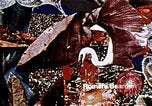
Romare Bearden with people at the Cinque Gallery, and working on a collage in his studio in New York City
Video about famous African American collagist, artist Romare Bearden, in New York. View of 1970s car and truck traffic on Canal Street at lower east side intersection of Canal Street and Broadway in New York City. A man walking to the apartment of Romare Bearden. Sign on mailbox reads "Romare Bearden and Rohan, Top Floor". View of an African American painter and sculptor walking on city streets and then heading toward the Cinque Gallery of art at 20 West 72nd Street in New York City. Romare Bearden with people at the Cinque Gallery displaying the works of the artist. People look at the man's paintings and sculpture. Romare tells of his time as a young artist trying to get started in the Great Depression. Still images of unemployed men in a line. Views of other artists and writers Bearden would work with and share studio space including Jacob Lawrence and Claude McKay and Charles Alston. Group picture of the a group of African American artists and intellectuals of the time who knew each other. Bearden with his wife, the dancer Nanette Bearden, at his home studio. Mrs. Bearden brings him a drink and sits and watches Romare Bearden work on a collage. Close-up views of a collage that Bearden is working on, which focuses on themes of the African American experience.
CRITICALPAST.COM: About Us | Contact Us | FAQs - How to Order | License Agreement | My Account | My Lightboxes | Shopping Cart | Advanced Search | Featured Collections | Website Terms & Conditions | Privacy Policy ©2026 CriticalPast LLC.
License Agreement |
Terms & Conditions |
Privacy Policy
©2026 CriticalPast LLC.