


 Francais
 Deutsch
 Italiano
Refine Your Search
Japanese-martial-arts stock footage and images
- Showing 1513 to 1518 of 4328 results more
more Hide
Hide
A U.S. submarine attacks a Japanese sailing junk underway in the Pacific Ocean during World War II.
Japanese junk being attacked while underway in the Pacific Ocean during World War II. Japanese sailing junk in the foreground. U.S. sailors aboard the submarine. Japanese sailing junk decks awash after being fired on by the submarine.
U.S. submarine rescues survivors from floating wreckage of a Japanese destroyer during World War II
At film start, sailors on a surfaced U.S. submarine wave at other sailors sitting on the floating remains of a sunken Japanese destroyer, during World War 2. It is nighttime and the scene is filmed in moonlight. Two sailors on the submarine, silhouetted in moonlight, raise their arms toward the survivors on the remains of the destroyer, who raise their arms to surrender, in response. Next, Japanese survivors are seen on the deck of the submarine, taken aboard the submarine. A U.S. navy officer, smoking a cigar, removes shirt from one prisoner and checks him for contraband. Next, a group of Japanese survivors on the wreck, raise their arms in surrender. View of the submarine deck as it backs away from the floating wreckage. Glimpse of other warships low on the horizon. Camera pans over more floating wreckage. Sailors in conning tower of the submarine. One on deck next to the conning tower waves at the camera. More floating wreckage. One sailor on the submarine deck holds a Thompson submachine gun. Sailors gathered in the conning tower of the submarine and posing for the camera, on deck, in front of it. Glimpse of the officer with his cigar, looking out at floating wreckage in the water. The submarine moves slowly toward a survivor standing on another piece of floating wreckage.
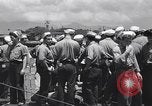
Japanese prisoners coming out of deck hatch and are marched along a ship dock at Pearl Harbor in Hawaii.
A U.S. submarine arrives at the dock at Pearl Harbor in Hawaii. Sailors and officers aboard the submarine and at the dock. Small Japanese flags flying at the conning tower. Japanese prisoners being brought up through deck hatch. Japanese prisoners are marched across the gangway and along the dock. Buildings in the foreground. (World War II period).
A periscope view of the explosion on a Japanese submarine after being hit by a torpedo in the Pacific Ocean.
Japanese submarine I-203 torpedoed by USS Caiman (SS-323) in the Pacific Ocean, as part of a live-fire exercise, post World War 2. A periscope view of the Japanese submarine underway. A huge explosion and the Japanese submarine sinks.
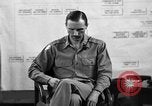
Major Tisdell describes ill treatment of prisoners at Japanese camps during the trial of General Homma in Manila, Phillipines.
U.S. Army Major Achille C. Tisdell testifies before a military tribunal in Manila, Phillipines during the trial of Japanese Army General Masaharu Homma for World War II crimes. Major Tisdell, aide-de-camp to Commanding General of the American forces in Luzon Major General Edward King is asked about how long he was at Camp O'Donnell. He says that he was there from April 13, 1942 to June 1, 1942. He recalls that at the camp the commanding officer of the prison camp addressed them. Major Tisdell being questioned about the Red Cross supplies. He says that once Red Cross food and medical supplies arrived at the camp gates but were not permitted to enter. He also speaks about the number of times he was questioned at the camp and that he was offered an opportunity to move to Manila and work for the Japanese. He says that a number of times the prisoners were beaten for no reason by the Japanese guards.
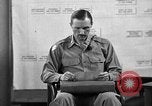
Major Tisdell reads out a Japanese note to the Americans during the trial of General Homma in Manila, Phillipines.
U.S. Army Major Achille C. Tisdell testifies before a military tribunal in Manila, Phillipines during the trial of Japanese Army General Masaharu Homma for World War II crimes. Major Tisdell, aide-de-camp to Commanding General of the American forces in Luzon Major General Edward King reads out an advisory note of the Chief of Imperial Japanese Army and Navy sent to the Americans on March 22, 1942. A member of the tribunal asks him whether there was any doubt that the Japanese had accepted the American surrender. Major Tisdell also testifies about the location of American headquarters and the surrender by the Americans.
CRITICALPAST.COM: About Us | Contact Us | FAQs - How to Order | License Agreement | My Account | My Lightboxes | Shopping Cart | Advanced Search | Featured Collections | Website Terms & Conditions | Privacy Policy ©2026 CriticalPast LLC.
License Agreement |
Terms & Conditions |
Privacy Policy
©2026 CriticalPast LLC.